Joshua Marshall
Establishes a clear problem and/or opportunity and justifies the design
decision and development of materials and or processes as an appropriate
strategy to solve the problem or take advantage of the opportunity.
Justifies and defends design decisions based on established models
and/or project-based contextual factors that dictate the need to not
follow a prescribed model.
During my studies, I have had the opportunity to use a number of
design and development models. Some models are systems based, such
the MRK or Dick and Carey model, while others are best used only in
certain situations, such as the NTeQ model for technology integration or
the Planes model for end-user experience design.
One instructional design model that I have become familiar with
is the Morrison, Ross, and Kemper (MRK) model. Looking at the picture
below, we can see that the MRK model is very different from traditional
systems models.
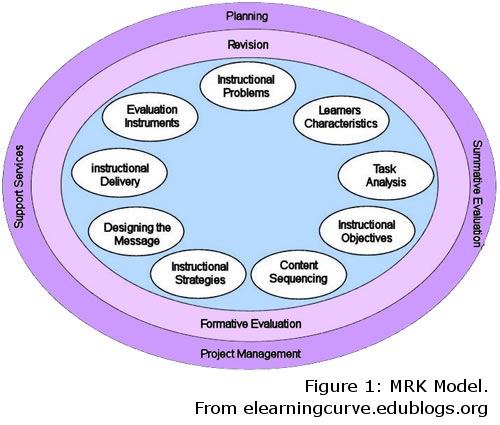
Instead of a flow chart, we are presented with a set of circles
and bubbles. This graphic
representation of the model illustrates it flexibility.
Notice that there are no lines connecting each phase, meaning the
designer is free to complete the phases in the order that makes the most
sense for each individual project.
This reflects the true nature of the design process.
For example, I have had to go back and re-write learning
objectives when developing assessment strategies to bring them more in
alignment. With a
traditional linear model, this would be discouraged.
I find this heuristic approach to be very exciting, although it
can at times be disconcerting attempting to view a large project in this
fashion. When working on a large design project, I will often
divide it into sections, which can sometimes be counter-productive with
the MKR model. However, understanding the inter-relationship of
each phase of the process, which the MKR model excels at, enables one to
create a more coherent design than otherwise possible.
I created this instructional design documentation
packet in Dr. Knowlton's IT 510 class working with the MRK model.
The actual instruction may be found
here. The content I chose to use for working with this model
was candle making. This model worked well in this case because it
required me to develop generative strategies, which would help the
learner formulate and carry out their own design decisions in making
their candles. The instruction contained both behaviorist goals
requiring the learner to demonstrate specific skills like molding the
wax, as well as cognitive goal requiring the learner to remunerate on
the candle making process and justify their design decisions. The
MRK model is perfect for providing a coherent framework for a variety of
learning objectives and the instruction was successful in teaching a
novice how to create candles.
One model that takes a different approach than the MRK model and
is also very popular in the industry is the Dick and Carey model (1990).
This model is very linear in its layout, although it does have some
feedback loops built into it, directing the designer to revise their
instruction at each point in the model. Looking closely at Figure
2 below, one can clearly see that it is derived from
another I will discuss later, ADDIE (Analyze,
Design, Develop,
Implement,
Evaluate).
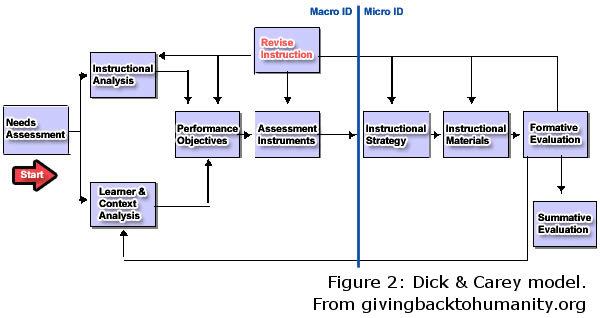
It has all of the same features as ADDIE, but then adds more or
divides them into separate steps. While ADDIE would have the
designer simply Analyze, the Dick and Carey model requires the designer
to conduct an instructional analysis and identify entry behaviors and
learner characteristics. From there the designer would develop
objectives and assessments, and then finally move on to crafting the
individual lessons. This
latter portion, as denoted in the graph, is labeled Micro Instructional
Design. The model is also
behaviorist in thought, as opposed to the MRK model which works quite
nicely with either behaviorism or cognitivism.
Although I have not had the opportunity to use the Dick and Carey
model in this program, thanks to the direction of Dr. Knowlton I have
spent considerable time learning its nuances because it is
a very prominent model in the industry.
Another model I have grown fond of is Gagne's Nine Events of
Instruction (1992). Although there are several steps to remember,
I find it to be a very straightforward yet elegant model. This
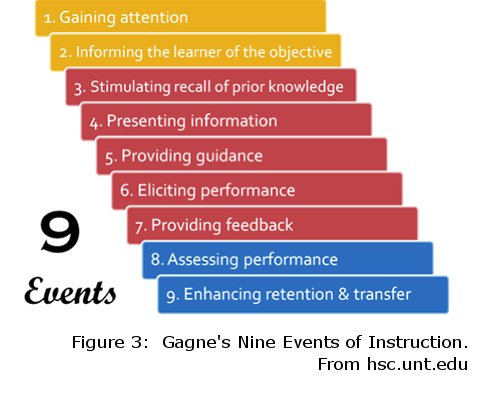
model, see below, can be divided into three distinct phases.
The first phase, called the pre-instructional phase, is meant to
"whet the appetite" of the learner.
This can be done through using instructional strategies such as
setting up cognitive dissonance within the learner, or posing what may
seem to be an intractable dilemma .
The second stage, the instructional phase, is where the bulk of
the designers effort will be spent.
Finally, we have the post-instructional phase where the designer
will devise mechanisms evaluate learner performance and instruction
effectiveness.
The NTeQ model developed by Morrison and Lowther (2011) also
takes a more linear approach to the design process. What I
particularly like about this model is that although it assumes the
inclusion of computers to aid in learning, it goes to great lengths to
ensure that not only do the computers serve a legitimate learning
purpose, but that each lesson is student centered.
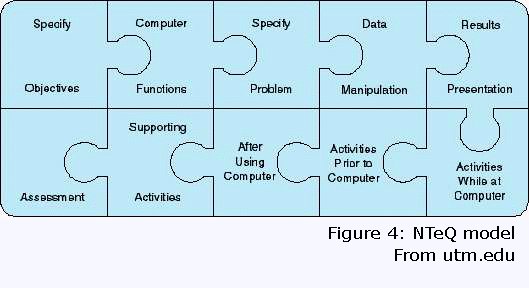
Notice that in this graphic each stage of the process is
represented as a puzzle piece.
This illustrates the idea that if the designer takes the time to
properly use the model and develop appropriate activities, the sum
effect of the resulting unit will be greater than its constituent parts.
The NTeQ model is designed to be used for K-12 school teachers,
however keeping these general principles in mind can be beneficial in
any instructional design context. I created
this
sample unit in Dr. Thomeczek's IT 481 class. The purpose of the unit was
to help student's utilize computer resources to learn more about local
history. The NTeQ model is perfectly suited to this type of
instruction because it forces the designer to make clear decisions about
what the learners will be using the computers for exactly, as well as
supporting activities before and after the lesson. Because this
model is best suited for a situation when technology integration is
required, I consider it to be a micro-model along with Gagne's.
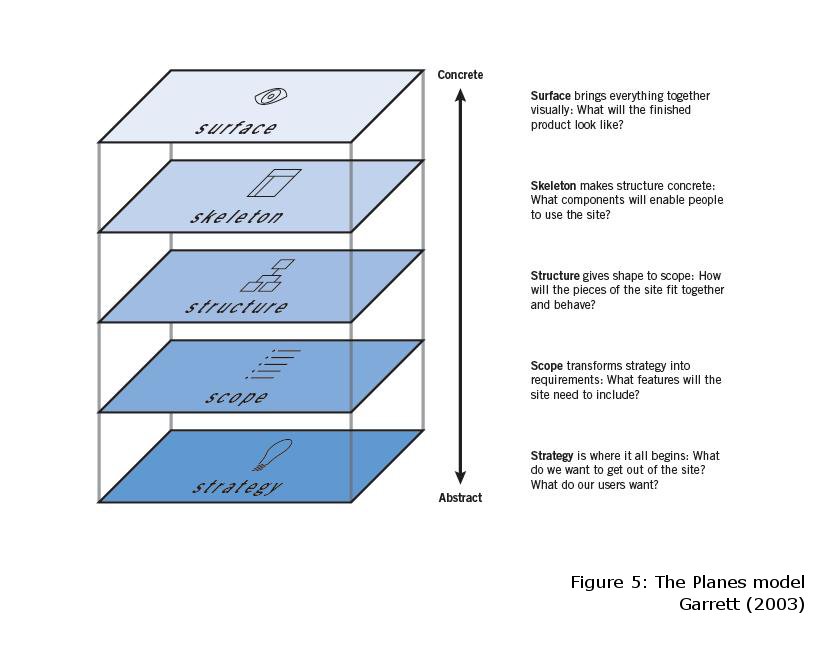
Another micro-model that is also technology based is the Planes
model from Garrett (2003). This model was developed to give a
graphical representation to what user-experience design (UXD) should
strive for. The model consists of a series of planes, beginning with the
user needs and the sites objectives, or the Strategy plane as Garrett
calls it, and progressing through to the Surface plane, which is what
the user will see. Each plane in the model represents a series of
decisions that the designer has to make, such as what will the
information architecture look like, how will the interface function and
so on.
I used the principles of this model when developing a
website for a local charter
school that will soon be opening. In the case of the website, I worked
with the client to get a good idea on the overall look and feel of the
site, and then I had to develop it based on what I thought would be of
most use to the user. In this case, I made the site very simple to
use with a very straightforward architecture. I did this because I
felt that the audience for this site would be the parents of inner city
school children and their familiarity with computers and technology
could not be assumed.
The last micro-model I would like to talk about is the ARCS (Attention, Relevance,
Competence, Satisfaction)
model developed by Keller (1987). This model is meant to
help the designer address the motivational needs of the learner.
Each phase of the model requires the designer to ask certain questions.
For example, for Attention the designer will have to address how to
capture the learners attention and how to create an inquiry arousal.
For Satisfaction the designer must devise opportunities for the learners
to use the new skill or knowledge, and to foster a positive feeling
about the learning accomplishment. Answering these questions, and others
derived from the model, will help the designer "get the students to give
the time and intensity of effort necessary in order to learn the
required knowledge and skills" (Gagne, 1992, p. 117).
ADDIE (Analyze,
Design, Develop,
Implement,
Evaluate) , although sometimes criticized for being too general to
be of any real use, does have a place in the repertoire of the designer.
What others may find it vague and general, I consider it flexible,
meaning that at the least it provides a solid starting point, regardless
of the project or content. This has real value for the designer
because one can start addressing each component of the design process
before finally settling on another model that will may be better suited
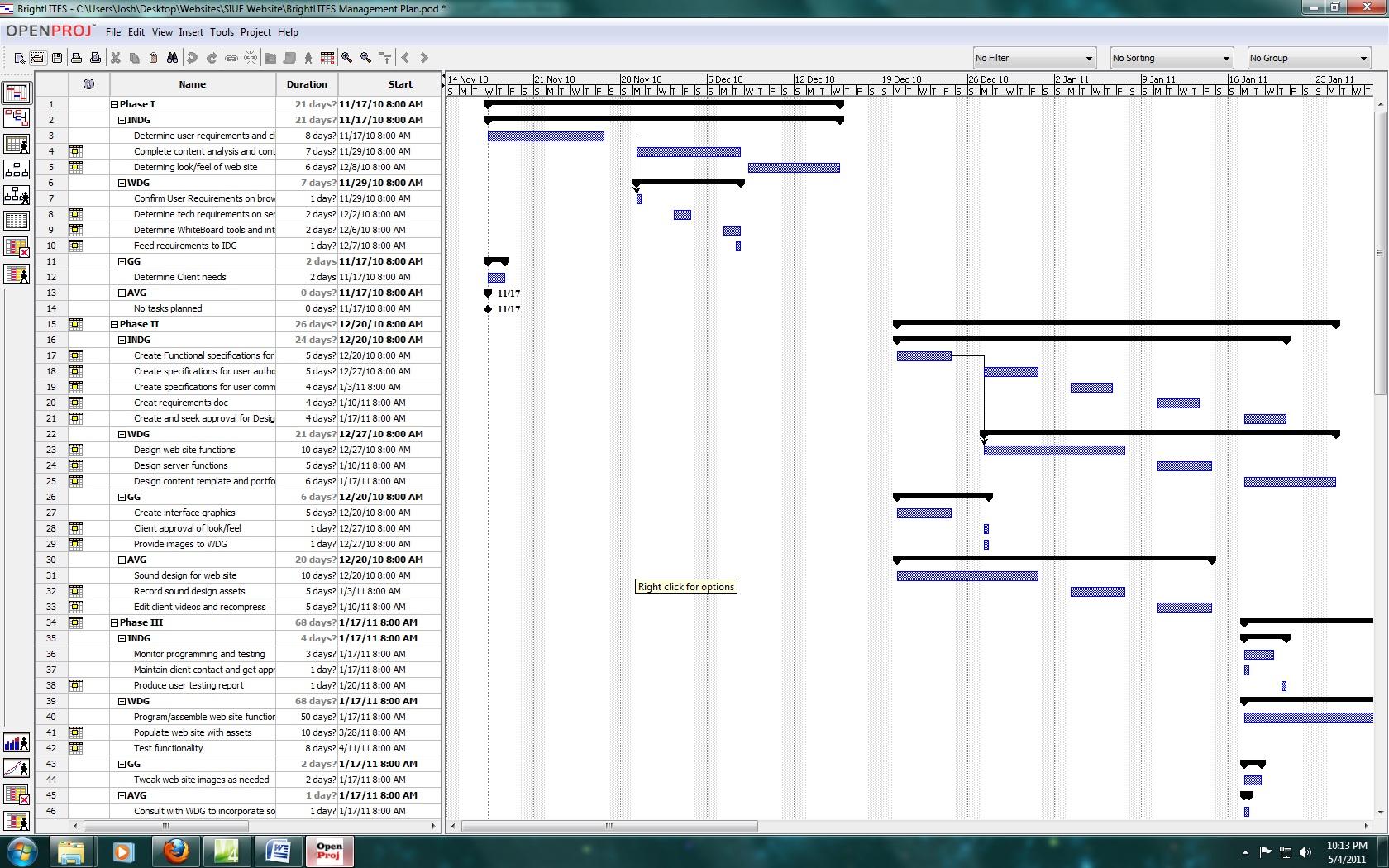
to the task at hand. This project management
plan was developed for Dr. Nelson's IT 530 class using the ADDIE
model. Although it may be vague and slightly nebulous, ADDIE
was the perfect model in this instance because the project was operating
at a macro level. The problem in this case that ADDIE so perfectly
met was that there was a variety of design processes occurring
simultaneously, such as graphic and sound production, and web design.
This meant that ADDIE could function as a project management tool and
life-cycle model, while other design models would function beneath it to
carry out the individual content development.
Because I am interested in eventually working for the Army as
civilian in their Training and Doctrine Command (TRADOC), I did some
research to learn more about what model they use.
TRADOC uses ADDIE, not as a model, but as a philosophy.
In their Systems Approach to Training white paper, they note that
most, if not all, instructional design models are simply elaborations on
ADDIE. The Figure 6 below
illustrates how the Army views the instructional design process.

The
instructional designers of the Army recognize that this is very vague
and aknowledge that the graphic is a simplification of the process.
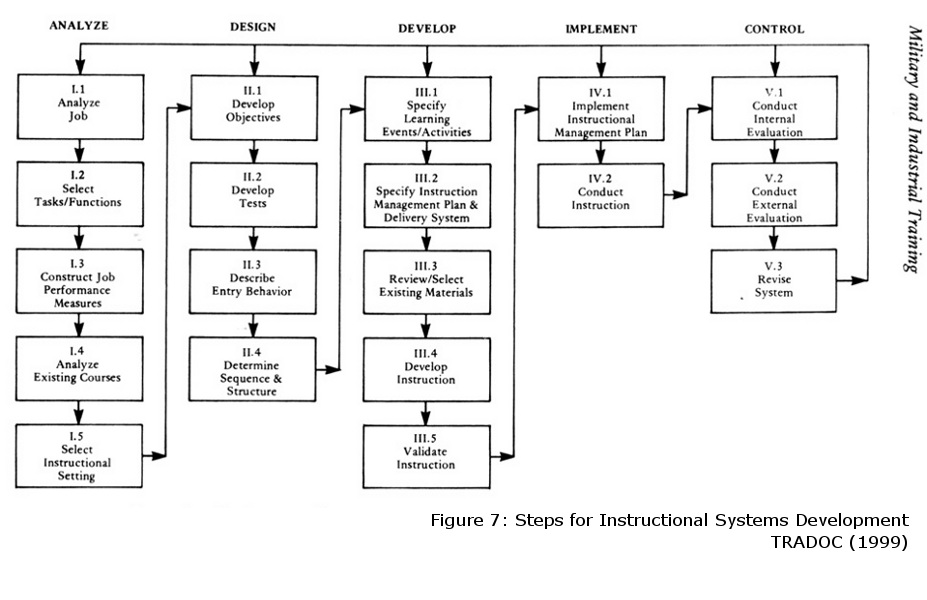
In the following picture from their instructional development
technical manual, we can see that they outline the procedures that ADDIE
only implies.
I recently had a job interview for an instructional design internship at
the Technical Training Center at Anheuser Busch. During the
interview, the manager asked me what models I am familiar with and I
began to recount some of the models I have worked with so far. I
ended my response with "...and then of course there's ADDIE." The
manager smiled and said "Yep, that's what we use here." Based on
my conversations with others in the field, the use of ADDIE is common
and having a solid understanding of it will serve me well.
During the spring 2011 symposium, Dr. Nelson asked a very
interesting question: "what exactly is a model?" This simple
question is very thought provoking. My answer would be that a
model serves as a tangible representation of a thought process.
While the instructional designer may develop their own personal model
and internalize it, the more popular and well known models act as
commonality, a lingua franca
of instructional design. Most of the models I have seen share
common traits, such as know the learners, develop objectives, design
well thought out instructional strategies, and devise a method of
assessment. In other words, most instructional design models seem
to be outgrowths and refinements of ADDIE and any model will work if
applied appropriately. By appropriately, I mean that the designer
must choose a model that best fits the design project at hand, rather
than trying to fit every project into a pre-determined model.
References
Altalib, S. (2011),
Instructional design and
development theme. Retrieved from
http://www.givingbacktohumanity.org/saifaltalib/experiences/index.html
ComTek (2000), Systems
approach to training process study. Florida State University.
Dick, W. & Cary, L. (1990),
The systematic design of instruction
(3rd Ed.) Harper Collins
Gagne, R., Briggs, L. & Wager, W. (1992).
Principles of instructional design (4th
Ed.).
Fort Worth, TX: HBJ College Publishers.
Garrett, J. (2003). The elements
of user experience: user-centered design for the web.
New York, NY: American Institute of Graphic
Arts.
Hanley, M. (2009). Discovering instructional design 11: The Kemp model. Retrieved from
www.elearningcurve.edublogs.org/2009/06/10/discovering-instructional-design-11-the-kemp-
model/
Keller, J.M. (1987). The systematic process
of motivational design.
Performance and
instruction, 26(9), 1-8.
Morrison, G., Kalman, H., Kemp, J., & Ross,
S., (2011). Designing effective instruction.
(6th Ed.).
Hoboken, NJ: Wiley and Sons.
Morrison, G. L., Lowther, D. L.,
(2011). Integrating computer technology into the
classroom
(4th Ed.). Upper Saddle River, NJ: Merrill, Prentice Hal
Spaulding, M. (2011). NTeQ.
Retrieved from
http://www.utm.edu/staff/mspaulding/311/311nteqform.html
(TRADOC),U. S. A. T. A. D. C. (1999). Systems approach to training management,
processes, and products. Fort
Monroe: Department of the Army.
UNT Health Science Center, Center for Learning and Development. (2011). Course design -
teaching strategies. Retrieved from
www.hsc.unt.edu/departments/cld/CourseDesignTeachingStrategies.cfm