Program Goal 4
Design is everywhere. But so what….. Sure, we’re surrounded by design. However, if you’re not paying attention to it, you won’t notice it anyways. My experiences within the IT program have taught me to be open-minded and view the world through another lens. You might be thinking to yourself, “another lens? Well how does this lens help?” Great question! The lens I have gained while being in this program has transformed the context in which I view things. Shifting from a broad view to a more narrow view, details are more easily perceived. For instance, within IT 430, I was assigned the task of taking pictures of various things I saw throughout my week. However, taking the picture was the easy part. The part that came next was analyzing the image. Learning about principles and elements of visual art, I was encouraged to view my surroundings differently. It was up to me to distinguish aspects within the image, as well as if any meaning/feelings were drawn from the image. This is when my perception of my surroundings transformed. I had begun acknowledging so many concepts of visual art that I had never considered before (lines, space, emphasis, balance, rhythms, and more). Within the IT program, I have gained a new lens when it comes to 1) learning from peers, 2) perceiving/noticing design, 3) multiple ways of producing design, and 4) seeing myself.
Learning from peers
Because of the IT program, I have become open in ways that I was not before. Prior to grad school, in undergrad the only person I relied on were myself and the assistance of professors. Besides that, ideas from my peers were heard, yet because suggestions from my peers were so rare, I could not say that I learned from my peers. During my undergrad, peers did not teach one another. Student to student learning was absent. Teacher to student learning was dominant. The way I perceived things was that the teacher taught, and the student learned or memorized. Boy was I wrong.
Entering the IT program I was apprehensive about how I was going to learn taking online courses. Under the presumption that all I would be doing was reading and typing papers (partially right. Lol), I shortly discovered that more was required of me. All of you (my professors) wanted me to discuss amongst my peers what I had learned or my thoughts about a subject. So my first reaction was “They want me to what? This should be interesting.” And surely enough, engaging in countless discussion boards with my peers has been interesting.
A memorable moment for me was taking into consideration thoughts from my peers in IT 430. Specifically, in IT 430, I had a mini-project that required me to use rapid prototyping. Not knowing exactly what I could do to make my flyer more appealing, I sought advice from my peers. The advice my peers offered was quite useful. If you look at the advice link, you will be able to see my initial thoughts towards each suggestion offered by my peers. This includes my reasoning for making certain changes. Having four prototypes for this project, listening to my peers ultimately aided in my creation of a better flyer.
Branching off of that, as an extension of my work in IT430, I’m working on a journal article with Shanda Nygard. She is the lead author and has given me a lot of feedback on my section of the journal article. Early in this program, I might have been more resistant. But, now I realize that her feedback has helped me dig deeper into my thoughts, encouraged me to use clear language, and has prompt me to reference/find more connections. This has helped increase the value of my contributions towards our paper.
A more recent project where my peers shaped the success of my project was in IT 597. Being both encouraging and insightful, my peers assisted me in the progression of my project. For this project, as shown in program goal 1, I had to create tutorials showing my learners how to build a home with Chief Architect. Truth be told, if it was not for my peers ideas and uplifting words, I would have scrapped the tutorials and created a website. Because of the poor visibility of my tutorials, scrapping my project seemed like the best thing to do. Long and behold though, my peers helped remind me that it is the instruction that makes or breaks a project, not the medium. Whether that was blatantly or indirectly stated by my peers, their feedback and ideas to help better my project prevailed. My tutorials were a success.
In this program, I became open to my peers suggestions and ideas. For instance, take the first concept that I discuss in program goal 2, flexible attention. I derived that concept from a peer’s idea. Exploring the subject of creativity, my classmate, Itzhak, wrote several posts discussing what he had found from a book written by Lehrer. Being able to connect and realizing that I had applied Lehrer’s concept of flexible attention, Itzhak’s postings allowed me to have a deeper understanding as to why breaks are important. Sometimes it is necessary to step back from details and allow your mind to subconsciously make connections, linking you to other facets. So, let your mind wander. Keep an open mind and take in your surroundings.
Perceiving/Noticing Design
Ultimately, everything that surrounds me is produced from design. Design is pervasive throughout my day. If I stop and look around the area I am at right now, I will find that design was produced to create and inform me about something. For instance, for the majority of my day, I am looking at a screen of some sort, whether it’s a computer, Ipad/tablet, or smart phone. These technologies were developed from a design. Even when I am sitting at a desk, I realize that the desk more so than likely had instructions for assembling. Also, analyzing my desk a bit closer, I notice that I have three drawers on the right side of my desk, and a panel that slides out of the center of my desk for me to write on. Believe it or not, the design of my desk has been utilized to help reduce cognitive load. Being a relief, not causing much focus or attention, my top desk drawer helps me locate writing materials, calculators, and other tools. My sliding panel within the center of my desk allows for me to have quick access to jotting down notes. Better yet, as I look up from where I am sitting (while writing this narrative); I see a light bulb on the ceiling. And if I recall, before I open the bulb out of its package, I was given instructions on how to properly insert the bulb. It is nearly impossible to escape design.
When I had first gotten the inkling that design was everywhere, I was in IT 510. It was more restricted at first, but as I progressed through the IT program, I noticed that those restrictions withered. I believe it was about half way into the semester when I began asking myself, “I wonder what the documentation for this lawnmower looks like.” Later, I found myself asking, “I wonder what the documentation for this treadmill looks like.” From there, I became curious about the design of objects I was in close proximity to. I began to question the design of objects I was surrounded by.
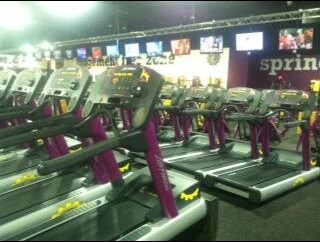
Now, IT 430 is the course that hammered the idea that everything is design. Originating from our class Twitter assignment, it was imperative for me to identify principles and elements of visual art. This is when I forced myself to find connections with what I was learning, and apply it to the real-world. In doing so, I had a revelation. My revelation was this, in looking for principles and elements of visual art, it is impossible to avoid design. The reason I say this is because everything I focused on had a design. The image of me taking a picture in a gym showed the design of a building, the design of treadmills, the design of water bottles, and more. Discovering this feeling/idea for the first time, I had to laugh. It wasn’t necessarily because it was funny though; but rather because I was amazed. My entire life I had been surrounded by design but never paid it any attention.
I now design more broadly, I see everything as designed. I am more open to learning from a social means. The example of IT 430 corresponds with my experiences in IT 510, and IT 597. Because, just like in IT 430, I was assigned the broad task of taking pictures (Twitter Assignment), and in IT 510, I was given the broad task of creating a design. However, instead of analyzing concepts within an image, I had to apply concepts to design instruction. Implementing these concepts is what gave me a newfound level of appreciation towards design. Whether delivered in the form of manuals, packets, books, websites/pages, or through videos, a great deal of time, effort, and consideration is placed into each form of design. So sometimes now when I look at an item or object, I wonder, “How much work was placed in designing this object?” I also wonder, “Were there prototypes involved? What were the goals and objectives of the product?”
Better ways of design
From my experiences in IT 510, IT 530, and IT 597, I realized how flexible the “acts” of design can be. I used a different model/approach to design each project. In IT 510 I used a very meticulous approach with the ISD model (discussed in program goal 1). In IT 530 I used a Traditional Project Management approach (a linear model used when the goal and solution of a project are clear). And lastly, in IT 597 I used rapid prototyping (as discussed in program goal 1). Because I was introduced to a variety of models and approaches to design, my impression of design was not stagnate. Being able to be flexible in my approaches to design allows for me to support the notion that design is not a “one size fits all” concept. Instead, design is ambiguous. There is no right or wrong answer. There is only the idea of what you feel the best approach to solving a problem or presenting a project should be.
Within IT 510, the ISD model was the best approach for me to use given my situation. Using a Traditional Project Management model would not have worked. But why you might ask? Well, for my IT 510 project, I had to design instruction to solve a problem. When I started this project, I had no idea what the goals of my project were going to be; also, I was uncertain of my projects solution. These two principles define a Traditional Project Management model (knowing your goals and solution to the problem towards the beginning of a project). Not to mention, a Traditional Project Management model is linear. Using the ISD model, I had flexibility. I was able to go back and forth and make changes throughout the process of my design.
To be quite frank, the rapid prototyping approach would not have been acceptable for the IT 510 course project either. The IT 510 project was a very time-oriented project, requiring critical thinking. Not saying that rapid prototyping does not require critical thinking, rapid prototyping does not necessarily work as well with time extensive projects. For shorter projects that can be put together/produced quickly, the rapid prototype approach is ideal. However, when heavy documentation is involved, it will take more time to go through several prototypes, as opposed to receiving feedback on segments of the design.
Seeing myself
I even see myself through a new lens! When I had entered the IT program, I had an idea of what I wanted to do. I envisioned myself being an Instructional Designer working for a well-known company. I imagined that my time would be invested in helping other companies implement initiatives to enhance their company’s performance. Yeah…this seemed like a promising career. However, the more classes I took in the IT program, the more I became uncertain of what I wanted to do. For as long as I can remember, I had utterly been against teaching; but I’ve aided in teaching others within this program. For instance, in EPFR 500 I was responsible for reviewing another peer’s paper. In doing so, I was able to help teach and reiterate on concepts that they were aware of but had forgotten to utilize in their paper. I always said that I wasn’t a great speaker; however, I have been placed into speaking situations and have been told that I am a good speaker. For instance, in IT 597 I had to produce tutorials. I was informed that I had a nice tone and my pacing for instruction was good. Also, in IT 530, I had to meet in collaborate with my team. I had to facilitate the conversation and speak to my team about our agenda and plans for finishing our tasks (project plan). Lastly, I have always considered myself as a good team member, and this program has shown me that I can be more than just a good team member; I can be a good leader as well (In program goal 1 I discuss how I was appointed as the team leader). So now I find myself torn between the options of teaching or consul ting.
When I entered this program, I was not interested in project management. After taking IT 530 though, my outlook on project management changed. At first, I viewed project management as being another term for instructional design; however, over time I began to see where the two differed. At first though, my thoughts were that project management should be common sense. The skills required of project managers dealt more heavily with leadership roles and working in groups. This is a characteristic I felt that most instructional designers possess as well. As I continued with my team project, shared in program goal 1, I began to see that project management requires for a different set of tools/skills to be used. There was a heavier emphasis placed on graphs and charts, as well as being diverse in certain content such as budgeting, forming work package assignments, staying in frequent communication with the client and more. Even though both project management and instructional design both need good communication skills, in project management projects, communication is essential for success.
Not necessarily saying I found my niche in project management, I will say understanding what a project manager is tasked with can strengthen my quality as a consultant or designer. To summarize, I know see that I have broader skills than I thought I had when entering this program. Also, I see myself differently because I recognize I can be more open to various ways of thinking about my future career.