Bacterial oxidative stress & single-cell biology
We use time-resolved fluorescence microscopy to study how individual cells respond differently to oxidative damage and antimicrobial treatment.
Photochemistry • Biochemistry • Microbiology • Imaging
We investigate how microorganisms respond to oxidative stress and use that knowledge to develop light-activated antimicrobial strategies, photoactive materials, and biologically targeted photochemical systems.
Research focus
Our work brings together mechanistic photochemistry, quantitative microscopy, microbiology, and materials science to address antimicrobial challenges from complementary directions.
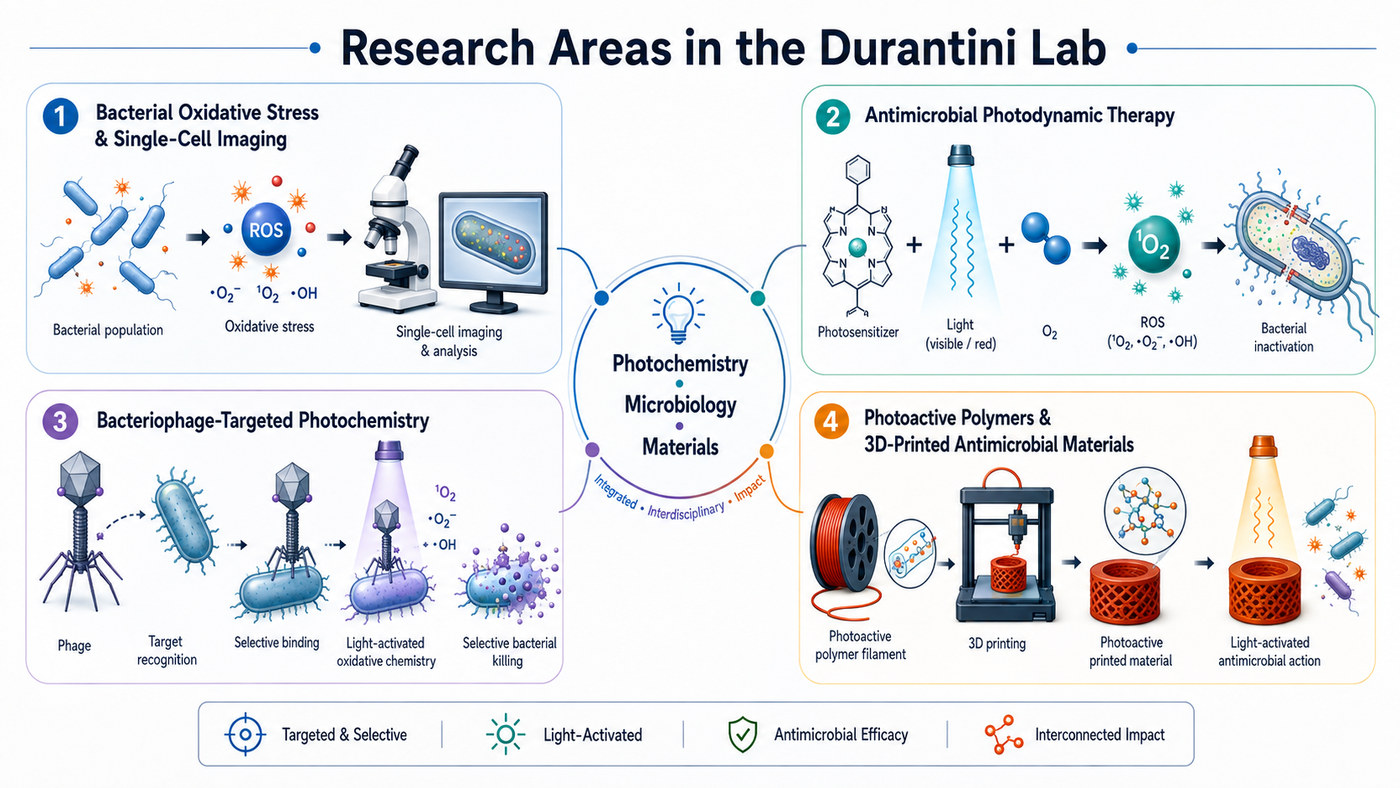
We use time-resolved fluorescence microscopy to study how individual cells respond differently to oxidative damage and antimicrobial treatment.
We investigate photosensitizer-driven reactive oxygen species generation and the cellular mechanisms that determine antimicrobial photodynamic outcomes.
We explore strategies that combine bacteriophage specificity with photochemical approaches to create more selective antimicrobial platforms.
We design light-responsive antimicrobial materials, including photosensitizer-loaded polymer systems and 3D-printed platforms for practical applications.
Our approach
The lab connects fundamental photochemical processes with bacterial physiology and functional materials.
Photosensitizers, reactive oxygen species, spectroscopy, and light-controlled chemistry.
Real-time and single-cell measurements that reveal behavior hidden by population averages.
Mechanistic studies of microbial stress, cell viability, membranes, and antimicrobial response.
Translation of photochemistry into reusable and light-activated antimicrobial platforms.
Research training
The Durantini Lab provides undergraduate and graduate researchers with hands-on experience in experimental design, photochemistry, microbiology, quantitative imaging, data analysis, scientific writing, and presentation.