1. Molecular Basis of Protein Function and Cellular Signaling
A major focus of our research is understanding the
molecular basis of protein structure and function, with particular
interests in metalloenzyme structure and function, protein electron transfer,
protein-protein interactions, and receptor-ligand interactions involved in
biological signal transduction.
Our current projects investigate the molecular mechanisms of
nitric oxide (NO) synthesis by human and plant nitric oxide synthases
(NOS) and reactive oxygen species (ROS) production by
non-phagocytic NADPH oxidases (NOX). NOS and NOX enzymes play important
roles in fundamental physiological processes, including vascular tone, platelet
function, neuronal signaling, cell proliferation, apoptosis, and cell migration.
A central goal of our research is to understand how
auxiliary cellular components and regulatory factors interact with these
enzymes to control their biochemical activities. Elucidating these
regulatory mechanisms provides important insights into enzyme function and
cellular signaling and may ultimately contribute to a better understanding of
human health and disease.
2. Enzyme-Based Biotechnology for Biofuel Production
We are exploring the use of enzymes and engineered biological systems
for sustainable biofuel production. These projects focus on utilizing
the catalytic properties of enzymes to convert renewable biological resources
into useful fuels and value-added products. Our goal is to develop efficient
and environmentally sustainable biocatalytic approaches that can contribute to
the advancement of renewable energy technologies.
3. Quantum Sensing for Biological Applications
An emerging direction of our research is the exploration of
quantum sensing technologies for biological and biochemical
applications. We are interested in developing and applying highly
sensitive quantum-based sensing approaches to investigate biological molecules,
enzymatic processes, and cellular systems.
Research Technologies and Approaches
Molecular Biology and Recombinant Protein Production
Molecular biology techniques are used for gene cloning, genetic
manipulation, and recombinant protein expression. Target proteins
are produced using bacterial, yeast, or mammalian expression systems,
depending on the biological and biochemical properties of the protein.
Protein Purification
Recombinant proteins are purified using a variety of
chromatographic techniques, frequently assisted by
fast protein liquid chromatography (FPLC). These approaches
enable the isolation of highly purified proteins for subsequent biochemical
and biophysical characterization.
Characterization
UV/Visible spectroscopy is used to determine protein
concentration and to monitor enzymatic activity
and other spectroscopic properties of proteins and cofactors.
Fluorescence-based approaches are used to investigate
protein conformation, molecular interactions, and binding
processes. Our studies employ steady-state fluorescence intensity
and polarization, as well as fluorescence lifetime measurements using
time-correlated single-photon counting (TCSPC).
Fluorescence resonance energy transfer (FRET) provides
additional information about molecular distances and conformational changes.
These techniques can also be used to characterize protein-protein and
protein-ligand interactions and determine binding affinities.
Isothermal titration calorimetry (ITC) is used to
characterize molecular interactions by directly measuring the heat released
or absorbed during binding. ITC provides quantitative information about
binding affinity, enthalpy, entropy, and stoichiometry,
allowing us to investigate the thermodynamic nature and molecular basis of
protein-protein and protein-ligand interactions.
Differential scanning calorimetry (DSC) is used to investigate
protein stability and thermal unfolding by determining the
melting temperature (Tm) and associated thermodynamic
parameters. DSC can also be used to examine how non-covalent
interactions, including protein-protein and protein-ligand
interactions, contribute to the stability and structural integrity of
protein complexes.
Dynamic light scattering (DLS) is used to characterize the
size, size distribution, and aggregation state of proteins
and other biomolecular complexes in solution. DLS provides information about
the hydrodynamic diameter of particles and can be used to monitor changes in
protein assembly, complex formation, and aggregation under different
experimental conditions.
Circular dichroism (CD) spectroscopy is used to investigate
protein secondary structure, folding, and conformational changes.
CD measurements provide information about the relative content of
?-helices, ?-sheets, and other structural elements. By monitoring changes in
CD spectra under different conditions, we can evaluate protein folding,
stability, and conformational transitions associated with ligand binding,
protein-protein interactions, and changes in the biochemical environment.
High-performance liquid chromatography (HPLC) and
fast protein liquid chromatography (FPLC), including
size-exclusion chromatography (SEC), are used to separate
and characterize biological macromolecules based on properties such as size,
molecular interactions, and affinity. SEC is particularly useful for
determining the apparent molecular size and oligomeric state of proteins and
protein complexes, as well as assessing sample purity, homogeneity, and
aggregation.
Native gel electrophoresis is used to assess the
oligomeric state, molecular assembly, and interactions of biological
macromolecules under non-denaturing conditions. This approach
preserves many non-covalent interactions and allows us to examine protein
complex formation, conformational states, and changes in molecular assembly
associated with ligand binding or other biochemical conditions.
Examples
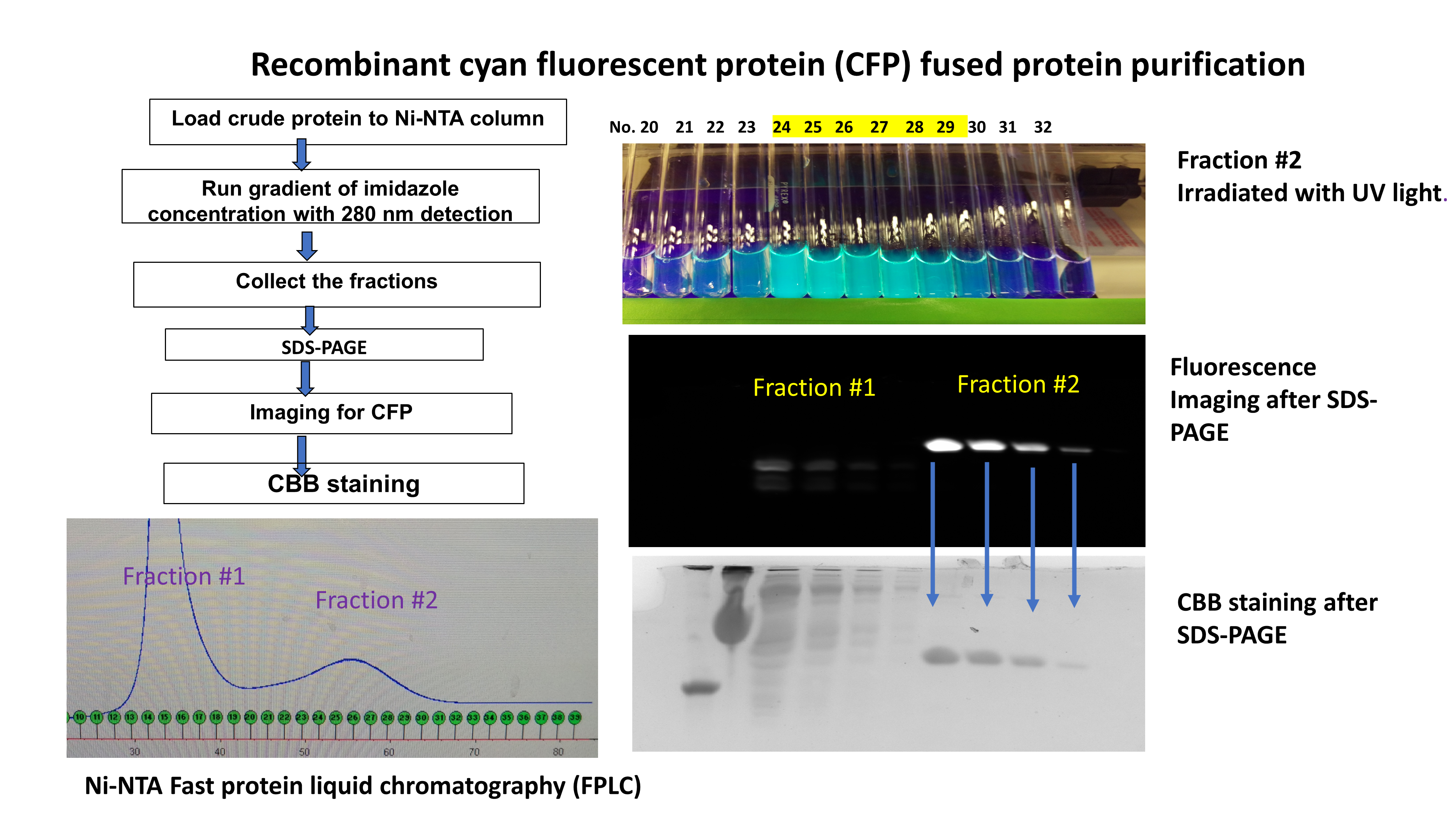
The proteins characterized in our lab are produced by recombinant tech and purified with chromatography. The following is an example of CFP-fused protein that is purified with FPLC
Isothermal Titration Calorimetry (ITC)
Our lab equips with a MicroCal VP-ITC calorimetry, which is used to obtain thermodyanic parameters of binding.
The following is a recoding of ITC experiment during the titration of ligand to receptor solution. In the begining, the system takes time to reach temperature equilibirum followed by several injections. This is an endothermal reaction.
Time-Correlated Single Photon Counting (TCSPC)
We use TCSPC for fluoresence lifetime measurement (~ nsec) for specific probe(s), which allows us to deduct the emitted components and determine the energy transfer yield from FRET.
Disclaimer: The views and opinions expressed on this page are strictly those of the page author.
The contents of this page have not been reviewed or approved by SIUE
Last update: 09/10/2010