


SIUE Awards 2026-2027 Hoppe Research Professor to Art and Design's Abbey Hepner
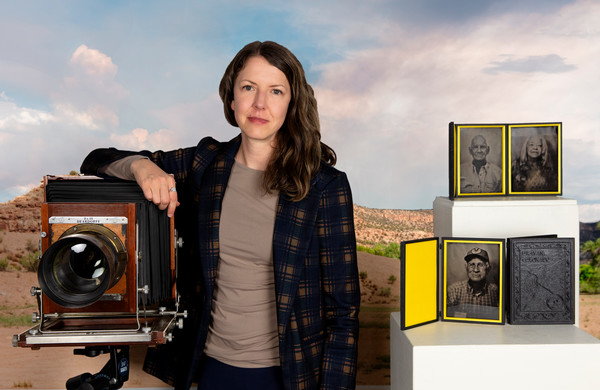 The Graduate School at Southern Illinois University Edwardsville has awarded the 2026-2027 Hoppe Research Professor Award to Abbey Hepner, MFA, associate professor and area head of photography and digital media in the College of Arts and Sciences' Department of Art and Design.
The Hoppe Research Professor Award recognizes faculty members whose research or creative activities promise to make significant contributions to their fields. Recipients are expected to produce published scholarly works and secure external funding.
Hepner's artistic practice examines health, technology, and humanity’s relationship with place through photography, video, electronic, and installation-based work. She holds an MFA in photography from the University of New Mexico and dual bachelor's degrees in studio art and psychology from the University of Utah.
“I am honored to receive the Hoppe Research Professor Award,” said Hepner. “This recognition affirms the importance of creative practice as rigorous research, and it is such a delight to be chosen. The award supports the completion of a project on the erased town of Uravan, Colorado.”
“Reconstructing Uravan” centers on storytelling, memory and environmental history. The project that features the former uranium mining town in southwestern Colorado has grown through collaboration with students, archivists, historians, and former residents, according to Hepner.
Hepner added, “Uravan shaped history and science, supplying Marie Curie with radium in the 1920s before becoming a uranium processing site tied to U.S. Cold War atomic programs. At its peak, nearly 1,000 residents lived and worked there before the town was buried and designated a Superfund site in the 1980s. Though physically erased, Uravan’s environmental and human legacies persist.”
The project centers on oral history recordings and wet plate collodion tintype portraits of former residents. This nineteenth-century photographic process emerged when mining activity in the U.S. was at its peak, aligning the process with extractive economies and industrial labor.
Developed in dialogue with the Center of Southwest Studies at Fort Lewis College, the tintypes are reintroduced into archival collections.
“These testimonies complicate official records and foreground lived experience as critical evidence. The resulting counter-archive remains open and layered, holding memory, testimony, and material trace in tension,” Hepner said.
“This year marks 40 years since Uravan was buried, and my project unearths this critical history, reflecting the ongoing nuclear legacy of the Manhattan Project. The story of Uravan stands as a testament to community resilience and serves as a warning for the future. As conversations on energy, climate change, and technological infrastructure grow urgent, storytelling is a powerful tool that can move people to make meaningful changes.”
Hepner’s work has been exhibited internationally, including at the Mt. Rokko International Photography Festival in Japan, SITE Santa Fe, the University of Buffalo Art Galleries, the Krannert Art Museum, and the Noorderlicht Photo festival in the Netherlands. She has participated in residencies at the Banff Centre for Arts and Creativity in Canada, and her work has been featured in publications such as Hyperallergic, Lenscratch, Ars Technica, Artillery Magazine, and Fraction Magazine.
Hepner has mounted nine solo exhibitions in galleries across the United States and participated in numerous group exhibitions both nationally and internationally. Her work is included in permanent collections such as the David M. Rubenstein Rare Book and Manuscript Library at Duke University and the University of California, Irvine, College of Health Sciences.
In 2021, Hepner published the book "The Light at the End of History: Reacting to Nuclear Impact," which explores the legacy of nuclear development in the western United States, drawing from her family's history in regions affected by nuclear weapons production and testing.
As mentioned, the Hoppe Award will support the completion of “Reconstructing Uravan,” Hepner's decade-long project on Uravan. The project will culminate in June 2027 with a book publication and exhibition at the Center of Southwest Studies museum.
“Hepner’s work exemplifies the power of contemporary art and research to recover histories that might otherwise disappear from public memory,” said Larry LaFond, PhD, Chair of the Department of Art and Design. “Her Uravan project demonstrates a remarkable combination of scholarly rigor, visual sensitivity, and deep human engagement with communities shaped by the long aftermath of extraction and displacement.”
In 2022, Hepner received a $15,000 fellowship from the Illinois Arts Council and was named a Silver List Artist by the Silver Eye Center for Photography.
She recently served on the Society for Photographic Education Board of Directors from 2020 to 2025 and has contributed to publications including "Seeing 2020: Photography Under Quarantine" and Thomas Werner's "The Business of Fine Art Photography."
PHOTO: Abbey Hepner, MFA, winner of the 2026-2027 Hoppe Research Professor Award


