


Lovejoy Library at SIUE Receives Historical Mississippi River Festival Collection Donation with Legendary Memorabilia
One July afternoon in 1969, tentmaster Skip Manley circled the grassy bowl of a former farm outside Edwardsville, craning his neck toward the monumental canvas above him. The tent’s twin pinnacles cast slender pointy shadows across fresh cut meadowgrass. About a month earlier, he drove the tent stakes in the earth himself with an enormous custom wood mallet—a tool with which the larger-than-life former Ringling Brothers hoistman had more than a little in common. Beyond him, waves of people approached the gates of the property, coolers in hand to cut the heat of July.
It wasn’t long before a sea of lawn chairs and crocheted afghan blankets dotted the grass outside the tent. Children ran and dodged neighboring carpets as if they were lava. Young adults exchanged wistful glances at one another as they claimed lawn real-estate and waited in lines. According to eyewitnesses and archival photography, everyone seemed to be smiling and awaiting the arrival of another entertaining summer evening on a large stage under the amber glow of the tent.
The first performance this summer was crowned by the St. Louis Symphony, the next weekend it was Janis Joplin. Tonight it would be a show by rock and roll superstars, The Band.
With no warning, Manley, 21-year-old festival manager Lyle Ward, and the now thousands of audience members watched as Bob Dylan walked on stage and joined his former backing group. They were about to witness one of Dylan’s few live appearances since his 1966 motorcycle crash. Reportedly, he had spent the intervening years avoiding the crowds and mythmaking of a movement that elected him their voice.
For four songs under a new moon, a young University rising from the river bluffs above the Mississippi became the beating heart of American music. This would be the first summer of the Southern Illinois University Mississippi River Festival (MRF).
The MRF would run 12 years and created a space for public enjoyment of performance arts on soil that is home to Southern Illinois University Edwardsville. It entertained the Metro East with everyone from Bob Hope to Emmylou Harris; Bette Midler to B.B. King; John Denver, Glenn Miller Orchestra, The Allman Brothers, Abrašević dancers, The Beach Boys and Ike and Tina Turner. One night in 1971, it shattered attendance when it welcomed 33,000 people to see the rock band The Who.
An intersection of culture and expression born from the fever pitch of the Vietnam War, the MRF fostered an idea that could bring the humanities and all its elasticity to people in an inexpensive and family-safe setting. Today, a monument remains in the field that serves as a memorial to its reign.
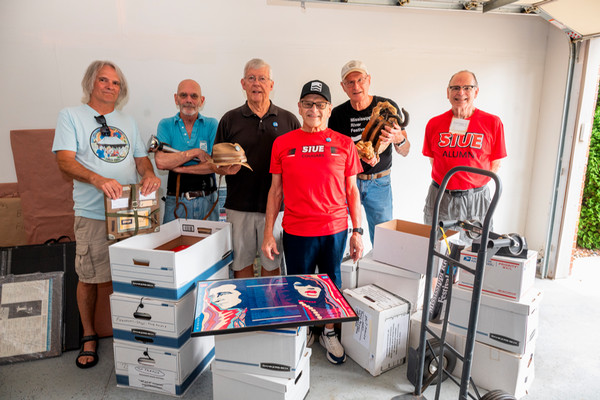
More than a half century later, that accessibility continues to expand. By the beginning of this fall semester, Ward donated a vast personal collection of MRF memorabilia to Southern Illinois University Edwardsville’s Lovejoy Library to preserve the stories, artifacts and ephemera of the famed festival.
Ward, who recalled the day when Dylan came out on stage, became the managing director of the festival and later, an SIUE administrator for 31 years. He was directly involved with the MRF for nine years during the 1969-1977 seasons. Currently, he is president of the Mississippi River Festival Preservation. His contribution to Lovejoy Library’s University Archives and Special Collections contains thousands of elements ranging from signage exhibits, autographed photos and structural artifacts that document the festival’s history, production and cultural influence.
The materials will be preserved at SIUE and made available for research and future public displays. It is the only anthology of its kind.
“It was an easy decision for me to give this exhibit to the University after I met the current staff of the library,” said Ward.
For Ward, access was central to that decision. He wants it to serve both students and the people whose memories remain tied to summers beneath the tent.
“My whole thing has been making it available to current students to study, but also accessible to the people who attended in the past,” said Ward. “Everyone who was there, on any level at all, has memories that are so important to their lives. They have stories that are just remarkable.”
A Festival Built by a University and Its Region
Ward’s involvement with the MRF began almost by accident.
After accepting a position in SIU’s University Center, he became assistant to its director, who handled the festival’s early bookings. His first responsibilities included selecting uniforms and hiring students for the inaugural season.
The job grew quickly.
When the director left for another university, Ward inherited responsibility for the festival’s programming after only one year. He worked with a student advisory board that helped identify popular performers and recommended artists for the festival.
“It was critical,” Ward said of the students’ involvement.
He began meeting twice annually with directors of major summer festivals across the country. Many of those festivals, like the MRF, featured a symphony orchestra in residence. Their leaders shared information about performers, costs, scheduling and previous concert experiences.
“I was lucky to learn from a group of people who were skilled at what they were doing,” said Ward. “I got good information about things to avoid and great ideas from things that had worked well.”
Artists were offered a modest, guaranteed payment and a percentage of concert revenue. As the MRF’s reputation grew, musicians and their representatives increasingly wanted to include Edwardsville on their summer schedules.
“They wanted to be with us,” said Ward. “It wasn’t a sell to them. They wanted to be there.”
Although closely identified with SIUE, the Mississippi River Festival operated as a private organization. Regional business and industry leaders served on its board, helped raise funds and established ticket outlets throughout the bi-state area.
The University, however, supplied the people, infrastructure and institutional support necessary to transform a farm field into a nationally recognized performance venue.
“The board of directors made the major decisions,” Ward said. “It was not the University’s festival, but it was the University that made it happen.”
Former SIU President John S. Rendleman was among Ward’s most important supporters. Ward met with him regularly to review plans and seek guidance.
“To say that he was brilliant is an understatement,” remembered Ward. “He knew so many students that, as he walked through campus, he would call them by name. I was lucky to meet with him regularly and to have him give me the space to make decisions. He was almost like a father to me.”
More Than Music
The MRF offered far more than a succession of concerts. Its Grand Opening Gala with the St. Louis Symphony Orchestra on June 20, 1969 and subsequent musical guests painted from a palette of music for everyone. Whether age nine or 90, audiences were introduced to performances of scale and an expansive assortment of genres like chamber music, folk, country, pop, rock, bluegrass, family, jazz and blues.
Ward’s collection contains exhibit panels, photos and images that tie back to these legacies and the stories that shaped them.
Theater and dance was represented through Aesop’s fables and Shakespeare, The National Dance Troupe of Zambia performed. Hal Holbrook presented Mark Twain. At the conclusion of the 1976 opening night concert from the Preservation Hall Jazz Band, the audience climbed onto the stage and danced to "When The Saints Come Marching In."
Regional artists and craftspeople displayed their work beneath smaller tents during several festival seasons. In 1973, a beloved local band, The Guild, shared the bill with Sha Na Na.
Folks didn’t go hungry, either. SIU’s University Center food service operated dining areas where guests could purchase full meals before performances. The result was an environment that invited audiences to arrive early, eat, explore and linger.
At the center of that world stood the great tent— and Manley, its guardian.
The veteran of Ringling Brothers and the Stratford Festival in Ontario, Manley helped design, erect and supervise the tent, which itself became an icon and a participant of the MRF. Manley’s beard, tinted glasses, hat and three-wheeled Cushman vehicle became one of the festival’s most recognizable figures.
“He was the expert for the tent,” emphasized Ward. “He had all the experience needed to talk about creating it, monitoring it and supervising it.”
Manley was notorious for many things, but chief among them was wearing a different hat year after year. At the end of the season, a favored staff member might receive it as a gift. At least one surviving hat carries a handwritten note inside identifying its intended recipient. One of his hats is included as part of Ward’s collection.
The personal artifacts and stories surrounding Manley are part of what makes Ward’s newly donated collection more than a record of dates and performers. Together, the materials preserve the human machinery behind the MRF: the students who staffed it, the administrators who championed it, the business leaders who supported it and the workers who transformed a farm field into a singular cultural destination.
A Legacy to Share
The MRF helped introduce the young Edwardsville institution to audiences from far beyond the region. Tickets could be purchased from 25 different ticket outlets across the area.
“The festival helped put SIU on the map— big time,” said Greg Drexelius. “People finally figured out that they could cross the river and there was life over there. It was a pretty good life, and there was a university that fit the festival very nicely.”
According to Ward, organizers met every Saturday morning in the spring to make decisions on what to buy and how to sell tickets. One of the main drivers of ticket sales was a coupon book sold all across the bi-state area, Ward included photos of their sales in the collection.
When the MRF ended in 1980, performers offered their support. Some major headliners were even willing to return for benefit concerts because of its almost magical uniqueness.
“The Eagles were one of them,” said Ward. “We had external support and, of course, a lot of disappointed audience members.”
Rarity, however, can be sustained in other ways.
Lovejoy Library’s stewardship of Lyle Ward’s collection will allow the MRF legacy to be embraced in rotating displays, granting access to a new generation. Conversations with the library’s current leadership gave Ward confidence that the collection would remain active and vibrant rather than disappear into storage.
“Mr. Ward has given SIUE a tremendous gift— a carefully preserved and curated collection that represents an important part of SIUE’s history, the history of our region and the memories of generations of alumni and community members,” said Marlee Graser, dean of Lovejoy Library. “This one-of-a-kind collection vividly captures the zeitgeist of the Mississippi River Festival, which was a formative experience for so many people in our community. We are deeply grateful for Mr. Ward’s dedication to preserving the history of the MRF, and we look forward to making this remarkable collection available to our students, faculty and the broader community.”
“We're deeply grateful to Lyle for his generosity and for entrusting University Archives and Special Collections with the preservation of this remarkable collection,” said Zachary Palitzsch, MLIS, University Archivist and Special Collections librarian. “What makes this gift especially meaningful is his desire for future students to experience and learn from the history of the MRF. Thanks to this extraordinary gift, one of SIUE's defining cultural legacies will remain accessible for generations to come, providing a lasting resource for teaching, research and community engagement.”
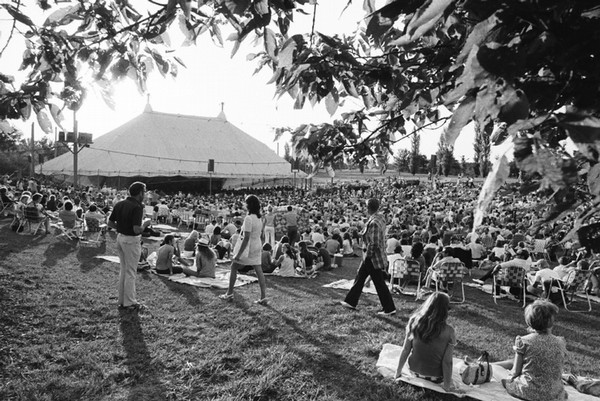 The donation will offer longtime festivalgoers a path back to the lawn. For SIUE students born decades after the final performance, it will reveal what becomes possible when a university and thousands of music and art lovers gathered around a tent.
The collection may be viewed by request at any time and curated rotating exhibits are planned for future display.
Back in Lyle Ward’s home, friends of the MRF gathered around his collection before he entrusted it to SIUE. Perhaps, they ponder, the site itself retains something no archive can hold.
“If you go back and listen really carefully, you can still hear things,” said Drexelius. “Think about the physics: The music goes out, but it never goes away. You have to listen hard… but you can still hear it.”
Photos: MRF legacykeepers: Jack Twesten ’84, Thomas Werner ’82, Greg Drexelius ’77, Lyle Ward ’69, Rick Stankoven ’77, Ernie Peters, Jr. ’76, Photo by Howard Ash. Bottom: legacy photo courtesy of SIUE Archives.


