


Dr. Katherine Poole-Jones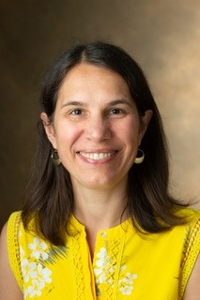
Art History
Katherine Poole-Jones is a Professor of Art History at SIUE, specializing in early modern Italy. She teaches both halves of the introductory survey course in art history, as well as upper level courses on the Italian Renaissance, the Northern Renaissance, the Baroque period, Islamic art and architecture, and the public monument in Renaissance and Baroque Italy. She also team-teaches an Interdisciplinary Studies course (IS 370) on the history of museums and is very active in the Women’s, Gender, and Sexuality Studies Department at SIUE, frequently giving lectures to support the program, and also teaching two of her most popular courses, Women in Art and Women in Renaissance and Baroque Italy, as cross-listed offerings.
Professor Poole-Jones received a Fulbright Fellowship to Italy in 2005-2006 to complete the research the resulted in her dissertation, The Medici Grand Dukes and the Art of Conquest: Ruling Identity and the Formation of a Tuscan Empire, 1537-1609, and she has published several essays on the Medici family and their use of patronage as propaganda. She also has presented her research widely, including at the annual conferences of the Renaissance Society of America, the College Art Association, SECAC, and the Midwest Art History, as well as maintains a strong relationship with the St. Louis Art Museum where she has presented numerous gallery talks as well as the Women’s History Month lecture. Her current research investigates the public monuments of late nineteenth- and early twentieth-century St. Louis and the role they played in shaping collective memory and civic identity in the post-bellum years. She received her Ph.D. in art history from Rutgers University (2007) and an M.A., also in art history, from American University (2002).
“I entered the teaching profession because I loved being a student. The same aspects of academia that stimulated me during my college years, the open exchange of ideas and the intellectual challenges and discoveries, continue to inspire me as a professor. My own liberal arts background as an undergraduate instilled in me the critical thinking skills, intellectual curiosity, and academic self-confidence that are instrumental to my success as an educator. I also owe my desire to enter the teaching profession to the example set by my professors, specifically their focus on challenging and dynamic classroom instruction, but above all, their unwavering commitment to their students. I now strive to recreate that inspirational educational atmosphere with my own students here at SIUE.
I am deeply committed to the values of diversity, inclusion, and equity as integral to the success and health of an academic community. I strongly believe in the potency and value of empathy, not only in our personal lives, but also in our academic communities, and that seeing the word through another's eyes can be powerful driver of one's intellectual development and growth. I embrace a plurality of voices, opinions, and experiences in my classroom, investigate the ways in which gender as well as race, class, and other factors have had a significant impact on the history of art and artists - as well as on the way my discipline overal has been practiced. I would like to think that every student will leave my classroom with a new passion for art history. Regardless, they will possess an understanding of the importance and relevance of studying art history, both as a tool for examining diverse cultures and time periods, and as a path to a greater appreciation of their own world."
Contact Prof. Poole-Jones: kpoole@siue.edu
“Public Monuments in Early Modern Italy" in The Routledge Enyclopedia of the Renaissance Word, eds. Kristen Poole and Monica Dominguez Torres (July 2024); https://doi.org/10.4324/9780367347093-RERW208-1
“Historical Memory, Reconciliation, and the Shaping of the Postbellum Landscape: The Civil War Monuments of Forest Park, St. Louis” in Panorama: Journal of the Association of Historians of American Art (Spring 2020, 6.1); https://journalpanorama.org/article/historical-memory/
“The Medici, Maritime Empire, and the Enduring Legacy of the Cavalieri di Santo Stefano,” in Florence in the Early Modern World: New Perspectives, eds. Brian Maxson and Nicholas Baker, 156-186 (New York: Routledge Publishers, 2019)
“A Tale of Two Removals: Public Monuments and Civil War Memory in St. Louis,” in Monumental Troubles: Rethinking What Monuments Mean Today, eds. Erika Doss and Cheryl K. Snay (CurateND/University of Notre Dame, 2018), 29-41; doi:10.7274/r0-30e5-2840
“Heroines and Triumphs: Visual Exemplars, Family Politics, and Gender Ideology in Baroque Rome,” in Midwestern Arcadia: Essays in Honor of Alison Kettering (Northfield, MN: Carleton College, 2014); https://apps.carleton.edu/kettering/
“Medici Power and Tuscan Unity: The Iconography of the Cavalieri di Santo Stefano and Public Sculpture in Pisa and Livorno under Ferdinando I” in A Scarlett Renaissance, ed. A. Victor Coonin, 239-266 (New York: Italica Press, 2013)
“Christian Crusade as Spectacle: Medici Festival Decoration and the Cavalieri di Santo Stefano” in Push Me, Pull You: Physical and Spatial Interaction in Late Medieval and Renaissance Art, 2 vols., eds. Sarah Blick and Laura Gelfand, 2: 383-420 (Leiden: E.J. Brill, 2011)
Honors and Awards
2005 – 2006 J. William Fulbright Fellowship; in residence at Kunsthistorisches Institut in Florenz, Florence, Italy


