
 |
Dr.Timothy B. PatrickProfessorDepartment of Chemistry Southern Illinois University at Edwardsville Edwardsville, IL 62026-1652 (618) 650-3582 (Office) (618) 650-3556 (Fax) tpatric@siue.edu |
      Over the past 25 years we have been actively studying
mechanisms and synthesis in organofluorine chemistry.  On occassion we
take other paths to study NMR spectroscopy, carbene chemistry and
chemistry associated with non-fluorine containing chemicals, but most of
all we like fluorine chemistry. Over 100 students have conducted
experiments with 50 of them receiving MS degrees and the rest Bachelors
degrees.  After graduation these students have gone diverse ways including
Ph.D. and M.D. programs, industrual and medical employment, and
teaching.  Most students, and I wish all, keep in contact with me.  Now
with email there is a very good chance that I can reply fast.

	The current research covers two main areas.  One area is the
synthesis of small molecules containing one or two fluorine atoms, and the
use of these small molecules in the synthesis of many new and larger
fluorine-containing substances.  I call these small molecules fluorons and
I have included some structures below. Just click on the structure and see
what is going on.

	The second area of fluorine research involves the use of reactive
fluorination reagents to develop new methods for the synthesis of
fluorinated materials.  Xenon Difluoride and Iodine/xenon difluoride have
been very nice reagents for the preparation of new fluorinated
systems and for providing some interesting mechanistic problems.
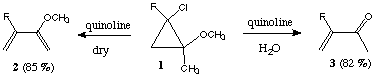
      We have a simple reaction process for the preparation
of fluorobutenone 3, an analog of methyl vinyl ketone, and
for fluorobutadiene 2.  As shown in the equation both fluorons
are prepared by heating the cyclopropane 1 in quinoline.  When
water is present only 3 is formed.  The fluorons are very
useful for the preparation of many new fluorinated materials..
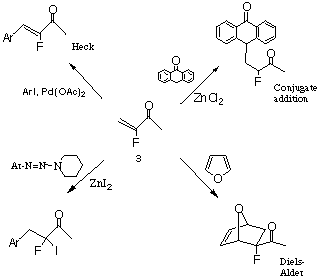
Several new reactions of 3 have demonstrated its utility in the Heck
Reaction, conjugate addition, Diels-Alder cyclization, and free radical
addition.
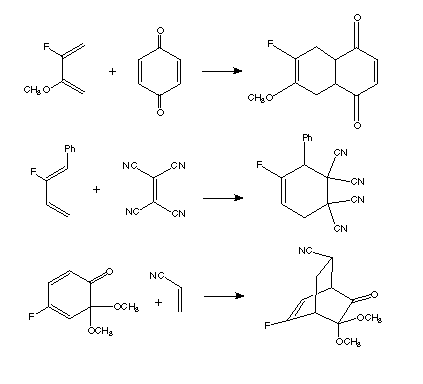
Fluorinated Dienes
The diene 2, as well as some other dienes, have been
used in cycloaddition reactions to prepare new fluorinated
cyclic materials. We observed that when 2 undergoes
cycloaddition reactions it is greatly assisted by using microwaves.
Thus the reaction of 2 shown occurs in 8 minutes in a
microwave oven, otherwise it takes 16 hours with normal
heating. Cycloaddition methodology promises to be very
useful for the preparation of new cyclic fluorinated systems.
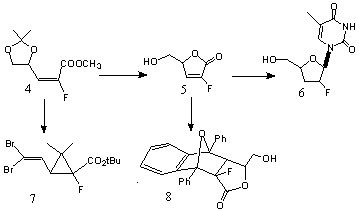
Fluoro-butenoates
We have been able to prepare two useful fluorobutenoates
that serve as fluorons. The ester 4 has been converted to the
cyclopropyl fluoroester 7 that is related to the pyrethrin family.
Also 4 has been converted into the fluorobutenolide 5. This
fluorobutenolide has been converted to fluoro-nucleoside 6, an
anti-HIV compound. Also 5 has been converted into the tricyclic
compound 8 in a study of steroechemistry.
Xenon Difluoride and
Iodine Chemistry
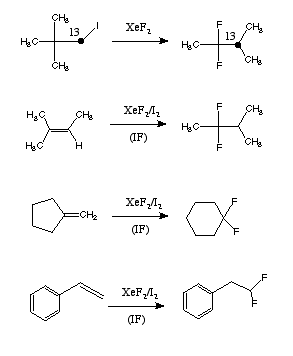
Xenon difluoride, a commercial reagent, reacts with alkyl iodides
to give products from loss of iodide, rearrangement and addition
of two fluorine atoms. When a mixture of excess xenon difluoride
and iodine are allowed to react with alkenes the first step occurs
by addition of IF followed by reaction of the newly formed alkyl
iodide with the xenon difluoride to give products of rearrangement
and fluorination.
Xenon Difluoride-
Cations and Radicals
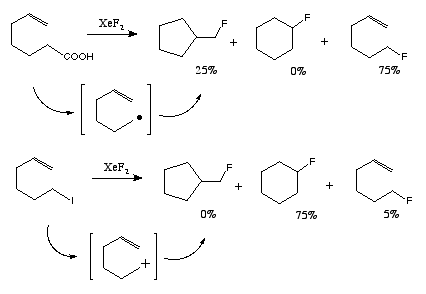
We have learned that both the COOH and iodine functions will
react with xenon difluoride causing replacement of the function by
fluorine. The reactions are very interesting for the study of
mechanism, and are also unique for the synthesis of new compounds.
The carboxylic acid function in the alkene system below undergoes
decarboxylation to produce a free radical that cyclizes to give the
5-membered ring. The iodine-alkene system undergoes loss of iodine
to give a cation that cyclizes to give the 6-membered ring. These
results are typical for radical and cation cyclizations.
Last Updated August 2011