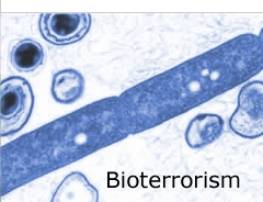
 The use of biologic agents as weapons, potentially weapons of mass
destruction. Even prior to the events of September 11, experts have warned that
technology existed for biologic agents to be used as weapons. For approximately
the last two years, public health agencies have been working hard to develop
disaster plans and remedy some of the shortfalls identified above.
The use of biologic agents as weapons, potentially weapons of mass
destruction. Even prior to the events of September 11, experts have warned that
technology existed for biologic agents to be used as weapons. For approximately
the last two years, public health agencies have been working hard to develop
disaster plans and remedy some of the shortfalls identified above.
Some of the measures taken include:
Ø Developing
protocols for collaboration among state & local health agencies, hospitals,
academic health centers, labs, professional societies, emergency response
units, media, & government agencies
Ø Establishing
active surveillance systems that can quickly identify diseases.
Ø Increasing lab
capacity
Ø Developing
clinical treatment protocols
Ø Planning &
responding to the need for equipment, medications & supplies. This includes
secret storage & means for rapid mobilization & distribution
Ø Develop, test
& implement the Health Alert Network
Ø Develop
contingency plans for mass mortuary services
Ø Train all health
organizations that may require participation in the event of an emergency
Ø Resolve legal
issues related to public health authority (vs. criminal investigation) in
emergencies
While this section we are discussing the U.S. response to bioterrorism, this is not an issue confined to the U.S. The results of bioterrorism could result in a catastrophic global event, so this truly is a global concern.
In the U.S., the CDC along with FEMA are the lead agencies for bioterrorism. The CDC has identified 3 major categories of agents that could be used as weapons of mass destruction:
Category A: 9 agents, which are rare, but
have a high impact. These agents pose a threat to national security because
they can be easily disseminated OR transmitted person-to-person, cause high
mortality, could cause public panic & social disruption.
Ø Variola major
(smallpox) – highly contagious attack rate up to 90% in unimmunized persons.
Mortality as high as 35%
Ø Bacillus anthracis
– highly effective agent because of it’s sport forming capacity for easy
dissemination
Unfortunately, we’ve all learned more than
we’d like to know about Anthrax. In October, the CDC delivered a satellite
training broadcast to health professionals around the nation.
I have edited & broken this broadcast
into 3 video-streamed segments for you. Click here to view & listen to this
information.
For those of you
using For
those of you on a
a dial-up
modem. high-speed
modem.
(for example if
you are (for
example if you are
dialing through a
phone using
Cable, DSL or if
line for Internet)
56 kbps on
Campus) 150 kbps
For a more
recent update on Anthrax visit the CDC website http://www.cdc.gov/od/oc/media/ARCHIVES.HTM
Ø Yersinia pestis (plague) a respiratory
acquired illness spread from person to person.
Ø Clostridium
botulinum (botulism) easily cultured from the soil. Victim require intensive
care & treatment with an antitoxin which is limited in supply &
availability
Ø Francisella
tularensis (tularemia) can be disseminated in water. In aerosolized form
produces a severe pneumonia
Ø Ebola
Ø Marburg fever
Ø Lassa fever
(hemorrhagic)
Ø Argentine fever
(hemorrhagic)
Category B are considered second priority because they are moderately easy to disseminate & cause moderate morbidity & low mortality.
Ø Q fever
Ø Brucellosis
Ø Glanders
Ø Alphaviruses
Ø Epsilon toxin
of Clostridium
Ø Staph
enterotoxin B
Ø Cholera
Ø Salmonell
Ø Shigella
Ø E coli 0157:H7
Ø Cryptosporidium
Category C include emerging pathogens that could be engineered for mass dissemination in the future due to availability, ease of production & dispersion & potential for high morbidity, mortality, & impact.
Ø Nipah virus
Ø Hantavirus
Ø Tickborne
hemorrhagic or encephalitis viruses
Ø Yellow fever
Ø MDRTB
This section on bioterrorism has been adapted from:
Landesman,
L. (2001). Public health management of disasters: The practice guide,
Washington D.C. : American Public Health Association
Also
Linked are 2 PowerPoint Presentations, on:
Bioterrorism and