
LECTURE NOTES: Introduction to the 16th Century
Slide #1 – engraving from Robert Fludd (History of the Macrocosm and the Microcosm, 2 volumes, 1617-19)
Robert Fludd (1574-1638) was an alchemist and mystic, chemist and mathematician, fellow of Oxford's College of Physicians, and author of the all-encompassing History of the Macrocosm and Microcosm (Utriusque Cosmi Maioris scilicet et Minoris Metaphysica, Physica atque Technica Historia, 1617-19), in which he attempted to include all the knowledge of his time--the various subjects covered include geometry, vision and music theory, harnessing water power to run clocks, architecture, anatomy and physiology, hermetic philosophy, astronomy, meterology, prophecy, and the art of memory, among others. Fludd, therefore is an interesting (if somewhat eccentric) representative of the English "Renaissance man." The illustration above is pertinent to our discussion for although it represents the Ptolemaic (and therefore pre-Copernican) view of a geocentric (earth-centered) universe, and that universe is also bound by a rope held by an angel heading, we can imagine, for heaven, nevertheless, we also have a rather large human figure superimposed, not only over the earth, but also over a large part of the cosmos--here then, we have a glimpse of one of the Renaissance's important catch-phrases: "man as the measure of all things."
By the "English Renaissance," historians of literature mean the period from about 1509-1660, from the reign of Henry VIII and his children and the first two Stuart kings, James I and Charles I, through the revolutionary government of the Commonwealth (which came to an end with the Restoration of Charles II to the throne).
The term, "The Renaissance," was first used in the 19th century (see Walter Pater, The Renaissance: Studies in Art and Poetry, 1866), and draws attention to the period’s conscious break with medieval culture. It applies to the revival of Greek and Roman culture that began in Italy during the fourteenth century and spread to England in the late fifteenth and sixteenth centuries. Because the term means "rebirth," it implies that classical learning had become moribund in the Middle Ages, although of course, the Middle Ages and its monastic institutions had actually preserved and transformed much of the Latin culture it inherited. Few medieval scholars, on the other hand, knew any Greek, and the revival of Greek learning, therefore, was enormously influential upon Renaissance writers and artists. Sidney, in fact, shows off his Greek and Latin learning in his Defense of Poesy, and even adopts a somewhat condescending tone toward Chaucer’s learning and poetry there. Renaissance writers, then, often set about constructing a deliberate break with what they saw as a "dark" ("unlearned") Middle Ages, and the belief, in fact, that the medieval period was a "fallen" and even "dark," barbarous period persisted right into the 20th century (see, for example, W.P. Ker, The Dark Ages, 1904). At the same time, there were certain aspects of the medieval period that Renaissance writers, like Sidney and Spenser, romanticized and revered--for example, the ideal of the chivalrous knight.
The term, "Early Modern," is borrowed from linguistics, where it is used to distinguish what is called "the Great Vowel Shift" from Middle to Modern English. But the term Early Modern is also used to refer to historical and cultural changes in the sixteenth century (roughly, 1485-1603) that emphasize ways in which some of the seeds of the modern world were sown--seeds of such phenomena as the market economy, the individual subject, and the centralized state. The period was marked by what we might call great "paradigm shifts"—in science, for example, Copernicus (1473-1543) attempted to prove that the sun, rather than the earth, was at the center of the planetary system (1543—publication of On the Revolution of the Spheres), and in religion, Martin Luther (1483-1546) challenged and ultimately caused the division of one of the major institutions that had united Europe throughout the Middle Ages—the Catholic Church (1517—beginning of Reformation in Germany). The literature of this period is best seen as resulting from the confluence of many different currents and events—such as humanism, the Reformation (and counter Reformations), the Italian Renaissance, and exploration of the New World—in the minds of writers attuned to their culture. In addition, the invention of the printing press in Germany, and its introduction in England by William Caxton (ca. 1422-1491), helped to bring about a phenomenal increase in literacy in the 15th and 16th centuries and helped to reinforce the trend in silent reading (which could be said to have eventually led to the birth of the novel in the 18th century).

Slide #2 – Raphael, The Entombment (1507)

Slide #3 – Raphael, The School of Athens (1510-11)
.jpg)

Slides #4 & #5 – School of Athens: detail of Plato and Aristotle; School of Athens: detail of Raphael, Zoroaster, Ptolemy, & Perugino
Raffaelo Sanzio (1483-1520)—the youngest of the three giants of the High Renaissance (the others: Leonardo da Vinci and Michaelangelo); while Renaissance artists did not abandon religious subjects in their paintings--in fact, of necessity (patronage), as well as interest, their chief subjects were mainly religious (see The Entombment above, but note also the new "realism," as it were, of the depiction of what might be called the standard repertoire of the religious canon--mainly, note how Raphael attempted to capture his figures in motion--an intense preoccupation of Renaissance artists). The School of Athens (large, arched frescoe) was commissioned by Julius II as part of a series of decorative paintings for a suite of papal rooms. Plato and Aristotle are IN MOTION, as an illustration of their peripatetic teaching style; Plato (model: Leonardo da Vinci) is pointing upward to the realm of ideas/pure forms, whereas Aristotle is pointing downward to the realm of the empirical world. Raphael put himself beside the pillar at the extreme right-hand edge of the picture and is looking out at the viewer in a striking instance, for the period, of aesthetic self-reflexivity. The painting ultimately paints an overly romanticized portrait of classical learning (which also collapses time boundaries, since philosophers and scientists from different classical cultures and ages are seen together in one idealized frame of vision), while it also, because of Raphael’s self-reflexive gesture, looks outward toward what might be called the beginnings of the modern self.
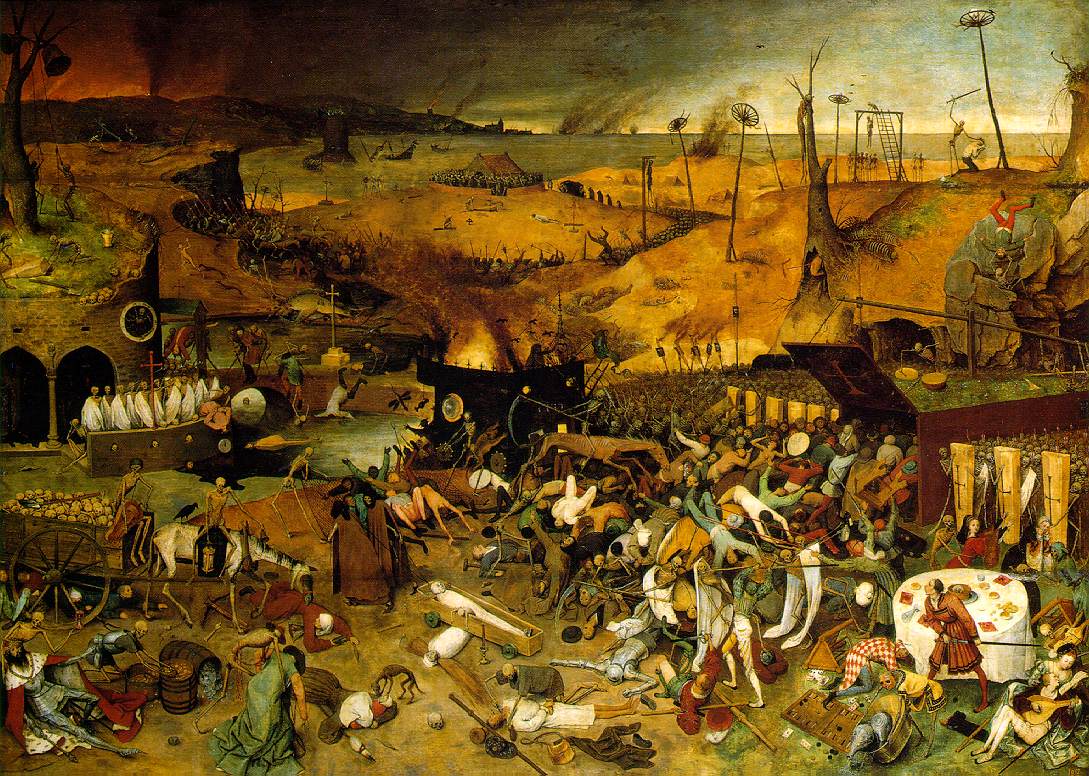
Slide #6 – Bruegel, The Triumph of Death (1562)
Although the Renaissance was a period of great artistic and intellectual fecundity, and also was the period that saw the emergence of what might be called powerful structures of national and transnational consolidation--the nation-state (whose court then also became a center for an emerging "national" culture, which culture was then always inextricably bound up with politics), and the international marketplace--nevertheless, because it was also a period of great social change and upheaval, as well as continual aggression and war and natural disaster, there was also the prevalent feeling that civilization was always perched just on the edge of an apocalypse. Even though everyone believed that as one world—the Middle, or Dark Ages—was ending to make way for newer, brighter worlds and structures of order, at the same time, it often seemed as if oblivion was always threatening, due to events such as the Bubonic Plague/Black Death, peasant uprisings, civil wars, rebellions and massacres, various campaigns of religious persecution, continual tensions between England, France, and Spain, etc. Therefore, the Renaissance was ultimately a period of new hopes and intellectual/artistic achievements set against a backdrop of great, threatening catastrophes. Sidney, for example, a man of great cultural achievements and also someone who really believed that he lived in an age of great technical and intellectual innovation, witnessed as a young man when he was in Paris the St. Bartholomew's Day Massacre (August 24, 1572) when thousands of Protestants were murdered (see the historian De Thou's firsthand account of the massacre). This is an event, we can imagine, that would have indelibly imprinted itself on the young Sidney's mind, and it would not have been the last time he would have witnessed such violence.


Slides #7 & #8 – Durer, Self-Portrait at 26 (1498); Durer, Self-Portrait at 28 (1500)
Durer (1471-1528) was probably the greatest artist of the Northern Renaissance—he lived in Nuremberg, halfway between the Netherlands and Italy—and he was very much an innovator. He is considered the first artist to have ever undertaken a self-portrait. His range and versatility were astonishing—woodcuts, engravings, oil paintings, drawings, altarpieces, watercolors; he published hundreds of woodcuts and engravings in his lifetime. He also was a prodigious tourist and diarist—in his diary, he recorded his visits to the Netherlands where he visited the leading artists of the day, he sketched the philosopher Erasmus, worried over the fate of Martin Luther, and attended the coronation of the Holy Roman Emperor—and that was just 1520-21. It was said by a friend of Durer’s that his self-portrait (at age 26) was so realistic that Durer’s dog barked and wagged his tail when he saw it. The landscape in the background is Alpine, reminding the viewer that Durer was well-traveled and had just returned from Venice—one of the leading cultural centers of the Renaissance. In the self-portraits painted when he was 28, Durer inscribed, "Thus I, Albrecht Durer from Nuremberg, painted myself with indelible colours at the age of 28 years." Interestingly, in this portrait he depicts himself in a Christ-like pose. Both portraits offer instances of a trademark of the Renaissance artist--"self-fashioning."
According to Stephen Greenblatt, in his book Renaissance Self-Fashioning: From More to Shakespeare (Chicago, 1980), because "the early modern period produced a change in the intellectual, social, psychological, and aesthetic structures that govern the generation of identities," there came to be a recognition both of "selves and a sense that they could be fashioned." For the first time, the self came to be understood as "a sense of personal order, a characteristic mode of address to the world, a structure of bounded desires."

Slide #9 – Durer, St. Jerome in His Study (1514)
Durer’s engraving of St. Jerome in his study is especially significant to the period we are delving into. Although Jerome lived from the mid-fourth through early fifth centuries, he was an extremely popular subject for Renaissance painters. Jerome spent much of his life translating scripture from Hebrew into Latin and Greek, while carrying on a self-advertising correspondence with social and literary eminences across the Roman world. In fact, he wrote over 120 letters, many of which he edited and revised several times, indicating he was keenly aware of his persona as a product of a laborious process of self-fashioning (he was the first "spin doctor" or "image manager," as it were); he was a multilingual, classical scholar; he was a traveler; and he also often challenged church doctrine, so some in the Renaissance saw him as a precursor of Protestantism. The importance of self-fashioning in period derived partly from Italian Renaissance, and especially from Pico della Mirandola’s Oration on the Dignity of Man (1486), in which God tells Adam, "We have made thee neither of heaven nor of earth, neither mortal nor immortal, so that with freedom of choice and with honor, as though the maker and molder of thyself, thou mayest fashion thyself in whatever shape thou prefer." But, while the period placed a new emphasis on self-fashioning, there was always a tension between humanism’s emphasis on the individual self and the powers of the human intellect and an orientation toward what was perceived to be the higher "author"—God, and the Christian Church.
By the time of the Renaissance St. Jerome became a model to emulate and an object of veneration. The Dutch humanist Erasmus modeled his own career on Jerome’s and even wrote a biography of Jerome. There are some anachronisms in the engraving that tell us something about the ways in which a veneration for the past was always mixed in with the "new" in Renaissance culture—for example, codex books were a relative novelty, and it is unlikely Jerome would have had several sitting on his shelf by the window as he does in Durer’s representation. Likewise, the painting contains a popular motif of Renaissance art—the memento mori (Latin for "remembrance of death")—the human skull sitting on Jerome’s window ledge. Because the Renaissance, as I have already mentioned, was a time of great, tumultuous change, as well as of pestilence, famine, plague, and war, Renaissance artists were somewhat obsessed with death and their own mortality, and painters often included, even in portraits of living subjects, some kind of memento mori object—usually a skull.
.jpg)
Slide #10 – Holbein, The Ambassadors (1533)
Holbein's painting hits closer to an image we want to keep in mind as we move into a discussion of the work of Sir Philip Sidney, who himself was an ambassador, as well as courtier, royal cup-bearer, knight, Protestant, humanist, patron of the arts, soldier, and poet. He was educated in and revered all his life classical literature, yet also saw himself as a literary innovator; he was at pains in his Defense of Poesy to both embrace classical (past) culture while also gently distancing himself from his own medieval predecessors (such as Chaucer), yet he also idealized the figure of the courtly medieval knight and often participated in ceremonial jousting tournaments; finally, he died in Zutphen (the Netherlands) at the age of thirty-two from a musket ball wound he suffered on the battlefield there--in other words, he was killed by a gun, a very modern instrument of war. Sidney's life, therefore, embodied the obsessions and contradictions of his age. He was a man very much concerned, as the two men depicted above, to fashion an image of himself as educated and cultured, well-versed in the musical and literary arts as well as in science, well-traveled, and as one who moved in his life with the powerful, yet when he died, he was actually estranged from his Queen and country, and even wrote in a letter to Sir Francis Walsingham (his father-in-law) shortly before his death: ". . . so much of my regality is fallen. I understand I am called very ambitious and proud at home: but certainly if they knew my heart they would not altogether so judge me."
Eileen A. Joy (with some help from Alfred David et al., Teaching with The Norton Anthology of English Literature, 7th ed., pp. 37-38)
