ENG200.001 -- Introduction to Literary Study
Prof. Eileen Joy
Spring 2005
EXERCISE #s 5 & 6 −- Explication Essay (20 points)
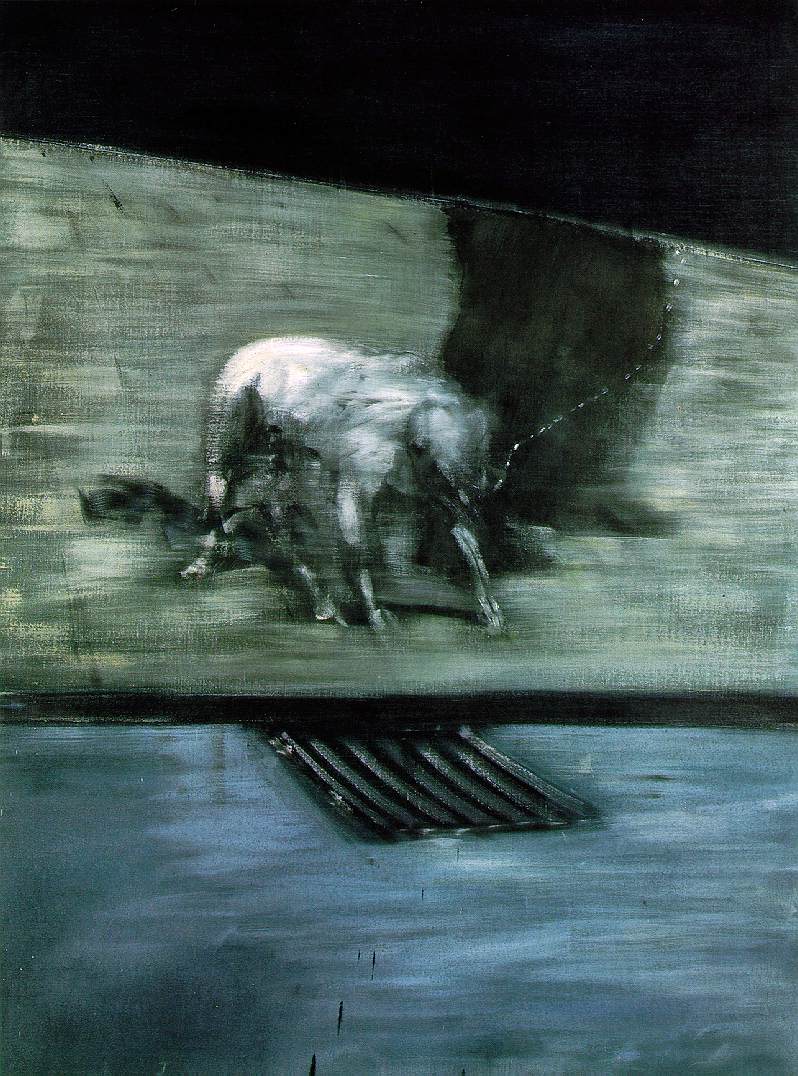
Figure 1. "Man With Dog" (painting by
Francis Bacon, 1909-1992)
explicate (verb):
1. to unfold, unroll, unravel in
words; 2. to open out and expand what is wrapped up; 3. to enter into
explanations
This
exercise (which counts as #5 & #6) is an explication essay, where
you will analyze a short
poem or a short (10-20 line) passage from a longer poem. Essentially, an
explication is a complete description of a poem. I am going to describe one way
of doing such an exercise. Do it my way for this assignment, as a practical
way to get your feet wet in this kind of thing. It is not the only way, but as
the farmer says to the pig in Babe, "that'll do" (for now).
This sort
of essay is often
associated with the movement in literary criticism known as “The New Criticism,”
which as been somewhat passé for forty years. While that theory became
nonsensical at its extremes—where it argued, for instance, that neither the
author’s intention, nor the reader’s response, nor the historical situation of a
poem mattered in its interpretation—the close analysis of the text itself must
always be the basis of any legitimate criticism and interpretation. (It
will
only continue to be legitimate if those other three things are taken into
account as well.) Only elements
that bear directly on the interpretation of the text and a further understanding
of its meaning are considered; hence the practitioners of this method
concentrate on such things as style, symbolism, diction,
and imagery. Choose a poem from our anthology (that we have not discussed
in class), and use the following guidelines as a template for your essay:
- Describe the poem briefly,
mentioning author, title, form, and any necessary historical
background. (“Emerson’s ‘Concord Hymn’ is a four-stanza poem in iambic
tetrameter rhyming abab which was written to commemorate the fiftieth
anniversary of the battles of Lexington and Concord in the American War of
Independence…”)
- Briefly paraphrase the
poem. To paraphrase is to restate the literal meaning in other words. If
you cannot paraphrase something, you don’t understand what it says on the most
basic level. (“Emerson emphasizes that he is discussing a specific place,
Concord, as he begins the poem describing the battle. ‘Here’ at this
bridge and by this river the American farmers displayed their flag,
and
in firing when attacked, they sent a message to the whole.”)
- If the
poem is in the voice
of a speaker other than the poet, you will need to mention that in the
paraphrase. If there is a dramatic situation, you will need to mention that,
as well: “In Browning’s ‘My Last Duchess,’ is a dramatic monologue about a
sovereign duke in the era of the Italian Renaissance who speaks to a foreign
ambassador while showing him through his art gallery…”
- Consider the implications
of the kind of poem you are describing. (“‘Concord Hymn’ is indeed in
the meter and rhyme scheme of many hymns, which may be surprising, since it
celebrates the acts of men, rather than acts of God, and addresses only a very
vague deity at its conclusion…” or “Shakespeare's ‘Let me not to the marriage
of true minds’ is classic sonnet, a verse form typically used by the poet
to
address a beloved, but this poem appears to be a philosophical rumination
upon
friendship, or perhaps fidelity in love . . .”
- If you are analyzing
a
passage from a longer work, put the passage in context (in other words, tell
you reader briefly what the rest of the poem is about, where the passage
you
have selected fits in the larger scheme, and why you have chosen this
particular passage)
- We
will not say, “After the paraphrase, begin to analyze the poem line by line,”
for two reasons: 1) Often you need to deal with more than a line at a time
for reasons of syntax; and 2) You have already been analyzing, since any
attempt to describe even the barest facts about a poem without analysis will
be a) impossible and b) dull. All the same, now you begin “unfolding” the
poem as it goes on. This is the fun part (I hope), where you begin to
focus on
specific aspects of the language and imagery in order to think out loud about
the poem's deeper meanings. Here are some things you may want think about
as
your prepare your analysis:
- Form. You need to
discuss how the sense of the poem (among other things!) fits the form.
[Refer to chapter 19 in your textbook, “External Form,” pp. 1044-71,
for
help with this, and we will also discuss this in class.]
- Development. How do we
get from the beginning to the end? Are we following a narrative? Are we
hearing something described and then explained? Are we being presented with
an example and then a moral? Or do we return, through repetition
or
otherwise, to where we began?
- Diction;
that is, word
choice. Why “Spirit,” not “God” in Ralph Waldo Emerson's “Concord Hymn”?
Why, “They fuck you up, your mum and dad,” rather than, “cause lasting
emotional problems” in Philip Larkin's poem “This Be The Verse”? You
will
need to consider the connotations of words as much as their denotative
meanings.
- Syntax. Are the
sentences simple or complex? Are there “poetic inversions,” such as
Coleridge's “In Xanadu did Kubla Khan a stately pleasure dome decree”? Does
the sentence structure match the other formal structures, such as rhyme
scheme, or depart from them?
- Imagery. Why does Anne
Bradstreet talk about her book as a bastard child in her poem “The Author to
Her Book”? Why does Eliot compare “evening” to “patient etherized upon a
table”?
- References
to things
outside the poem. Such references may include allusions to other literary
works, to biblical stories or images, or to various mythologies. They
may
also include references to historical events or to popular culture.
- Punctuation
and
pauses, which may or may not affect the overall rhythm (beat) of the
poem.
How are caesuras (breaks between lines) used?
- The use of rhyme
to
emphasize certain words.
- The use of other
sound
effects, such as alliteration, assonance, etc.
- The use of figures
of
speech, such as simile, metaphor, personification, etc.
- The
title. What's
important or surprising about the title? How does it function as an integral
part of the poem?
- You may
want to consider
how whatever you are describing is characteristic of its time period—or of
another time period the author is invoking.
- You can,
of course,
consider any explicit purpose the poem may have, political or social.
(Langston Hughes's poetry, for example, was very political, and explicating
a
Hughes poem often means talking a little bit about the political or social
message behind the poetic diction.)
- Finally,
end your paper by
saying briefly what everything you have described adds up to. What's the
overall message, mood, impression, effect, statement, etc. that the poem
seems
to be conveying?
- Should
you have an opinion
about the poem, you may certainly express it. But this really isn't an opinion
paper ("I love this poem because . . . ."); rather, it's an essay
that
attempts to describe what the poem does.
Go
HERE for an excellent
explication of a poem by Whitman, written by S.I.U.E. student Andrew Crider.
Target
length: 3 pages, double-spaced, TYPED. Due: Thursday, Mar. 17th