Lecture Notes, Biology 203, Human Sexuality and Reproduction
Pregnancy and Childbirth
- Early Pregnancy
- Symptoms
- Missed menstrual period (about two weeks postconception, but some women continue to menstruate, possibly for several months)
- Tender breasts and nipples (about one to two weeks postconception)
- Fatigue, increased frequency of urination, nausea and vomitting (not necessarily just in the morning) (about four weeks postconception)
- Softening of cervix and uterus, purplish vaginal walls (about 6 weeks postconception)
- Tests
- Now primarily detect HCG (rises after implantation to peak at 8-10 weeks, then declines to week 16 or so)
- Seven days postconception: ultrasensitive radioimmunoassay (done from blood sample by a laboratory)
- Ten to 24 days postconception: enzyme immunoassay (done from urine sample in doctor's office, by laboratory, or at home)
- False positives (says she's pregnant when she's not)
- Blood or protein in urine
- Recent pregnancy (<10 days)
- Disease that produces HCG
- Various drugs
- False negatives (says she's not pregnant when she is)
- Test done too early (before rise in HCG) or too late (after fall in HCG)
- Urine too old, too dilute, or not properly preserved
- Due dates (measures of progress through pregnancy as fetus develops)
- Full term in humans is 38 to 42 weeks postconception
- Last menstrual period dating (LMP)
- Take 1st day of LMP + 7 days - 3 months + 1 year
- Gives date accurate 85% of the time plus or minus 2 weeks
- Measurement of fundal height
- Distance from pubic bone to fundus of uterus (top)
- # cm x 8/7 = weeks of pregnancy (physician looks up in table)
- At 16 weeks, fundus is about 1/2 way to mother's navel
- At 20-22 weeks, fundus is about even with navel
- Tests for Fetal Maturity
- Ultrasound
- Safe, noninvasive, but shouldn't be used for trivial reasons
- Measure diameter of head and/or length of thigh bone, then look up in table
- Head diameter at 36 weeks: 8.7 cm
- Head diameter at full term: 9.8 cm or more
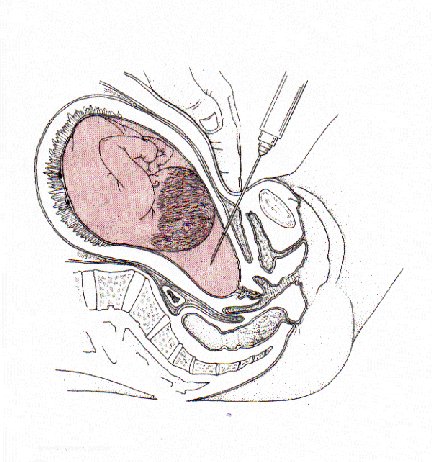
- Amniocentesis
- Done at 14 to 16 weeks (plus takes as much as 4 weeks to get results)
- Invasive, carries risk of infection of amniotic fluid
- Cells and fluid in sample collected from amniotic fluid from amniotic fluid surrounding fetus (using ultrasound to locate fetus)
- Cells provide genetic information
- Fluid provides information about lung maturity (lipids), liver maturity, and kidney maturity
- Risk of infection reduced to less than 1% when done by experienced personell
- Chorionic villus sampling (CVS)
- Done at 9 to 11 weeks
- Cells obtained from very early placental cells--can look for genetic defects
- Risk of infection now reduced to less than 1%
- Physiological Changes During Pregnancy
- Most changes involve an increase in size or function of various organs and often an increase in blood flow to them
- Reproductive tract
- Uterus: increased size and increased blood flow
- Cervix: change in color and increased blood flow
- Breasts: increased size, increased blood flow, growth of blood vessels, development of mammary glands
- Ovaries: have corpus luteum in first trimester
- Fallopian tubes: become longer
- Vaginal walls: increased blood flow, increased vaginal secretions and discharge
- Cardiovascular system
- By midpregnancy, there is an increase in heart rate.
- By the 3rd or 4th month, there is a 30-50% increase in blood volume
- Sometimes in the 2nd trimester, there is a decrease in blood pressure, but by the end of pregnancy, there is often a slight increase in blood pressure
- Respiratory System
- By midpregnancy, there is approximately a 15% increase in oxygen consumption
- Urinary tract
- Kidneys: increase in function, 25% increase in blood flow
- Bladder: increased frequency in urination, due to sensitivity to estrogen in early pregnancy, later also due to pressure from enlarged uterus
- Gastrointestinal tract
- Stomach: nausea/vomitting (may be due to estrogen sensitivity early in pregnancy)
- Intestines: constipation and heartburn in late pregnancy due to pressure from enlarged uterus
- Nutrition, Exercise, and Sex During Pregnancy
- Nutrition
- Table of Recommended Daily Dietary Allowances for Nonpregnant, Pregnant, and Lactating Women
- As a general rule, pregnant women need more of many nutrients than nonpregnant women.
- Increased requirement: protein, vitamins D, E, C, thiamin, riboflavin, niacin, vitamin B6, and B12, folic acid, calcium, magnesium, iron, zinc, iodine, calories
- No change: vitamin A, phosphorus
- Lactating women continue to need increased amounts of many nutrients, sometimes more than during pregnancy
- Increased requirement compared to pregnant women: protein, vitamin A, E, C, thiamin, riboflavin, B12, magnesium, water
- No change or decrease compared to pregnant women: vitamin D, niacin, B6, folic acid, calcium, phosphorus, iron, zinc, iodine, calories
- Iron is needed for making red blood cells
- Folic acid (folacin) is needed for synthesis of many molecules needed to make new cells and tissues in both mother and fetus
- Calcium is needed for bones and teeth
- A nursing mother of a vigorously nursing baby may require as much as 1200 calories per day for making milk as well as increased water intake
- Weight gain--25 to 30 lbs., but recommended amount varies, but gaining too little weight (less than 20 lbs.) increases the chance of a low birth weight baby
- Weight gain from fetal tissues: 10.5 lbs. (fetus 7.5, placenta 1, amniotic fluid 2)
- Weight gain from other sources: 11.5-15.5 lbs. (uterus 2, breasts 1.5, mother's body 4-8, fat deposits 4)
- Exercise
- Moderate levels of exercise to which the woman is accustomed are recommended, possibly reduced in late pregnancy (not bed rest, unless indicated by medical history)
- Walking or swimming, 30 min, three times a week
- Improves muscle tone, shortens labor, makes labor easier to manage
- Sex
- Couples tend to continue to have sex at whatever frequency is normal for them, regardless of recommendations
- No reason for abstinence unless medically indicated or if it becomes extremely uncomfortable in late pregnancy
- One study of 27,000 women provided evidence that intercourse in the last four weeks of pregnancy caused an increase in the number of stillbirths due to amniotic fluid infection
- If the cervix has begun to dilate, making the amniotic membrane more vulnerable to abrasion, abstinence may be recommended
- Risk Factors During Pregnancy
- Age: (<15, >35) (although older women can have risk-free pregnancies if carefully monitored)
- Physical condition: <100 lbs., malnourished, or obese
- Medical history: chronic disease of heart, kidney, lung, tuberculosis, diabetes, hypertension, cancer
- Reproductive history: >8 children, history of prematurity, history of miscarriages
- Maternal smoking
- Decreases oxygen available to fetus
- Limits fetal growth
- Increases chance of low birth weight babies, and of prematurity
- Brain damage: learning disorders, attention deficit disorder
- Maternal alcohol consumption
- Fetal alcohol syndrome
- Physical defects (facial, heart)
- Central nervous system defects (delayed development, learning disabilities, speech delay, coordination problems)
- Frequency 0.2 per 1000 births in general population
- In native American population, 3/1000
- Increased prematurity, decreased birth weight
- Disorders of Pregnancy
- Hemorrhagic disorders (excessive bleeding)
- Spontaneous abortion (miscarriage)
- Causes: >50% fetal/placental origin, 15% maternal, rest cause unknown
- 3/4 of miscarriages happen before 16th week, most before the 8th week, possibly a large number very early before conception can be confirmed
- Bleeding, painful cramping (uterine contractions), loss of tissue
- Ectopic pregnancy (implantation and/or development outside uterus)
- 90% of ectopic pregnancies are tubal (in Fallopian tube, often the right one)
- 3/4 are identified in the first trimester
- Structures other than uterus not adapted to support growth of fetus, especially Fallopian tubes
- High risk of rupture of tube, leading to hemorrhage and death
- Termination of tubal pregnancy essential to preserve mother's life
- Placental problems
- Placenta previa
- Occurs in 1/200 deliveries
- Implantation near cervix causes placenta to develop across or adjacent to cervix
- May require bed rest during part or all of pregnancy and a Caesarian delivery
- Premature separation of placenta
- Occurs in approx. 1/150 deliveries (fetus dies in 1/500 to 1/750 deliveries)
- Placenta separates from uterine wall before 3rd stage of labor
- Causes fetal distress and damage due to oxygen deprivation
- May cause maternal hemorrhaging and fetal oxygen deprivation, resulting in 0.5-5% chance of maternal death and 20-35% chance of fetal death
- Hypertensive disorders (high blood pressure)
- Preeclampsia (milder) to eclampsia (severe)
- Also called toxemia of pregnancy
- More common in 1st pregnancies, and in the last half of pregnancy (after 20 weeks)
- Mild preeclampsia
- Increase in blood pressure
- Sudden weight gain, possibly due to fluid retention
- Edema (swelling)
- Protein in urine
- Severe preeclampsia
- Greater increase in blood pressure
- Headaches
- Vision problems
- More protein in urine
- Eclampsia (only 5% of preeclamptics progress to this point)
- Convulsions, shock, death
- 15% maternal deaths, 20% fetal deaths
- Infectious disease
- Bacterial
- Gonorrhea (if infected during vaginal delivery and not treated, baby may have gonococcal ophthalmia--blindness)
- Syphilis (crosses placenta to infect fetus--if mother has untreated secondary syphilis, baby is born with congenital syphilis)
- Rubella virus (many other viruses can also cause problems)
- Mild infection for mother
- If mother has infection in 5th - 10th week, severe damage to fetus
- Blindness, deafness, heart defects (congenital rubella syndrome)
- If infant is born with active infection, can spread to other infants in nursery
- Vaccine for rubella not usually given to pregnant women--live virus vaccine may be slightly risky to fetus
- Blood test can establish state of immunity of mother
- Toxoplasmosis (protozoan)
- Cysts of protozoan inhaled from dust from cat litter boxes, or ingested in poorly cooked meat
- Protozoan crosses placenta, causing death, CNS damage, eye problems
- Uncommon, since most people in this area have protective immunity, but people who move into an area where toxoplasmosis is endemic may not be immune
- Other medical disorders
- Diabetes
- Insulin deficiency or resistance causes poor utilization of glucose by cells, leading to high blood glucose levels with many toxic effects
- Pregnant diabetic should carefully control blood glucose levels, with diet, drugs, or insulin
- Insulin requirement varies during pregnancy--dose may need to be adjusted frequently
- Often have large fetus that may require Caesearian delivery
- Other fetal problems due to fetal exposure to high glucose levels
- Gestational diabetes
- Temporary diabetes during pregnancy--goes away after delivery
- 80% of women who have gestational diabetes develop type 2 diabetes within 5 years
- Rh disease
- Rh+ women have Rh molecules on surface of red blood cells; Rh- women do not
- If an Rh- woman is pregnant with an Rh+ fetus for the first time, there are no problems for that fetus, but at delivery, some fetal blood may mix with maternal blood, exposing her to Rh molecules for the first time
- Her immune system recognizes Rh molecules as foreign and reacts by making anti-Rh antibodies which circulate in her blood
- If she again becomes pregnant with an Rh+ fetus, the anti-Rh antibodies may cross the placenta and destroy fetal Rh+ red blood cells
- The destruction of fetal red blood cells makes the fetus anemic--too few red blood cells to carry oxygen
- Can be treated by fetal (intrauterine) or newborn transfusion with Rh- blood
- Can be prevented by giving Rh- woman (pregnant with Rh+ fetus or fetus of unknown Rh type) Rhogam shots during pregnancy to prevent development of anti-Rh antibodies
- Rhogam must be given in every pregnancy, miscarriage, or induced abortion to protect fetus in subsequent pregnancies
- Childbirth
- Stage 1 of labor
- Uterine contractions dilate and efface cervix (widen opening and flatten walls)
- Contractions regular, fairly predicable
- Pain manageable, continued breathing helps
- May last 9 to 36 hours, depending on many factors
- Shorter if labor induced with pitocin (oxytocin)
- Longer labor is gentler for fetus unless it becomes too prolonged, exhausting the mother and putting the fetus at risk
- Near end of stage 1, reach short (45 min. - 1 hr.) phase called transition--shorter harder contractions, less predictable, less manageable, mood changes, irritability
- By end of stage 1, cervix is dilated to 8 to 10 cm
- Stage 2 of labor
- Signalled by urgent need to push fetus out
- Contractions of uterus more vertical, more powerful--tend to push down on fetus at the same time as uterine wall pull up
- Shorter stage than stage 1
- Ends with delivery of baby
- Stage 3 of labor
- Separation of placenta from wall of uterus
- More contractions to expell placenta from uterus
- Should be examined carefully to make sure all placental tissue has been removed from uterus