


From Ukraine to SIUE: Fulbright FLTA Builds Connections Through Language
 For nearly a year, Orest Matsiyevsky did not know whether the application he had submitted would bring him back to the United States. He advanced through the Fulbright selection process but was named an alternate finalist, waiting as one month folded into the next.
Come spring 2026, that answer changed. By August, the Ukrainian language instructor was on his way to Southern Illinois University Edwardsville. This time, he would not only be a student, but a teacher eager to share his language and culture.
Matsiyevsky joined SIUE as a Fulbright Foreign Language Teaching Assistant in the Department of Foreign Languages and Literature. During his nine-month appointment, he will teach Ukrainian, take a couple of courses and experience American university life from the other side of the classroom.
His arrival also creates an opportunity for the department to expand the cultural perspectives available to SIUE students.
“His presence enriches our department by bringing the Ukrainian language and culture to our students while creating meaningful opportunities for intercultural exchange,” said Heidy Cuervo, PhD, chair and associate professor of pedagogy and Spanish. “We are fortunate to have Orest as part of our SIUE community.”
For Matsiyevsky, that exchange begins with recognizing that language carries far more than vocabulary.
“I believe that language is not just grammar and rules, but it’s more about the culture,” said Matsiyevsky. “I’m eager to show Ukrainian culture through the language, because I strongly believe that it’s more than just words.”
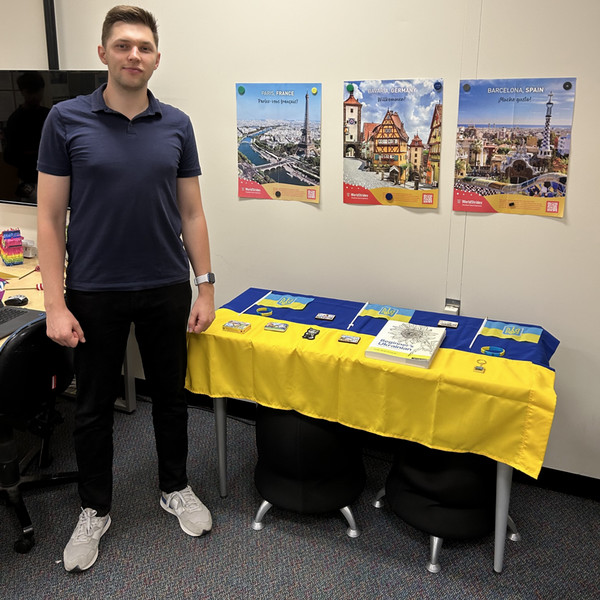
His introductory course begins with the basics of the alphabet and pronunciation before moving into practical situations such as ordering coffee or visiting someone’s home. Students will learn about Ukrainian food, films, sports, art and traditions through conversations, games and quizzes. Matsiyevsky brought flags, magnets and other souvenirs from Ukraine to share as classroom prizes.
The ongoing war will be approached thoughtfully as another part of understanding contemporary Ukraine.
“I want to explain Ukraine not through the news headlines, but how it really is,” said Matsiyevsky.
Matsiyevsky grew up in Ostroh, a city in western Ukraine. Both of his parents work at the National University of Ostroh Academy, whose history dates to 1576. He earned a bachelor’s degree in English and a master’s degree focused on language mediation and teaching English to speakers of other languages.
During his undergraduate studies, Matsiyevsky began teaching. He has more than six years of language-teaching experience. Before leaving Ukraine, he also worked as a military interpreter, facilitating essential communication between Ukrainian soldiers and military personnel from partnering countries. It was his way of supporting his country during the Russia-Ukraine war.
International exchange has been another defining part of his education. Matsiyevsky participated in short-term Erasmus+ programs in Spain, Georgia, Slovakia and Turkey. In 2023, he studied at the University of Central Missouri through an international exchange program.
After returning to Ukraine, he organized workshops to help other students pursue similar opportunities. He offered guidance on résumés, recommendation letters, motivational statements and application materials. One student from his university later participated in the same American exchange program.
“I’m from a small town,” said Matsiyevsky. “It doesn’t limit you to the opportunities.”
Since arriving at SIUE, Matsiyevsky has begun building connections among international students and found a supportive welcome across campus. During international student orientation, he joined fellow students in painting the Rock and added a tribute to Ukraine.
“I do feel included,” said Matsiyevsky. “I’m grateful for that.”
While he is eager to introduce students to Ukraine, Matsiyevsky views his appointment as a two-way exchange. He is equally excited to learn from his students and colleagues and experience American higher education as an educator.
“That’s how the Fulbright program works. It was setup to create mutual understanding between cultures, and that’s what I’m here for as well.”
Photo courtesy of Orest Matsiyevsky.


