ENG505 - Beowulf, Cultural Memory, and War
Spring 2004
OUR BEOWULF BLOG*
(natterings, chatter, dialogue, and other bits and pieces of intellectual and lower forms of discourse flung across national and cultural borders between students at Southern Illinois University-Edwardsville and Université Laval in Quebec City, Quebec)
Map of Edwardsville, Illinois/Map of Quebec City, Quebec
*All interested queries and submissions to weblog should be directed to Eileen Joy via e-mail: ejoy@siue.edu
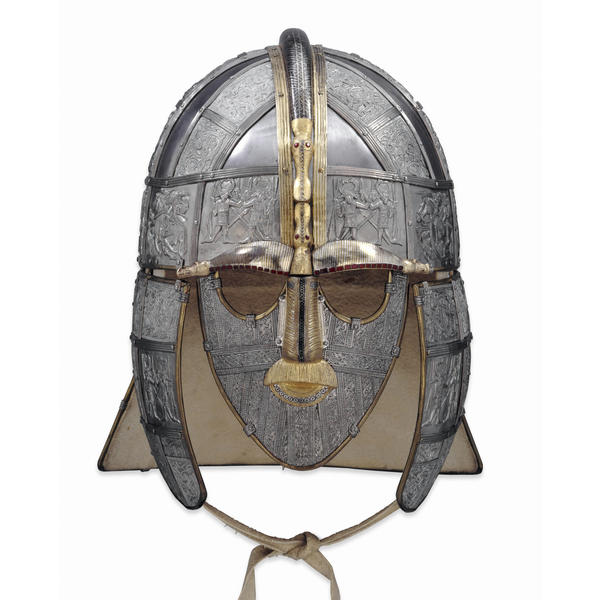
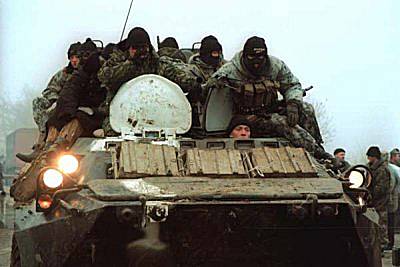
Figures 1 & 2. Replica of a helmet found at Sutton Hoo ship burial site & Russian soldiers returning from Chechnya
I N D E X O F P O S T I N G S
22 Jan. 2004: Simone Weil, "The Iliad, or The Poem of Force" (B. Rable)
3 Feb. 2004: Tolkien, "Beowulf: The Monster and the Critics" (J. Olson)
3 Feb. 2004: Response to Olson re: Tolkien Essay (E. Joy)
5 Feb. 2004: The Godfather films and Beowulf (E. Joy)
5 Feb. 2004: Beowulf & the "Dating Controversy" (B. Rable)
5 Feb. 2004: R.M. Liuzza, "On the Dating of Beowulf" (J. Olson)
5 Feb. 2004: Beowulf & the "Dating Controversy" (P. Heyen)
5 Feb. 2004: Beowulf and the "Dating Controversy" (S. Kollbaum)
5 Feb. 2004: R.M. Liuzza, "On the Dating of Beowulf" (J. Bosomworth)
5 Feb. 2004: The Electronic Beowulf (J. Moy)
7 Feb. 2004: Response re: Comments on the "Dating Controversy" (E. Joy)
9 Feb. 2004: The Narrator of Beowulf (B. Rable)
9 Feb. 2004: Response to Rable re: Beowulf Narrator (E. Joy)
12 Feb. 2004: Why Beowulf in Quebec City? (S. Bédard)
17 Feb. 2004: Response to Bedard re: Beowulf in Quebec (E. Joy)
17 Feb. 2004: Overing and Osborne, "Mapping Beowulf" (B. Rable)
17 Feb. 2004: Overing and Osborne, "Mapping Beowulf" (C. Liu)
17 Feb. 2004: Overing and Osborne, "Mapping Beowulf" (P. Heyen)
19 Feb. 2004: What do we mean by "basic human condition"? (E. Joy)
20 Feb. 2004: The "grassy knoll" and Kiernan's Beowulf (S. Barclay)
20 Feb. 2004: Sailing, Sutton Hoo, and Niles's "Appropriations" (S. Kollbaum)
20 Feb. 2004: Niles, "Appropriations: A Concept of Culture" (J. Olson)
20 Feb. 2004: "Anglo-Saxonism" and Social Identity (D. Krisinger)
20 Feb. 2004: Frantzen, "Origins, Orientalism, and Anglo-Saxonism" (J. Bosomworth)
20 Feb. 2004: Frantzen, "Origins, Orientalism, and Anglo-Saxonism" (C. Liu)
20 Feb. 2004: Niles, "Appropriations: A Concept of Culture" (J. Smith)
20 Feb. 2004: Niles, "Appropriations: A Concept of Culture" (P. Heyen)
20 Feb. 2004: Niles, "Appropriations: A Concept of Culture" (J. Moy)
20 Feb. 2004: Them's Fightin' Words, Frantzen! (E. Zelasko)
20 Feb. 2004: Niles, "Appropriations: A Concept of Culture" (C. Cooper)
20 Feb. 2004: Niles, "Appropriations: A Concept of Culture" (J. Turbe)
20 Feb. 2004: Niles, "Appropriations: A Concept of Culture" (B. Rable)
26 Feb. 2004: Is History Only in the Mind? (E. Joy)
26 Feb. 2004: Grendel as Minotaur? (M. Dulude)
27 Feb. 2004: The Things We Carry (E. Joy)
27 Feb. 2004: Howe, "Beowulf and the Ancestral Homeland (S. Drake)
27 Feb. 2004: Niles, "Locating Beowulf in Literary History" (B. Schrimpf)
27 Feb. 2004: Howe, "Beowulf and the Ancestral Homeland" (D.Krisinger)
27 Feb. 2004: Niles, "Locating Beowulf in Literary History" (B. Rable)
27 Feb. 2004: Niles, "Locating Beowulf in Literary History" (J. Bosomworth)
27 Feb. 2004: Howe, "Beowulf and the Ancestral Homeland" (S. Kollbaum)
27 Feb. 2004: Niles, "Locating Beowulf in Literary History" (J. Moy)
27 Feb. 2004: Howe, "Beowulf and the Ancestral Homeland" (C. Liu)
28 Feb. 2004: Howe, "Beowulf and the Ancestral Homeland" (P. Heyen)
28 Feb. 2004: Niles, "Locating Beowulf in Literary History" (J. Turbe)
28 Feb. 2004: Beowulf as a Migrating, Unifying Figure (E. Zelasko)
28 Feb. 2004: Beowulf and Geography (C. Cooper)
28 Feb. 2004: The Function of Criticism? (E. Joy)
2 Mar. 2004: Niles, "Locating Beowulf in Literary History (J. Smith)
2 Mar. 2004: Beowulf, Fightin' Jesus, and Severed Ears (J. Bosomworth)
2 Mar. 2004: Human Culture is a Complete Slave to History (B. Schrimpf)
2 Mar. 2004: Lamentably, She Answers Her Own Question (E. Joy)
3 Mar. 2004: A "Sense of History" was Rare in Medieval England? (D. Krisinger)
3 Mar. 2004: Response to D. Krisinger re: Medieval "Sense of History" (E. Joy)
8 Mar. 2004: A "Sense of History" & Cave Drawings in Siberia (J. Moy)
8 Mar. 2004: Earl, "Transformations of Chaos" (D. Krisinger)
8 Mar. 2004: History and the Geats--Some Questions (S. Kollbaum)
8 Mar. 2004: History's Dark Shadows (C. Liu)
8 Mar. 2004: Beowulf and the Past (C. Cooper)
8 Mar. 2004: Beowulf and Kin-Feuds (J. Olson)
8 Mar. 2004: Frank's "pastness of the past" (S. Drake)
8 Mar. 2004: Roberta Frank as the "hot topic" (J. Smith)
8 Mar. 2004: Should the title of Beowulf be . . . . Hrothgar? (E. Zelasko)
9 Mar. 2004: Beowulf, Pagan vs. Christian, Nazis, and Beer Maidens (B. Gilchrist)
10 Mar. 2004: Beowulf, Identity, and Quebec Independence (P. Dolbec)
10 Mar. 2004: The "Middle-ness" of Beowulf (E. Joy)
17 Mar. 2004: Junior Soprano's Ashes and Beowulf's Memorial Tomb (J. Smith)
17 Mar. 2004: The Female Mourner at Beowulf's Funeral (J. Bosomworth)
18 Mar. 2004: Death, Memory & Drowning Boys in Kosovo (E. Joy)
19 Mar. 2004: Feminist Criticism & the "Tower of Beowulf" (P. Heyen)
19 Mar. 2004: Overing, "Gender and Interpretation" (D. Krisinger)
19 Mar. 2004: On Being the Strong, Silent Type (B. Rable)
19 Mar. 2004: The "Others" of Beowulf: Women, Grendel & Beowulf (J. Moy)
19 Mar. 2004: The Female Mourner and Black Elk Speaks (S. Kollbaum)
19 Mar. 2004: Beowulf, Blanks, and Lacunae (E. Zelasko)
19 Mar. 2004: It's a Man's World, After All (B. Schrimpf)
19 Mar. 2004: Bennett, Lees, & Tolkien's Abstract Sadness (S. Drake)
19 Mar. 2004: Silent Mourners and Doomed Peace-Weavers (C. Cooper)
19 Mar. 2004: Some Questions re: Bennett, "The Female Mourner" (J. Smith)
19 Mar. 2004: The Female Mourner's Strength? (J. Olsen)
20 Mar. 2004: Monsters, Freaks, and X-Men (J. Bosomworth)
20 Mar. 2004: Beowulf as Monstrous "Other" (E. Joy)
23 Mar. 2004: Some Late Night Thoughts About Beowulf-as-Art (B. Gilchrist)
24 Mar. 2004: Earl, "Beowulf and the Men's Hall" & My Fair Lady (J. Bosomworth)
25 Mar. 2004: Earl, Monsters, Halls, & Death (J. Turbe)
25 Mar. 2004: Earl's Desire to Tame the Shrew (J. Moy)
25 Mar. 2004: Earl, Deformed Dolls, and "The Fall of the House of Usher" (P. Heyen)
25 Mar. 2004: Earl, "Beowulf and the Origins of Civilization" (C. Liu)
25 Mar. 2004: Beowulf in High School (S. Kollbaum)
25 Mar. 2004: The Heroic Life: No Girls Allowed (B. Rable)
25 Mar. 2004: Earl, Beowulf, and History (B. Schrimpf)
25 Mar. 2004: Earl, Beowulf, Hellboy, and Tall Buildings (S. Drake)
25 Mar. 2004: Earl, the Men's Hall, and Epic (E. Zelasko)
27 Mar. 2004: Earl, "Beowulf and the Men's Hall" (C. Cooper)
27 Mar. 2004: My Love Letter to James Earl (E. Joy)
29 Mar. 2004: Dancing with Beowulf (J. Beaulieu)
29 Mar. 2004: Emendation: Labelling for a Better Enslavement (P. Dolbec)
29 Mar. 2004: Grettir versus Beowulf (P. Dolbec)
30 Mar. 2004: Response to C. Liu: Earl, Hill, & the Narcissistic Wound (P. Dolbec)
31 Mar. 2004: Seth Lerer and the Body as a Foreign Country (M. Dulude)
31 Mar. 2004: Burial Rituals & Other Worlds (M. Dulude)
31 Mar. 2004: Earl, "Beowulf and the Men's Hall" (D. Krisinger)
5 Apr. 2004: What If Beowulf Were on Television? (S. Barclay)
5 Apr. 2004: Beowulf and Grettir's Saga (A. Kabbaj)
7 Apr. 2004: Marcello, Frederico, Beowulf, the Poet and 8-1/2 Pieces of a Doll (M. Dulude)
7 Apr. 2004: Cohen's Monster Theory and the Longue Durée (B. Schrimpf)
15 Apr. 2004: Pondering Pasternack (B. Rable)
15 Apr. 2004: Beowulf, Earl, and Nominalism (A. Beverley)
15 Apr. 2004: Beowulf--the Third Time, or: Liuzza vs. Heaney (A. Beverley)
15 Apr. 2004: Beowulf's Burial (A. Beverley)
26 Apr. 2004: Adieu, Beowulf Blog (E. Joy)
11 May 2004: Eleven Lessons from Reading Beowulf and All Those Monstrous Critics (B. Gilchrist)
22 Jan. 2004
B. Rable on Simone Weil's "The Iliad, or The Poem of Force":
Of the Achaean warriors, Simone Weil states, “At the outset, at the embarkation, their hearts are light [. . .] they go off as though to a game, as though on holiday from the confinement of daily life.” Weil’s image of the lightheartedness of warriors “with nothing but space to oppose” them is relevant to modern armies that believe themselves physically and morally superior to an untested enemy. Take for instance the following poem by Bob McDowell, a member of the Royal Irish Fusiliers, titled “The Hill Street Tommies,” which speaks of the men from the Lurgan linen mill, some of whom perhaps sought adventure if not flight from Ireland during World War I:
There’s big Bob Lunn and Donaldson,
Who could make boots with any other,
And the Blizzard Boy, his mother’s joy,
Who could never keep out of bother.
There’s Bobbie Gordon, solid man, old
Tom Black and Campbell.
When these lads brave cross o’er the waves
The Germans in their boots will tremble.
Further, there is evidence that at least some World War I English soldiers dealt with battle as a sort of game. For example, in The Great War and Modern Memory, Paul Fussell notes that on the German’s first use of chlorine gas, Sgt. Reginald Grant remarked, “It is a new device in warfare and thoroughly illustrative of the Prussian idea of playing the game.” Fussell also recounts instances in which “the sporting spirit was to kick a football toward the enemy lines while attacking.” Most notable was one Capt. Nevill, a company commander in the 8th East Surreys, who offered a prize to the platoon which, at the jump-off of the Somme attack, first kicked its football up to the German front line. Capt. Nevill, who kicked a ball apparently to signal the attack, was killed instantly. The following revealing poem resulted from this event:
On through the hail of slaughter,
Where gallant comrades fall,
Where blood is poured like water,
They drive the trickling ball.
The fear of death before them
Is but an empty name.
True to the land that bore them—
The SURREYS play the game.
One wonders how the bitter realities of trench warfare might have changed the author of this poem. One also wonders how the realities of modern warfare, in which the only thing between the combatants is space—for example, bombs dropped from 40,000 feet and missiles launched from hundreds of miles—have changed the rules of the “game” forever.
3 Feb. 2004
J. Olson on Tolkien's ideas re: myth and allegory:
I was reading over the Tolkien essay
again, and found myself at the passage we discussed in class: "Folk-tales in
being, as told—for the ‘typical folk-tale’ of course, is merely an abstract
conception of research nowhere existing—. . ." From this quote in class, we
ventured into the unexplainability of the origins of folk tales, in that if one
traces its origins back, one always reaches a vanishing point. However true
this maybe, I think Tolkien is talking about something different. He puts
stress around the words “typical folk-tale” because, for him, a “typical” folk
tale does not exist; folk tales, by their natures, cannot be typical. Each tale
is rich in its independence from other such tales of other such people. The
classification of folk tales, and thus the "typification," only arises within academia, only within
"an abstract conception of research."
Just below this explanation of the impossibility of typical folk tales, he talks
of the interconnectedness of myths and folk-tales and how both escape analytical
reasoning. Then he writes, "Its [myth’s] defender is thus at a disadvantage:
unless he is careful, and speaks in parables, he will kill what his studying by
vivisection and he will be left with a formal or mechanical allegory." What
strikes me about this passage is that Tolkien suggests that the critic, or the
"defender" of myth, must talk in parable, which is an allegory with moral implications, if he is to keep the myth from turning into a
poorly functioning allegory. Tolkien uses allegory in explanation/investigation
of myth to avoid the myth from becoming an allegory.
Eileen Joy's response to J. Olson:
That "folk-tales," by their very nature, cannot be typical--I agree with you. I think, in fact, that you are right about what Tolkien meant there--it makes sense. It's still connected, too, to why, when you search for a folk-tale's supposed "origin," you always reach a vanishing point, because these stories are so rich in their multiplications and transformations (always evolving, etc., and changing, too, along different cultural lines). As regards his comments about how a critic should "speak in parables," or else he will kill what he is studying--myth--while also degrading it, I guess, into an allegory (and here we can see Tolkien puts "myth" above "allegory" as a genre of tale-telling)--what he's really doing, in a way, is defending the important cultural role of the creative artist, while also insisting that "criticism" itself be more artistic, or metaphoric (which is what he himself is doing in his essay). There's a danger in all this, I think (although I have to say I *love* Tolkien's essay for many different reasons), in believing that "myth" can never really be "explained" without simultaneously destroying it, because it means that, ultimately, for Tolkien, "myth" stands in a realm "above and beyond" criticism, which means it is also not subject to cultural critique or to political inquiry, and cannot be investigated via ethics, philosophy, etc. In that sense, Tolkien seems to be treating myth in a religious way, as a form of mysticism, almost. But I *do* think Tolkien is ultimately right to point to the fact that, in certain times and places, art (broadly speaking) has its own rules and effects (aesthetics), and has to be judged, at some level, "on its own terms."
One other comment about allegory (which means, in the Greek, "to speak otherwise"--Joanne e-mailed me this definition, and I also realized I have a new website link for allegory, which you can access here): it appears Tolkien, gives a higher status to myth over allegory, perhaps because, for Tolkien, myth possesses a certain power whereby it can never be reduced to just one pat meaning, whereas an allegory almost always refers to something specific outside of itself; in other words, an allegory, once "solved," is thereby also "reduced." Of course, I might argue that allegory can be far richer than that, and certainly, medieval writers and the early Church fathers (like Dante and Augustine) read and interpreted texts, like the Bible, allegorically in a way that was productive of richly diverse and multilayered meanings (mainly spiritual, of course). For an explanation of the allegorical method early Church authors used to interpret the Bible (called "patristic exegesis"), go here.
5 Feb. 2004
Random thoughts of Eileen Joy on a snow day:
Realizing that we would probably have a snow day today, and feeling a bit insomniac, I undertook an experiment last night and watched the entire Godfather trilogy on DVD . . . backwards. So, I watched The Godafther--Part III first, then The Godafther-Part II, then the first film. [Never mind that The Godfather-Part III is awful--it's practically camp, especially the parts where an older and ill "godfather," Michael Corleone (Al Pacino, with a bad buzz haircut) is hatching nefarious deals with Catholic bishops at the Vatican--but the first two films are American classics.] Watching these films backwards is really kind of extraordinary because you're looking at a kind of "family history"/American mafia history "in reverse," with sometimes illuminating results. When you consider that the second film incorporates flashbacks related to the past of the "godfather" from the first film--Don Corleone, Michael's father (played by Marlon Brando in first film and by Robert DeNiro in second film)--then, in a way, watching the films backwards is really watching them "forward," too. But the reason I bring this up at all, is that I was struck, watching these films, how much the American mafia culture of the 1940s through 1960s was really very much like the tribal culture of Beowulf--"cosa nostra," they called it, or "our thing." In this world, even though "family" (as in blood relationships) obviously matters, what matters even more are the relationships formed between the strongest and most powerful members (always men) of the different crime families, who then also become "like blood." In the famous ending of the second film, Michael authorizes the murder of his own brother, and in the first film authorizes the murder of his sister's husband, because "business"--which is itself a "family" operation--always comes before "kin." A lot of the aspects of a kind of "machismo" Sicilian culture that are portrayed in the films (and also in the HBO series, The Sopranos), where the relationships between the men are always more important than the relationships with the women, and where all business activities exist in a realm somewhere "outside the law" but also always within a kind of family/tribal "code of honor," also resonates, I think, with the world portrayed in Beowulf. Just some thoughts.
B. Rable on Beowulf and the "Dating Controversy":
From Prescott, Kiernan, and Bjork and Obermeier, we deduce that scholars cannot agree as to when Beowulf was written, where it was written, by whom it was written, and why it was written. We also construe from Liuzza that in all probability none of these questions will ever be answered—Alain Renoir is quoted as saying, “I readily confess that I should be at a loss to tell when, where, by whom, and under what circumstances, this greatest of all early-Germanic epics was composed.” Following further discussion of the importance of answering the when, where, who, and why [4 W’s] of the poem—and the frustration of not being able to do so—Liuzza concludes, “When we talk about the dating of Beowulf we are talking about nothing less than the philosophical foundations of our discipline.”
Why is it so important to determine the origins of Beowulf? If there is little chance that the 4 W’s will ever be answered to everyone’s satisfaction, why do so many continue to invest so much in the problem? Indeed, it can be argued that even lacking the context of the 4 W’s, Beowulf treats many enduring aspects of the basic human condition, such as the concepts of honor, courage, loyalty, and immortality, not to mention the constant struggle of good versus evil.
I believe that the primary reason for the unrelenting quest for the origins of Beowulf (by scholars and readers alike) lies in the fact that the poem speaks to Everyman, and in doing so, it appeals to Everyman’s issues of authenticity and authority. I believe that further complicating the matter is yet a fifth question: is the text being studied either the original or at least an accurate copy? While common sense might suggest that such truths, regardless of their context, are immutable, and therefore, worth studying for themselves, the quest for answers may be the function of the modern reader’s need to ensure the legitimacy of the message.
Walter Benjamin, in The Work of Art in the Age of Mechanical Reproduction, says, “Even the most perfect reproduction of a work of art is lacking in one element: its presence in time and space, its unique existence at the place where it happens to be. [. . .] The presence of the original is the prerequisite of the concept of authenticity. [. . .] The authenticity of a thing is the essence of all that is transmissible from its beginning, ranging from its substantive duration to its testimony to the history which it has experienced. Since the historical testimony rests on the authenticity, the former, too, is jeopardized by reproduction when substantive duration ceases to matter. And what is really jeopardized when the historical testimony is affected is the authority of the object.”
Consequently, the modern reader wants assurance that the noble ideals that he or she is preparing to embrace from reading Beowulf spring from a truthful author, from a text written under honorable circumstances, and from a text that remains unaltered (for personal or political gain) over time. As the modern reader learns to sort fact from fiction in the glut of information he or she receives and ultimately accepts or rejects, his or her demand for assurances of authenticity and subsequent authority of the text will only increase. Beowulf will always be questioned; the stakes are too high for the modern reader who too often has been duped into accepting lies packaged as noble truths.
The issues of authenticity raises another interesting question: what if somehow it was determined that Beowulf was written to honor individuals who had actually committed gross atrocities, or that the poem had been altered to serve some sort of political or religious purpose that was considered totally dishonorable? These are judgments made routinely in an increasingly pluralistic world. Would the poem be banished from the Western canon to the first ring of the inferno? Or, would it receive a qualifying asterisk and continue to be studied? My question then is can a work, particularly its origins, be studied too much?
J. Olson on R.M. Liuzza, "On the Dating of Beowulf":
Liuzza ends his article, “On the Dating of Beowulf,” with the claim that the dating of Beowulf reflects the “philosophical foundations of our discipline” (Liuzza 295). Now if the discipline is literature, I am not exactly sure how the date of Beowulf could be consider essential to its philosophical foundations. When Liuzza says at the beginning of the article, “Few would nowadays consider the branch of Beowulf studies concerned with dating to be ‘most clearly serviceable to criticism’” (Liuzza 281), I believe this to be the end of the matter of the dating of Beowulf. But, he continues to reflect upon the dating methods and the inability to date the text, and then proclaims its necessity. He writes, “Without a doubt, the date of Beowulf matters; imagine the confusion that would result if some critic placed Paradise Lost in the late seventeenth century, others in the early sixteenth, still others in the middle of the nineteenth” (Liuzza 283). This specific example is tainted with understanding and knowledge. He is right to point out the misunderstandings that may arise out of the incorrect dating of Paradise Lost, but let me stress, Paradise Lost is not Beowulf. The scholars of today have an enormous amount of information about Paradise Lost, the time it was written and the social context into which it fits. We also know much about the surrounding centuries of its completion. This amount of knowledge is lacking in relation to Beowulf. Thus, the fact that the date of Beowulf is unfixed, varying within three centuries, has very different implications than if Paradise Lost was wrongly dated. If we had a complete picture of 8th to 10th century England, the dating of Beowulf would also be as important as that of Paradise Lost; but the simple matter of fact is that we do not.
Another issue that makes the dating of Beowulf secondary is the problem of measurement. Neither Liuzza nor Bjork attempt to talk about the philosophical nature of this problem. For any measurement to occur, (the dating of a text is a type of measurement) one must be able to fix one element upon which to measure the other. The problem is apparent in Quantum Mechanics. One cannot know the position while fully knowing the momentum of a quantum particle. If one does not know the momentum or the position, one cannot know the where the particle is, and thus cannot measure it. Measurement requires an “artificial” fixing of one element, on which to judge the other. In relation to the issue at hand, dating, time must be fixed. Usually, this fixing is not a problem because knowledge of chronological events makes it easy for one to do. But in relation to Beowulf, the knowledge is missing, thus the chronology is shady. Liuzza, in his analysis of the methods of dating and their drawbacks, always comes to this problem, but instead he does not attempt to think about it an abstract manner; he does not extract the philosophical problems, but instead names the concrete phenomena that occur. For example, he talks about the metrical analysis of the dating of Beowulf, and concludes that editorial acts of Anglo-Saxon scribes destroy the ability to date the text via metrical analysis.
The most problematic method of dating which Liuzza brings up is the “external evidence of historical context both in explicit references to historical events and implicit attitudes towards man and society” (284). Within historical methods of dating, the problem of measurement is most apparent. One who uses historical methods of dating engages in a circular reasoning. One of the main reasons to fix the date of Beowulf is to be able to extract an understanding of the historical and social context which the poem was written in and responding to. But if one uses outside knowledge of the historical happenings of 8th -10th century Anglo-Saxon England to date the poem, one is also prescribing the historical implications which will be drawn from the text. In other words, one wants to establish a fixed date to understand the content and implications of a text, but uses historical context as a method to attempt to date it. The activity invalidates itself. Liuzza mentions this, “Literary and cultural historians in increasing numbers have come to realize that there is often, sometimes inevitably, a circularity in historical argument when it comes to literary subjects” (285).
The solution to this problem, as it appears to me, is to look at Beowulf’s date in a general way. Why isn’t the current state of uncertainty satisfactory? Are we not drawing many interesting conclusions and doing much scholarly work within the limits of uncertainty? Does not uncertainty give Beowulf dominance as a piece of scholarly literature? Knowing the general date of Beowulf gives much room for interpretation and exploration—that is, it gives it scholarly motivation and perpetuation. And, what will we finally learn from fixing the date that we have not already hypothesized and obliquely considered?
P. Heyen on Beowulf and the "Dating Controversy":
When I read Tolkien’s “Beowulf: The Monsters and The Critics” last week, I was at once impressed by what seemed to me the particularly well-placed position of this article in the reading syllabus, and at the same time, gratified that someone was actually putting into words the feeling I had had since first beginning study of Beowulf. While the various articles were interesting of themselves, the entire time I perused them I wondered why everyone wanted to discuss the poem as history rather than poetry and consequently, felt an immediate affinity with Tolkien. While I understand the historical significance of a rare medieval document to historians, the questions always in my mind are why literary scholars would place so much emphasis on the dating, the author, and the provenance of this work of literature and how any of these can be definitively decided in the absence of all.
The more I read about the research that has been done to determine date, author, and provenance, the more I believe that the task is impossible. After reading Prescott’s and Kiernan’s descriptions of the digital processes involved in creating the The Electronic Beowulf, I recognize the significance of the project in preserving the document and helping to improve its legibility. (Although I have to confess that the project seems an exorbitant expenditure of time and money for an infinitesimal gain in knowledge. After all, the enhanced images are still indefinite and open to interpretation.) Liuzza makes some excellent points as to the relevance in having a historical background from which to analyze the poem and in knowing the various methods by which scholars have attempted to provide a date for Beowulf. (I use the term loosely in respect for Liuzza’s argument as to the ambiguity concerning “what we mean when we speak of Beowulf.”) His discussion of the problems with the methods and the ambiguity of the results e.g. analysis drawn from shaky information such as reconstructed language rules and metrical measures that may indicate a specific time period or simply a poet’s use of creative license suggest that the effort is moot. Likewise, the contradictory theories explained by Bjork & Obermeier and the seemingly weak foundations on which some of them are based, such as Walter Goffart’s assessment of a late date for the poem based on the appearance of two words (Hetware and Hugas) in the text, increase my sense of the futility of a historical pursuit of the poem’s origins. If few written works exist from this period, is it possible to make the assured determination that these terms were not used prior to a certain date? That these issues have been studied and debated for almost two hundred years with relatively no conclusive results makes me think that establishing a specific time and place for Beowulf is a dragon against whom, like Beowulf, the persistent scholar will meet “his inevitable overthrow in Time” (Tolkien 67). I just wonder if it would be more productive to ask questions such as, What can Beowulf teach us about the human condition at any time rather than, What can Beowulf teach us about the human condition at such and such a time? I also wonder if this opinion makes me a poor student of Beowulf?
S. Kollbaum on Beowulf and the "Dating Controversy":
I am absolutely sure I am not alone in my reaction of “wow” when reading all the different theories that exist for the date, provenance, author, and audience of Beowulf that Bjork and Obermeier provide so amply in Chapter 2 of The Beowulf Handbook. I do not doubt the impossibility of the task of correctly identifying these elements; I understand very clearly why scholars arrive “at a cautious and necessary incertitude,” and yet I am still in awe of the number of theories present (33). While intrigued by so many of the theories that Bjork and Obermeier share, I find myself captivated the most by the question of audience for two reasons.
First, I too question Baum’s two audience prerequisites of having “an interest in the ‘exploits of a heathen hero’ and in Germanic history and lore and must be attentive enough to comprehend and enjoy a difficult and often cryptic narrative” that disqualify a lay audience (31). Like Mitchell, I wonder why an audience would need “specialized knowledge” to recognize heroics. Perhaps an audience would need background to recognize historical references but not necessarily all historical references depending on who the audience in fact was. It seems that a lay audience would have more stake in the meaning of the Beowulf story than a monastic audience because of the ideas of honor, loyalty, and courage that the story fosters. The second reason for my interest in the audience questions stems from Bjork and Obermeier’s concluding statement concerning audience: “The question of audience, even in the presence of a firm grasp of who wrote the poem and when, is in the end exceedingly slippery, the most difficult of all such questions to answer” (33). Obviously, as they have related earlier the authorship and dating are impossible tasks facing Beowulf scholars, but I am confused as to why audience would be the “most difficult” question facing scholars. Would not the firm grasp of the author and the date aid the scholars in determining the existing audience then as the scholars would understand the world in which Beowulf was written? I am just wondering if I am missing something there.
J. Bosomworth on R.M. Liuzza, "On the Dating of Beowulf":
The first thing I found interesting about this work was the author's way of pointing out that Beowulf's considered composition date of some time from the 8th to the 11th century is ironic in that "the most historically-minded branch of English literary studies cannot place its most important poetic text more securely than in a range of three centuries" (283). This problem of finding an accepted date and the flaws in the main types of dating methods are the subject of this work.
According to Liuzza, there are problems raised even by trying to date the poem. What, for example, do we mean when we speak of Beowulf? Who was it written for? What, specifically, was the writer's main purpose for writing the poem down? For me, I think this is a key point. As was mentioned in class, it's not a standard epic as it doesn't really describe the foundation of anything. Indeed, it is arguably more similar to an elegy or tragedy, as it describes the eventual downfall of a noble man and race. If it was written as history, should it be critiqued along with literature? Does it even matter if it includes historical facts? Is it a classic because it defies classification, enabling endless discussion of its merits/faults due to these questions?
Liuzza writes that there are two main methods used to date the poem: "beauty of inflections," which focuses on internal evidence of meter and language, and "beauty of innuendoes," which focuses on external evidence in historical context using references in the poem to historical events and social attitudes. He refutes the argument by Ritchie Garvin that as Beowulf is an English work, there must be something in it that will give away its origin date, arguing that this would be accurate only if it was a typical poem, not one that is considered to have been written by a more worldly, educated person. He also points out that dating it from historical context clues is faulty, especially for those who date it prior to the Viking raids due to its praise of the Danes. This, he describes, is as much prejudice as fact, and says that there is no reason to believe that a person who lived through Viking raids, especially an educated person, would be unable to think of them reverently. Liuzza mentions that there were still Englishmen who accepted the talents of Beethoven and Goethe even during WWII. In the United States, this example could be expanded to say that in the distant future, a book such as Gone With the Wind could logically be thought of as 19th century literature, just because it speaks glowingly of southern culture in a specific, cultural era (not something I think most of us would find acceptable).
Liuzza also describes the problems inherent in linguistic methods used in trying to date Beowulf by word usage and metrical evidence. He describes the problems as stemming from the debate on when certain patterns first appeared, then to questions regarding rules of Old English meter and the chronology of Old English sound changes. Unfortunately, he points out, unlike other peoples, the "Anglo-Saxons left no text . . . to help us understand their poetry" (286). Even if they had, the propensity of writers to not always follow strict guidelines would make it problematic. What if it was a writer who was ahead of his time, or one who was intentionally trying to write in an antiquarian style? Another problem develops when a critic considers that the poem was originally performed orally, then was eventually written down, passed along, and rewritten. As described here, it is logical to assume that stuctural (metrical, etc.) and content changes were made as it went from an oral to a written work. Still more changes would have been made as it was recopied (he mentions a number of known mass-copied works which have variations ranging from minor to fairly major) and are being made today as it is interpreted by translators. Because of all of this corruption to the text, as well as questions regarding who its main audience was it what its main point likely was, it is unlikely that the debate over the date Beowulf was written in will end soon.
J. Moy on The Electronic Beowulf:
I found the article by Andrew Prescott, “The Electronic Beowulf and Digital Restoration,” as well as the article by Kevin Kiernan, “Digital Image Processing and the Beowulf Manuscript” to be both interesting and thought provoking in their assessment of the impact that digital image processing has had and will continue to have on the legibility and long term preservation of the Beowulf manuscript. In particular, Andrew Prescott’s article lays out both a brief historical overview of the Beowulf manuscript as well as the different attempts made over the years to decipher and restore the aging work. The focus of the article is the process of digital imaging as done by Kevin Kiernan beginning in 1993. Most interesting about Kiernan’s work was his use of the digital camera to identify images “in areas of damaged and obscure text.” His original intent in this process was to hopefully clarify mistaken letters, identify lost faded lettering, and minutely scrutinize severely damaged areas with this special imaging technique in hopes of finding traces of text or font. Kiernan was able to fulfill some of these tasks, but unfortunately his primary hope of being able to “establish [an exact] text of Beowulf” had to be discarded. Nonetheless, the advantages to this system are numerous and as Kiernan notes: “the possibilities of digital restoration may yet bear larger […] fruit than […] hitherto […] imagined.”
I was impressed by Kiernan’s concept, his dream of any person being able to take the text of Beowulf and view it alongside the “later transcript by Thorkelin, as well as the collations by Conybeare and Madden.” Not only does this make perfect sense for anyone wishing to analyze the Beowulf text historically or linguistically, but in addition it is also a wonderful way of conserving all of these related text in one location. Perusing the detail that Kiernan uses to describe the painstaking process required to photograph just one frame, it is astounding that he has achieved such a phenomenal task. The importance of this work will only become more magnified over time as the Beowulf manuscript itself continues to disintegrate.
Remarkably, even as early as the 1880’s the idea of photographing the Beowulf transcript as a means of identifying obscured parts of the text had already been established. Over the years the technological advances in both lighting techniques and photography equipment has aided tremendously in the greater exploration of Beowulf. As a supporter of the view that the Beowulf manuscript is, in fact, the original text, both written and composed by the same person as opposed to an older piece that had experienced numerous additions and changes, Kiernan has found some satisfaction in noting that certain areas, once thought to be water damaged, under the high-resolution lens of the digital camera appear now to be multiple erasures, and in some instances overwritten text of the same hand. And now the principal question that obviously comes to mind is: if this newly discovered evidence lends support to Kiernan’s theory that indeed the Beowulf manuscript was written by one man without numerous additions and changes, then does this necessarily change the dating of Beowulf to a later time period, making it a more contemporary piece than previously imagined? I believe only with improved technology and intense research, will an answer to this question possibly surface. It does now appear to Kiernan that even with technological advances, the hopes of ever fully recovering the whole and unchanged text of Beowulf are lost along with the fringed edges of the manuscript that turned to dust on the floor of the British Museum. Nevertheless, we can still hope that with further technological advances researchers will continue in their search for a more historically correct Beowulf translation and bring us toward a more nuanced understanding of the text.
E. Joy's thoughts re: students' comments on "Dating Controversy":
Bill raises an interesting point viz. the quotation from Walter Benjamin's "The Work of Art in the Age of Mechanical Reproduction"--that many scholars (and perhaps readers like us, too) are very interested in getting at what might be called the "authenticity" of Beowulf as an "original" work of art: we want to believe that there is such a thing as "the ORIGINAL, unaltered Beowulf," because such an "animal" would give us a kind of window into, or mirror of, some kind of unadulterated culture, or *mind*, that might have produced a work such as Beowulf. It's a little bit like discovering a "dead sea scroll" that begins, "I, Jesus, here commit my teachings to writing," as opposed to having a gospel written by someone *purporting* to have walked around with Jesus and later written down, from memory, what Jesus purportedly said and taught. [And obviously, for scholars of Christianity, the quest has always been to "discover or "deduce" what Jesus *really* said from the mass of written documents that exist, many of which are copies of copies of copies, and even the earliest Gospels were written a certain number of years after Jesus's death.] There is a kind of mysticism, then, that attaches to the idea that we could have in front of us an "original" manuscript, untouched by the ravages of time or the inkwells of monk-copyists and editors. If only we had this "original" with us today (an oral song, perhaps, or the "first first first first" version of the written poem), then we could better understand what the text was intended to "say" to us, before history got a hold of it and took words away here and there (fire, water damage, crumbling edges of manuscript before it was re-bound in 19th century), and added other words (the emendations--suggested text--of textual scholars and editors, and maybe even the added language of monk-copyists).
I should note here that, increasingly, contemporary literary studies have been putting a heavy emphasis on the "historicism" of literary texts as a mechanism for interpreting those texts' possible meanings (this is sometimes called "new historicism," a sub-field of literary theory whose most visible proponent is the Renaissance literature and Shakespeare scholar, Stephen Greenblatt; see his book Renaissance Self-Fashioning: From Shakespeare to More, and go here, also, for a general explanation of the basic tenets of "new historicism"). Basically, "new historicism" (which shares some precepts with the kind of "historicism" practiced by early Beowulf scholars that Tolkien derides and criticizes in his essay), believes that the "expressive content" of a work of art cannot be separated from the "material history/culture" in which it is originally "embedded." Basically, you cannot really understand a work of art, this theory dictates, unless you understand how it functioned/"performed" within a specific historical context. Further, there is no such thing as a work of art that could possibly express "unchanging truths" or certain ideas about a transcendental "human nature"--in other words, works of art do NOT possess "universal meanings." They can really only express (or, reveal) the social, cultural, and political dynamics ("networks of power," so to speak) of the time periods in which they were originally produced and re-produced. One example of how this might work in Renaissance literary studies would be to look at how a particular performance of Shakespeare's Richard II played a part in the Earl of Essex's rebellion against Queen Elizabeth in 1601, and then to extrapolate the play's possible meanings within this specific historical context (since today, Feb. 7th, is the anniversary of the rebellion, the example is somehow apropos; go here for Salon.com's description of the event in their "Literary Daybook"). This kind of scholarship owes an obvious debt to the French philosopher Michel Foucault (go here for a really cool site on Foucault that will also introduce you to his ideas in a way that you can glean a "basic" understanding).
But wait a minute--am I saying you *have* to adopt this viewpoint when thinking about Beowulf's possible meanings and/or value for us today? Absolutely not (although we *will* read examples of this type of criticism when we get to Frantzen, Howes, and Niles). Several of you raised concern about what you see as the "reductivism" inherent in what might be called the scholarly obsession in determining Beowulf's supposedly "original" provenance, date, audience, etc. As Jim points out, perhaps Beowulf endures somehow, as a "classic," precisely because it defies generic categorization and precise historical dating. Therefore, its very historical elusiveness helps it to escape the possible "trap" of historicizing that would reduce the poem to nothing more than the "emblem" of an age (and I loved Jim's example of how Gone With the Wind might be viewed, later on, when we're all long gone, in this scenario). Sara K. points out that almost *any* audience can recognize the "heroic" story in Beowulf (although this does beg the question of whether or not what is "heroic" is defined radically differently in different times and places--for the characters in the poem itself, Grendel is not "heroic" even though he is basically Beowulf's only true "match" as a fighter, and when his mother kills thanes, she does so out of a need to revenge her child's death, but still, she is not a "hero," but Beowulf, in seeking her out in her own territory/home and killing her, *is* a hero; further; who is a "hero" today: is a Chechen suicide bomber a hero? an American soldier in Iraq? an Iraqi Republican Guard insurgent who lobs a grenade at American soldiers? the firemen who rushed, heedlessly, into the Twin Towers on Sep. 11th and didn't come back out? the workers sitting at their desks in the Twin Towers that day? the German men, women, and children killed in the fire-bombing of Dresden during World War II? the Allied Forces pilots who dropped the bombs on Dresden? etc. etc.). Patti writes (rather beautifully and lucidly, I think), "That these issues have been studied and debated for almost two hundred years with relatively no conclusive results makes me think that establishing a specific time and place for Beowulf is a dragon against whom, like Beowulf, the persistent scholar will meet 'his inevitable overthrow in Time' (Tolkien 67). I just wonder if it would be more productive to ask questions such as, What can Beowulf teach us about the human condition at any time rather than, What can Beowulf teach us about the human condition at such and such a time?" What an excellent question. Joanne also raises the point that the very "uncertainty" surrounding Beowulf's date of composition has given rise to much rich scholarship that ponders all the different possibilities for different meanings. How true, I think. I also want all of you to know that you stand in very good company, as "New Historicism" has not been without its critics, who have raised these, among other, critical points:
9 Feb. 2004
B. Rable on the narrator of Beowulf:
Why does the poet refer to himself/herself at all? It seems unnecessary, for example, "I never heard ...", "I have heard"? What does saying this add to the poem?
Eileen Joy's response to B. Rable:
Bill raises an interesting question regarding what the purposes might be behind the narrator of Beowulf occasionally using the first-person perspective ("I have heard," etc.), a question to which I cannot give a pat answer, because it raises complex questions, like: what might an 8th, 9th, or 10th-century author have seen in the 4th to 6th-century past that he thought was somehow relevant to his times? What is the attitude of this author to the characters in the poem? Does he admire them, feel they are justly damned, regret their damnation, etc.? By inserting the "I" of himself into the poem, we have a "narrator"/"author" who adds extra layers of socio-cultural/psychological/historical perspective to the narrative, and makes the poem that much more interesting. Which also raises the question: are the author and narrator to be automatically assumed as being one and the same person? Is there an author, say, in a 10th-century monastery somewhere inventing a narrative persona (i.e. a "mask") for himself as, say, "one of the gang" of the world of the poem (after all, the poem begins, "Listen! We have heard . . .", etc.)? Or perhaps, his persona is that of one of the supposed descendants of the "gang" of the world of the poem. Or, perhaps that "we" he invokes includes everyone in his present, contemporary culture as those who have "inherited" and already "know" (or should know) this story--therefore, his narrative persona is saying, "listen everyone, we've heard about these people before, but let me tell you, again, why it's important to remember this story." Where do we, in the "present present" stand in relation to this "we" the narrator invokes (?)--this, too, is an interesting question: is its message still relevant to us, and do you think the author was looking to the future at all? Further, what if the person who either "wrote" or merely "copied" (or maybe "wrote/added" while "copying") this poem believed that he was mainly preserving an earlier narrator's "voice"/"persona," and how does that complicate out understanding of the author's relationship, as it were, to the subject matter of the poem (when we understand the "author" to be separate from the "narrator")? In other words, imagine a 10th-century writer imagining an earlier oral poet "speaking/singing" the poem, and in his writing/copying, he is trying to preserve this earlier, oral culture that he believes is embedded, somehow, in the writing (the author, therefore, might have believed he was invoking what this poem would have sounded like when it was being "sung" in the beer halls of the heroic past, and he mainly thinks of himself, therefore, not so much as an author as a preservationist-curator). The poem itself, is filled with singers ("scops") who also say to characters within the poem, "Listen! We have heard . . .," etc. Ultimately, the poem contains multiple layers of "narration" and "voice" that complicate our understanding of what we probably would like to believe is the main perspective, or point of view. For an interesting reading related to all this, go here for a summary of Michel Foucault's famous essay, "What is An Author?"
S. Bédard on Beowulf in Quebec City:
So your students wonder why francophone students in Laval would want to study
Beowulf? I never felt like being a French Canadian would prevent me from
learning about any other language or culture. My origins are so diverse, there’s
no reason to favour one over the others (I’m part French, Irish, Scot, and
Native). English literature is not all that interests me; I admit I am fond of
Japanese literature also. Some would say that’s distinctly Canadian, all this
mix of cultures and having no culture maybe to call your own except for that
very excellent confusion. Although at this point you can think there’s no sense
in trying to understand any of that, I still found some sensible reasons to
explain why I’m interested in Beowulf.
Every student of English literature knows what a haiku is, even if only vaguely.
Chaucer was familiar with works from Dante or Jean de Meun and they were Italian
and French. Learning about the literature of another culture or of a different
time helps to get a fuller picture of what can be literature.
Many are probably familiar with Latin or Greek authors already and do not find
that unusual. It should not be any more unusual that people would study ancient
texts in Chinese, Japanese, Anglo-Saxon, Sanskrit, or the like. It is not
because some people consider a few works “classics,” and seem to extend this
quality to languages or cultures; that this should become a bias and prevent
others from reading works from other cultures. You say Beowulf is culture; isn’t
it rather a blend of cultures?
As for culture and origins, if some people think Beowulf is part of their
origins, I think it is a question of just how far people want to look back in
time; the English, the French and the Sanskrit language share a common past
after all.
For my part, I have found a new reason to study Beowulf since classes started.
Because French is my mother tongue, I have one more reason to study it. I know
people who can not read books in English, people who can only read English
literature in French, even if what they know of English literature is Lord of
the Rings. I realised this because of my father who shows
a surprising interest in Beowulf and tries to relate it to other works
that he knows. Once I told him perhaps I should not tell him too much, in case
he would like to read it, and he had to remind me he would never be able to read
it. Language should not hinder learning and inquiry; Beowulf not only deserves a
good, readable and enjoyable translation in Modern English, it deserves one in many
modern languages. And studying Beowulf is the first step to making a good
translation.
Here I guess you can add many of the reasons you have for studying it too. I
noticed the words “culture and war” in your course title, also that you question
the heroism of Beowulf with respect to terrorism and that you try to relate
Beowulf to our time, “our” culture, to provoke a debate that can have more
meaning for people now? Isn’t this a way to find more reasons to
study Beowulf yourselves?
Best regards from Quebec,
Sonia Bédard
Eileen Joy's response to S. Bédard:
Sonia raises a very interesting point, I think, when she writes, "As for culture and origins, if some people think Beowulf is part of their origins, I think it is a question of just how far people want to look back in time; the English, the French and the Sanskrit language share a common past after all." Sonia emphasizes, a little earlier, that she is interested in all types of literature, not just those literatures that come from traditions closest to what might be called her "ethnic" background (which she describes as "French, Irish, Scot, and Native"), and therefore she is naturally interested in Beowulf, just as she might also be naturally interested in Chinese poetry or The Song of Roland (a medieval French epic). This is true, I think, for SIU-Edwardsville students as well, although we would have to be honest and also admit that ours is a department of "English Language & Literature," and for us, that usually means we mainly study the "canonical" texts of American and British literature, beginning with the medieval period and extending to the contemporary period (and if we go back further, it is usually to read "classic" Western texts, such as the Bible or the plays of Sophocles, which we believe important English texts "speak to" or "draw upon"--i.e. Milton's Paradise Lost, by employing classical epic forms, refers itself, rather purposefully and explicitly, to Vergil's Aeneid and Homer's Iliad, and it also draws, obviously, upon the Bible as an "authoritative" foundational text), and therefore, we are really reading and studying, as it were, within what I would call a "closed cultural system"--a system, moreover, that assumes there is important value in a "shared heritage," as that "shared heritage" is expressed in art and literature. Keep in mind, too, that this "shared heritage" can often be contested, such that, at various times in its history, the text of Beowulf has been claimed as an "authentic" cultural document by the Germans, the Dutch, and the British.
Which brings me to Sonia's important point, I think--aren't our ideas about what constitutes, say, an "authentic," "original," "English" culture somewhat tied to "how far back" (as Sonia puts it) we are willing to look? And I would add to this that the very notion of how we LOOK at things, period, shapes what we see. Therefore, a Danish scholar sees only what is "Danish" in Beowulf (its Northern geography, for example, and its Nordic spiritual allusions to Wyrd/Fate and to heathen idols) and a British scholar sees only what is "English" (the language in which the poem is written, for example, and the inescapable fact that the text was found in an English library and was likely written in an English monastery). Ultimately, for me, the really intriguing question is why determining cultural origins is so important to so many people, and why it is that whole programs of study at colleges and universities are often pre-determined by national culture--therefore, at most American universities and colleges, you will find countless departments of "English," but you won't find many departments of "Literature" (and when you do, "Literature" often denotes Western literature only). Programs devoted to "comparative literature" are far and few between. Why do we value what is "native" over what is "non-native"? Why do we value the teaching of a "shared literary heritage" as an integral component in a liberal arts curriculum over the teaching of "different" and "foreign" literary heritages? What do we mean, really, when we use the word "foreign"? Isn't "foreign" a word whose meaning derives, partly, as Sonia points out, from how we "look" at the past, and where we think we come from in that past? How do we ultimately determine our "borders"--linguistic, cultural, historical, as well as those lines we draw on maps? Think of what is happening right now in Iraq where the U.S. government has put together a council to decide Iraq's future as a country (a country, moreover, whose present borders were demarcated by European countries in the 1950s), and how different ethnic groups within Iraq are jockeying for a voice in this process, and are also highly suspicious of one another. How one defines what it means to live in an "authentic Iraq" will have a lot to do with where one is standing when "looking" at this question: am I Shi'ite, Sunni, or Kurdish, and how does that affect my answer? How will American understanding (or lack of understanding) of these cultural issues affect the outcome of this debate, and even, the future of a country (which is also the future of the different "cultures" that make up that supposedly "one country")? If recent work in anthropology is to be trusted, we all have one common ancestor, her nickname is "Eve," and the remains of her "collective corpse" have been dug up in Africa. [If you are interested in this subject, see the recent article in American Scientist, "We Are All Africans."]
I am not going to answer any of the questions I am raising here (that wouldn't be any fun), but what I am going to do is leave you with some words from the eminent professor of Law and Ethics at the University of Chicago, Martha C. Nussbaum, from her recent (and I think, important) book, Cultivating Humanity: A Classical Defense of Reform in Liberal Education (Harvard University Press, 1997):
"In ethics, in historical knowledge, in knowledge of politics, in literary, artistic, and musical learning, we are inclined to be parochial, taking our own habits for that which defines humanity. In these areas as in the case of language, it is reasonable to immerse oneself in a single tradition at an early age. But even then it is well to become acquainted with facts of cultural variety . . . . As education progresses, a more sophisticated grasp of human variety can show students that what is theirs is not better simply because it is familiar" (62).
"The study of non-Western cultures is extremely challenging. Cultures are not monolithic or static. They contain many strands; they contain conflict and rebellion; they evolve over time and incorporate new ideas, sometimes from other cultures. It is not surprising, then, that many difficult questions should arise when we add the study of other cultures to the curriculum. When we decide to teach 'Chinese values' in a course in comparative philosophy, what should we be studying? The Confucian tradition? The Marxist critique of that tradition? The values of contemporary Chinese feminists, who criticize both Confucianism and Marxism (often by appeal to John Stuart Mill, whose The Subjection of Women was translated into Chinese early in the century)? Much depends on our purposes, in the course in question. But we should not fail to ask these questions. To make things still more complex, we must remember that even 'the Confucian tradition' was itself not monolithic . . . that much of what we now think of as the 'traditions' of ancient China (and ancient Athens) was really the work of subversive antitraditional intellectuals, engaged in argument with their surrounding societies. Similarly . . . be aware of the radical challenge posed by Buddhism to people's everyday ways of thinking and speaking about the self. . . . Non-Western cultures are complex mixtures, often incorporating elements originally foreign. This is true of our own traditions as well . . . . Cultural influence does not flow only, or even primarily, in a single direction" (117).
B. Rable on Overing and Osborne, "Mapping Beowulf":
In “Mapping Beowulf,” Gillian Overing describes her efforts to “reinvent” Beowulf’s voyage. She explains her aims as attempts “to locate the poem in our imagination” and “to act out and through conceptual maps.” But what is most interesting about this essay is the unstated, and perhaps unconscious, purpose of her journey. Indicative of her intention, and crucial to our understanding of her quest, is her selection of the words of Claude Gandelman: “All the great narratives of world literature contain maps, maps that we can read.”
In his book Reading Pictures, Viewing Texts, Gandelman discusses the links between viewing and touching. Janez Strehavoc, writing in the journal Afterimage, notes that Gandelman "invokes the figurative interpretation of this relationship in important symbols of the sixteenth century, drawing particular attention to Julius Wilhelm Zincgref’s Renaissance emblem Emblematicum Ethico-Politorum, which depicts an eye that is laid into an open palm. Here we are witnessing a unique eye-embodiment in the form of its insertion into touch, symbolizing the hand’s active role in the conception of discernible objects. On this subject Gandelman wrote the following: ‘In the emblem, the eye is merely a pilot guiding the hand toward its objectives.’"
I think that Overing’s endeavor to reinvent Beowulf’s adventure, to see and to touch what the poet describes, is an attempt to reify the poem, that is, to convert the abstraction of the poem into something concrete, something to grasp and hold on to despite its fiction. In effect, to read the map, not create the map, of Beowulf. We see this time and again in her “travelogue,” which seems to slip in and out of wistful musings of places visited or inhabited by monsters and kings as if they really existed.
An additional motivation behind Overing’s mapping effort might be connected to the basic human need to order an environment in order to make sense of it or, as in Overing’s case, to map a theory of the poem. David Turnbull, in his book Maps Are Territories: Science Is an Atlas, discusses a map as a metaphor for a theory, but cautions, “There is no clear understanding amongst scientists, philosophers or cartographers as to what either a theory or a map is.” I think Overing is caught up in the vagaries of trying to make sense of a fictional narrative with a technique that itself is, in this case, fictional. On the other hand, it could be argued that Overing is merely employing another tool to try to understand the poem. Turnbull quotes Harley and Woodward: “Maps are graphic representations that facilitate a spatial understanding of thin concepts, conditions, processes, or events in the human world.” In support of Overing’s argument, we might add, “and events in but not of the human world.”
C. Liu on Overing and Osborne, "Mapping Beowulf":
It really shocks me a lot whenever people not only take Beowulf as a “literary work” but also as “history,” though Tolkien says it is the least thing related to Beowulf. Scholars try their best to figure out where Beowulf is from and how he sails to Heorot. For me, it is also the “imaginary dream” of scholars, for they believe there should be some factual history in the poem. But I just wonder why it can’t be merely a tale, without any historical background. For instance, when Sutton Hoo was first discovered, many scholars abruptly related Beowulf to Sutton Hoo, although this relation is not acknowledged fact anymore. Why do people always assume there is “ONE” fact or truth in the world? Why can’t it be an imaginary creation of the poet? Though the poem, to some extent, shows similarities to history, yet I still think there is probably no distinct answer to it. . . . In ancient China, we had a history official who would write everything about the present dynasty he was in. In doing so, lots of literary works can be proved to belong to a certain dynasty and its historical remains can be proved by the official history books.
P. Heyen on Overing and Osborne, "Mapping Beowulf":
“Mapping Beowulf” turned out to be nothing like I expected. Judging from the title and length of the essay, I anticipated another article exploring the critical landmarks of what seems to me the incredibly vast territory of Beowulf. Instead, I discovered a somewhat whimsical recreation of Beowulf’s voyage from Geatland to Heorot. I liked the idea of getting a feel for the land and establishing a connection between the real world now, the real world then, and the poet’s fictional world, but I found myself thinking that the project seemed a little frivolous, academically speaking. It wasn’t until I reached the section in which the writers acknowledge E.G. Stanley’s admonishing reminder that literature is not fact, while offering a valid retort with the Huck Finn analogy, that I could actually appreciate the venture they had undergone. This analogy had a personal impact on me because, although I have never traced Huck’s journey myself, I have done so second-hand through the lecture and slide presentation of a man who has canoed it. That presentation gave me a better understanding of Twain’s descriptions, making the geography more “real.” Thus, the Huck reference enabled me to recognize the value in the Beowulf expedition.
E. Joy's thoughts re: "enduring aspects of basic human condition":
In an earlier posting, Bill wrote that "Beowulf treats many enduring aspects of the basic human condition, such as the concepts of honor, courage, loyalty, and immortality, not to mention the constant struggle of good versus evil." For some reason, I'm returning to this now (partly because I think it's a sentiment we all might share and have even expressed in different contexts), partly to play the devil's advocate, and partly because I think ruminating on this statement a bit might also help us to continue thinking about how we finally judge Overing's and Osborn's trip up and down those Northern waters and territories in their "quest," as it were, to "map" Beowulf's imaginary voyage (and therefore, although they are very smart scholars, they also want to believe that something somehow endures in that landscape that they could see and connect with their imaginings of the time period and place they believe Beowulf would have moved within, if he were real). I also think there's a segue in here somehow, too, between Overing's and Osborn's essay and the essays we just read by Frantzen, Bjork, and Niles, all of which deal with what we might call the issue of "cultural appropriations." I suppose I should first admit that I share Bill's sentiment here (otherwise, I'm not sure why I would want to teach ancient literatures at all), while at the same time I distrust, and even fear it. You see, I feel we need to be somewhat wary of those ideas or values often referred to as "basic" and "enduring" and "transcendental," because that implies that certain concepts, feelings, aspects of human nature (or the human condition), and social and cultural beliefs are static over long periods of time, and furthermore, that in different times and in different places, love is always love, courage is always courage, justice is always justice, God is always God, blood is always thicker than water, mothers always love their children, rolling stones always gather moss, evil is always evil, etc. In order to believe this, we would have to believe that for certain words--such as good or evil--there are very concrete, discrete, and distinct meanings that are attached to those words that are always "true" (or, let's say explicitly "evident") in all times and places. Are the meanings denoted and connoted by our language, though, really that stable? And further, aren't the meanings of abstract concepts, such as love or good or evil or justice or reason, especially susceptible to how different individuals and groups of individuals want to define those concepts in relation to either their experience/interpretation of them, but also to what they think they need those concepts to do for them at a particular moment in history? So, for example, to a French revolutionary in late 1700s France, justice means beheading the king and queen, but for Queen Elizabeth during the Essex Rebellion of 1601, justice means beheading the Earl of Essex. How does the concept of romantic love differ between 12th-century Persia and 14th-century France, and then again, between these periods and 1960s America? Yanomami villages in the highlands of Brazil? How did we devise the term human, and what are the attributes that attach to this term that signify our difference, as it were, with every other living creature, such that we are human, and they are not? The category "human" obviously has biological connotations, but what are its other connotations, and what is at stake in these--socially, historically, politically, ethically?
As we well know from the philosophy of Jacques Derrida (especially in his 3 books published in 1967: Of Grammatology, Speech and Phenomena, and Writing and Difference), there is no fixed distinction between a word and the supposed "thing" or "concept" that word signifies. [For a brief primer on Derrida's theory of deconstruction, go here.] As Madan Sarup writes in his theory primer, Post-Structuralism and Postmodernism (2nd edition):
"If one answers a child's question or consults a dictionary, one soon finds that one sign leads to another and so on, indefinitely. Signifiers keep transforming into signifieds, and vice versa, and you never arrive at a final signified which is not a signifier in itself" (33).
Okay, here's an example: I look up justice in the Oxford English Dictionary, and I get, variously, uprightness, equity, righteousness, just dealing, and integrity. Hmmm . . . now, what do those words mean? Chances are, if I look up any one of them, I'm going to get . . . yes, justice (in addition to even more words like virtue). Sarup writes further:
"Derrida argues that when we read a sign [a word], meaning is not immediately clear to us. Signs refer to what is absent, so in a sense meanings are absent, too. Meaning is continually moving along on a chain of signifiers, and we cannot be precise about its exact 'location,' because it is never tied to one particular sign. . . . In each sign there are traces of other words which that sign has excluded in order to be itself. And words contain the trace of the ones which have gone before. All words/signs contain traces. They are like the reminders of what has gone before" (33-34).
And what is also both present and absent, of course, are all the psychic and cognitive energies (both individual and collective, I would argue), that go into inventing and defining language in different times and places. Language is psychological, social, cultural, and historical, and as such, is highly complex and always evolving. How then, can we speak of "enduring aspects of basic human nature," or of human meanings that are transcendental? Obviously, language works, right (?), or otherwise we couldn't communicate at all, but we need to be careful, I think, to assume that what we, in modern Western culture (or, more narrowly, in an SIU-Edwardsville British literature classroom) believe is the "enduring" value of something like "heroism" may not look (or feel) the same to persons situated in different places. For the members of the "Ayran Brotherhood" (a "gang" formed by inmates incarcerated in maximum-security federal prisons across the United States), heroism is killing anyone who "snitches" on or "offends" anyone in the Brotherhood, and these killings are brutal, hands-on affairs that often leave the victims with fifty to sixty stab wounds and the gang member exulting in the blood he's drenched in. Members of the Brotherhood have a strict code of honor they live and die by, and it runs so counter to what most of us "on the outside" conceive of as "honor" and "integrity" that we would have a hard time fathoming how these men could do what they do on a daily basis. For my own part, I find myself in awe of their psychopathology, but I also understand that, given their situation as "lifers" who are never coming back out, that Nietzsche and Sun Tzu's The Art of War are more appealing to them as "ethical" texts than the New Testament or the statutes of the U.S. Department of Justice or the U.S. Constitution. [For those of you who are curious, check out the article in the recent New Yorker by David Grann, "The Brand: the most violent prison gang in America," 16 & 13 Feb. 2004.] The men who flew their planes into the Twin Towers on September 11th are considered martyrs by some, but as "evil" terrorists by others. Because my grandfather was a commanding officer in the Irish Republican Army from 1915 to 1923, I know very well the broad gulf that can open up between the words "soldier-hero" and "terrorist," between "martyr" and "murderer." I also know how these "binary" terms are also sometimes the two "faces," as it were, of the same coin.
But, does all this mean that certain concepts, such as (again), love and heroism, don't have some kind of meaning or important value that could be (and needs to be) transported, in powerful ways, across cultural, national, and chronological borders? Of course not. But how to carry them and protect them and wield them in socially productive and ethically valuable ways? Now, that's the hard part.
S. Barclay on Kiernan's Beowulf and the Beowulf Manuscript:
I suppose it’s because we just can’t resist a good mystery. Certainly, no one would read Kevin Kiernan for his literary merits. If Ker prompted us to work on our defence and Tolkien brought out the poet in us all, Kiernan appeals to that part of us that refuses to scoff at Oliver Stone’s theories, no matter how many experts refute them. The notion of the "second scribe" obviously wasn’t new when Kiernan set to work, though his findings are probably the most shockingly conclusive to date. However, the best thing about him is that he got me fascinated by the same questions I had been willing to dismiss about Beowulf. Who wrote it? When? Did Lee Harvey Oswald act alone? In the end, I had figured, Beowulf exists, Kennedy is dead, the rest is just a series of accidents and incidents. Yet reading Kiernan, I was unable to resist his enthusiasm. Every time he writes that this or that finding leads to so many "exciting" possibilities, I get giddy. He is the prefect example of how people’s passions are highly infectious. So while a lot of his proof went admittedly flying over my head, his conclusions were about as satisfying as finally finding out that the butler did it, with some help from the cook. Elementary, my dear Kiernan.
There was also the thrill of finding out that the manuscript was probably an unfinished draft (the answer to why it doesn’t look like all those beautiful books we looked at) and that poet and scribe may well have been one and the same. I remember being bewitched the first time I saw John Donne’s handwriting. I was fascinated to see that we draw the letter "d" the same way, starting with the loop at the bottom and ending at the top, like a backwards "6". Kiernan’s statement made me stare at the various folio pages in awe. And for the first time, the pages whispered: "Hwæt, the wielder of words was here". Suddenly, this leather had meaning. And there he was, the image of this second scribe: copying other people’s texts for a living while his imagination turned a bunch of smoke into a dragon. The first scribe was there, too: A poet, but like most poets, he had to endure some tedious job in order to pay the rent. In my mind, he was a mentor; what Dante (and consequently, Eliot) called Il miglior fabbro. Then I couldn’t even focus on Kiernan anymore. My imagination was too busy traipsing through medieval libraries, inventing conversations between these two scribes. Do you like my poem? I think it’s brilliant! You’re too kind. I just wish it didn’t have to end there. And then came the death of the first scribe, the political times a changin’, and a thousand-line tribute to the end of an era. All this speculation, all because of Kiernan’s curiosity.
That has to be the kicker: that Kiernan could answer so many questions and still leave us full of wonder. Through the whole reading, I thought he was laying the brickwork for a solid conclusion. Turns out he was building a mystery. It seems to me that he must have accomplished what he had wanted to do. Just like Oliver Stone, he gave us the facts, minimal speculation, and plenty to think about. Just who was that scribe over in the grassy knoll? Why did he shoot Beowulf out to us? Was it one man’s desperate act or did he speak for a whole nation? I’m not really unpleased that Kiernan didn’t tell us more; I like to think that there are some mysteries that won’t be solved. As the saying goes, perhaps some things are better left to the imagination.
Best regards, Sarah Barclay (Université Laval)
S. Kollbaum on Sutton Hoo, Sailing Voyages, and Niles's "Appropriations: A Concept of Culture":
After the readings from last week, 2/12/04, I was feeling a bit disturbed by all the attempts to connect Beowulf to true historical facts, e.g. the reenactment of the sailing voyage and the word connections based on Sutton Hoo discoveries. As I was reading these articles, I could not help but think of Emerson’s 1836 Nature and his opening questions concerning our need to connect to the past: “Why should we not have a poetry and philosophy of insight and not of tradition [. . .] and not the history of theirs?” and “ [. . .] why should we grope among the dry bones of the past [. . .]?” Why do we need to know that Beowulf was written in a certain time period and place? As these thoughts were swirling in my head and still churning early this week, I really appreciated reading Chia-Hui’s response to Overing and Osborne’s “Mapping Beowulf” in which she eloquently questions “why [Beowulf] can’t be merely a tale, without any historical background,” “why do people always assume there is “ONE” fact or truth in the world,” and “why can’t it be an imaginary creation of the poet.” I wasn’t alone in my queries concerning the past; my classmates obviously were questioning these attempts to historicize Beowulf.
Two things have happened since these thoughts last week that have got me thinking contrary to my original questions. First, I had written my response for last week about Roberta Frank’s “Beowulf and Sutton Hoo: The Odd Couple” article and my astonishment at the extent that people would go to find those connections, i.e. changing the word liðe/leow to hoh to connect to hoo of Sutton Hoo. However, during our class discussion, I got to thinking about a fact that Professor Joy related – we do not have all of the Old English poetry that was ever written. Based on that truth, I was set back in my response as I had been using Klaeber’s 1941 statement that hoh “occurs nowhere in Old English poetry” to convince myself that these historical connections were completely unfounded (56).
What has since and secondly made me question my disillusionment with historical connections was John D. Niles’ “Appropriations: A Concept of Culture.” Niles relates that “every civilization has built on what it has found already in place as well as what it could invent or borrow from outside sources” because it is a natural process. Niles contends that “[s]ooner or later, a time comes in the life of many people when they feel they must lighten the burden of their education, discarding other people’s stories in favor of their own,” and “[w]hen such moments arrive, then one task that presents itself is to search out elements of past eras that have long been ignored or forgotten,” for, “[l]ike stones that have tumbled in a heap, buried with shards and dung, the elements of past civilizations may be waiting patiently for someone with sufficient clarity of vision to discern their features and mark out their possible use” (221). At this point, I can see that our Beowulf scholars, those we have been reading and those we have yet to read in the future, are exactly those “someone[s]” who are trying to discern the connections.
J. Olson on Niles's "Appropriations: A Concept of Culture"
John Niles article “Appropriations: A Concept of Culture” is provocative and interesting. He has suggested and argued that appropriations from and by other cultures is the “controlling element in the production of culture” (220). These appropriations form our “historical present” and Niles argues that this is the aim of appropriations. What makes me uncertain when reading Niles article was the blurring of history and culture. Our present culture is no doubt formulated by our history as well as our appropriations past and present. But what happens to history per se in the formulation of culture? When I say history per se, I am talking about undeniable events and happenings. Towards the end of his article, Niles makes the claim that this sort of history is unimportant. He writes, “In a sense, despite all one’s passions for accuracy in sifting through the annals of the past, it no longer matters what ‘really happened’ in history. What’s done is done. . . . What does matter greatly is what people believe happened in history, what they say happened, for such beliefs and claims can have a passionate relation to rivalries of which the outcome is still in doubt” (220). What about historical events such as the bombing of Hiroshima or the Holocaust? Or the genocide which occurred in Rwanda? Or, even a social event like landing on the moon, or the invention of the internet? Yes, people interpret these acts and events in history differently, but how does that negate the importance of their occurrence? For Niles, an account of culture cannot reach beyond that which can be appropriated—that is, of ideas, trends, technology, customs. The historical past cannot be appropriated in the same way, and I would argue that it greatly influences culture. One just needs to think about revolution, but even this example is not sufficient because the ideas behind revolution can be “appropriated” by others. But the idea of guilt cannot be. A culture which carries “guilt” with it from its actions in the past cannot be shared in the same way. It seems as if the appropriation that Niles talks about is not simple “stealing” from others, but stealing from oneself. A culture can remember its past or certain parts of its past if it is beneficial to the present culture. I am really stuck over this because I agree with Niles, but question my agreement at the same time.
I think my uncertainty arises from the fact that Niles seems to say that culture is something a certain group in the present can choose through their appropriations. Who is culture determined by? The present self? The other, or outside collective, the past? Culture, in some sense, is created by a people, but it is also recognized and evaluated by others. If a culture goes unrecognized by others is it really a culture, for does not culture imply difference from another? Maybe, instead, Niles is saying that one can understand his or her culture by looking at what it has appropriated. But how is one to know exactly what it has taken and from whom and when.
D. Krisinger on "Anglo-Saxonism" and Social Identity:
I find it ironic that the English scholars (most notably Benjamin Thorpe) pursued a path similar to the Swedish/Norwegian/Danish scholars when it came to the claiming of the language and poem of Beowulf. There is no question that Anglo-Saxon is related to German and the Nordic languages, but most probably a fear or anger of German aggressive posturing along with English and Nordic nationalistic fervor led to this behavior. Even the German federations trying to unite into one Germany had their issues about a Germanic identity and Prussia was the power and thorn to be dealt with in their situation. One cannot ignore that same nationalistic fervor rocked all of Europe during the turbulent period of the 19th century. Everybody wanted their own national identity to go along with their freedom. It is a shame Thorpe eliminated the reference to Danish scholarship [in his 1830s edition of Rasmus Rask's Grammar of the Anglo-Saxon Tongue] as he did, but the behavior was typical of that time. [This erasure is referred to in Robert Bjork's essay, "Nineteenth Century Scandinavia and the Birth of Anglo-Saxon Studies."]
Part of English antipathy to Nordic scholarship/claims (besides nationalism) could be based on Rask’s penchant for preferring heathenism instead of Christianity. After all, Christianity came to the British Isles (spreading from Ireland to England as well as coming from France) before it truly affected Nordic culture, and Beowulf definitely has more Christian-like behavior. Frantzens’ discussion [in a chapter from Desire for Origins, "Origins, Orientalism, and Anglo-Saxonism in the Sixteenth and Nineteenth Centuries"] of the Church as the protector of social order holds merit in English thinking. The English have always been proponents of order. (Just look at the international process of ‘queing,’ which despite its French name is most definitely an English accomplishment.) Note that while the Reformation led to the dissolving of the Catholic Church in England, that void was filled by something very similar and definitely un-heathen, the Anglican Church.
While there is no question language plays a major role in the definition of a country and its history (Hans Gram quote, Bjork 216), England has always been isolated due to natural boundaries and I believe language’s role was more limited. The easiest example available is there was no Austro-Hungarian Empire refusing to let go of English speaking peoples in England. Another example is the ‘roman-ization’, or lack thereof, of the British Isles compared to the continent. Britain and Ireland were always the farthest from the epi-center of what was happening and thus they always received a ‘watered down’ version and in many ways were left to do their own thing. Thus language was not necessarily used to set boundaries as much as it was used on the continent. After all, crossing the Channel, while not a major feat, can still be dangerous even today depending on the weather/ time of the year. The Norman invasion was the last real invasion of England, both physically and mentally. England exported its ideas and the only question of invasion came a la Belle Epoque from its former colonies which spoke English.
I would mildly protest Nile’s suggestion that “England owe[s] more to the Germanization of a resident Romano-British population than to invasion from across the North Sea” (Niles 211). While there is no question that the two groups eventually settled together somewhat peacefully as Athelstan’s history shows, the original Viking excursions were not ‘socially’ oriented. They were young men looking for ways to make money and obtain land when their homeland had too many limitations. After all, they were landlocked and trading was good but a man needs his own ‘castle.’ Some of them would see the logic in ‘you get more flies with honey’ and seek to live in a more hospitable land, making their own villages in a non-occupied area and sometimes (probably rarely) joining a village already in existence. This does not make it less of an invasion, just a different kind. Germanization only came about after the invasion.
But I have to go in a different direction. These three scholars [Bjork, Frantzen, and Niles] are preoccupied with the idea of a Germanic influenced English culture and this I cannot dispute. However, it brings up the question of Celtic influence in the creation of an English identity. Celtic culture honored the individual (women had a more equal status), and Celtic religion assimilated Christianity more effectively. While Germanic culture honors the exceptional person, I believe they retained more of a ‘herd’ mentality. And as part of a collective on the continent, they were exposed to more ‘group’ cultures as a whole than the isolated community of the British Isles.
J. Bosomworth on Frantzen, "Origins, Orientalism, and Anglo-Saxonism":
In this work, I saw a number of ironies and parallels with the ongoing efforts on the part of many to make English the "official" language of the U.S. based on this country's origin as a group of English colonies. Obviously, this is not an accurate representation of the origin of the U.S., as any educated person knows, but neither is English the "original" language of either the U.S. (or Britain, for that matter). While this isn't necessarily what the article was about, it is what the article made me think of.
One thing that connects America with England is its stated connection to religion. Another is its inability to accept any one religion as a complete unifier. True, Christians make up the largest stated religious group, but fractures in the Christian society as a whole have traditionally kept believers in general from being believers of a whole (Christian = Catholic, Protestant, Evangelical, etc., each of which disagrees with each other on specific matters) in both countries. Likewise, the language in their religious texts differs, even though they would argue that they are all thematically the same. Nonetheless, each would argue that they, not the others, have the idea right.
This same idea of rightness is seen in our languages. Frantzen describes the overall aversion to and dismissal of value of Oriental literature by English critics, and I think that there is still a great deal of Anglo-superiority in the scholastic world. As a reader, I think it is interesting to note the differences in structure in writings from other "world" societies, and I also think it's interesting to note the differences in structure in writings from within our own "world" (urban, etc.). I also admit I have some biases towards or away from some types of writings, but it irritates me to think that scholars (which I do not classify myself as) could degrade other cultures' literature and dismiss it as primitive simply because it was different.
Frantzen is obviously trying to make a statement about the value of Anglo-Saxon and Oriental cultures as vibrant things worthy of study and criticism, refuting the assertions of English and other writers that later Western literature was intrinsically superior. This narrow-mindedness seriously limited, and still limits, honest assessments of early and Oriental works due to the fact that so many early critics were so obviously biased to their religious and/or national beliefs. I think a goal for the current generation of critical writers and researchers should be to keep these biases in mind, working toward a more neutral, hopefully more balanced, stance.
C. Liu on Frantzen, "Origins, Orientalism, and Anglo-Saxonism":
Frantzen’s “Origins, Orientalism, and Anglo-Saxonism” elucidates the concept of “otherness” for Anglo-Saxon scholars in the sixteenth and nineteenth centuries. It is amazing for me to learn how Frantzen relates Edward Said’s Orientalism to Anglo-Saxonism, for the subject of both "isms" is a western cultivated country—England (either Orientalism that exploits and suppresses the East or Anglo-Saxonism that glorified West as England is represented, at least for me, as hegemony).
Though most of the English thinkers and scholars think it is a national identity of England, yet for me, it sounds like England both in the sixteenth and nineteenth centuries had her own political consideration to claim herself as civilization's origin of the West. I’m probably too biased to make this assumption. Henry VIII broke away from the Roman Catholic Church and made the Church of England and then most of the Anglo-Saxon scholars under Elizabeth's reign were to justify “settlement of the Anglican Church as the new custodian of monastic property and the new authority for forms of worship and ecclesiastical conformity” (37). Because of their mission to glorify the Anglican Church for the “Reformation” the tradition of Anglo-Saxon scholarship in the sixteenth century was mostly to denounce clerical [Catholic] corruption.
What shocks me a lot when I read "The Eighteenth-Century Establishment" [section in Frantzen's essay] is that scholars in the eighteenth century held the hostile attitude towards the scholarly tradition comparing the origins of the English language to Germanic worlds. For instance, John Fortescue-Aland in 1714 announced that “Germany was mother of ‘most’ of the laws of Western Europe but Saxon is ‘Mother of our English Tongue,’ and Old Enlgish was a better—since ‘fuller—tongue than Latin or Greek’” (52). But I got confused as to whether Saxon is another language different from German because from my understanding, it is also German, isn’t it? Besides, I assume that most of the European languages, including English, derive from either Latin or Greek so, for me, Fortescue’s standpoint is sort of invalid. Fortescue’s viewpoint of English as the language of the “true religion” sounds like he is claiming that English is the only one “authentic” language related to an exclusive authentic religion—Christianity. It is significant for me to know that every aspect of western cultures mostly relate to religion in terms of literary works, linguistics and politics, and the westerners seem to claim that their belief of religion is the authentic one. The concept to apply religion to everything is totally opposite to oriental or most specifically Chinese ideas about religion.
J. Smith on Niles, "Appropriations: A Concept of Culture":
John Niles writes, “The principle underlying each example is the same; people appropriate what they will, from wherever they can get it, as part of an effort – whether conscious or unconscious, implicit or explicit, successful or unsuccessful – to shape the ground on which the historical present lies” (220). Niles’ article really made me consider cultural identity. We, as Americans, think we have a strong cultural identity, but when it comes right down to it, do we really? It seems to me that the things we use to define ourselves are in fact just appropriations. Take for example the foods we eat that are seen as “American”. Hamburgers? Invented in Germany. Fries? French (I’m of course excluding the infamous Freedom Fries). Pizza? Italian. Most every food we eat has been directly taken or adapted from other cultures. Another example is holidays. Besides holidays like Martin Luther King Jr. day or President’s Day [or, the 4th of July] all of the major holidays we celebrate have been in existence long before Americans got a hold of them. It just fascinates me that while our national identity is seemingly so strong, what is it made of really? Our unique qualities are few, but our borrowed ones are many.
I know because our country is relatively young and was filled with immigrants a hodgepodge of different identities became all rolled into one, but our failure, or perhaps refusal, to recognize this is interesting. Perhaps this is where Orientalism comes into play. History is certainly written by the stronger culture.
Another spot in which Niles is so correct is when he writes, “the chief unstated aim of appropriation is to shape the ground on which the historical present rests” (216). Genealogy is so important to people. Some will even hire professionals to trace their family trees. Why? Because it gives them a sense of past. It’s valuable to know that they came from somewhere. Cultural identity works the same way. We appropriate, as Niles says, to have a sense of history, a sense of past.
P. Heyen on Niles, "Appropriations: A Concept of Culture":
In the final paragraph of “Appropriations: A Concept of Culture,” John Niles contends that “[t]he beauty of the past is that it is never the same thing twice” (222). If I might appropriate his statement in the true sense of the word as he defines it, I would amend it to say rather that the beauty of Beowulf is that it is never the same thing twice. Although Niles refers to Beowulf only fleetingly, this article offers not only an explanation for the multifarious claims on the poem but also a justification of its continued allure. Once again, I am struck by the timely appearance of this article in the reading material inasmuch as it goes a long way in answering the questions concerning the value and validity of efforts to date and map the poem that have been a major concern for me (and others, judging by the issues raised in class responses to the readings).
In contemplating Anglo-Saxon England as existing only as a mutable concept, as being “nothing other than what it has been perceived to be by historically grounded human beings,” I began to understand that my frustration with previous discussions of Beowulf stems from asking the wrong questions (209). Instead of inquiring as to the significance of establishing a specific time and place for the plot and authorship of Beowulf, I should have been wondering about the significance of these issues to each author. It occurred to me that each of the Beowulf scholars is appropriating portions of its history and its text in accordance with his/her own purposes and interests using the very methods Niles attributes to researchers of Anglo-Saxon history. The attempts to claim Beowulf on the basis of names, genealogy, translation, even Overing's and Osborne’s recreation of Beowulf’s sea journey, are all representative of “the myriad ways in which appropriations take place” (220). Consequently, the value of these studies lies not in their effectiveness in pinpointing the date and time of Beowulf but in indicating its relevance in our own time.
Ironically, Niles’ discussion has brought me full circle. Since beginning this course, I have wondered that none of the authors we were reading seemed to approach the poem from a reader response perspective; after reading Niles, I realize that, in appropriating different aspects of the text as their own, that is exactly what they have been doing. I had believed that the Beowulf scholars were detracting from the poem’s aesthetic value in squabbling over its indeterminate origins; now it seems that the ambiguity which allows for diverse ownership may be the essence of its attractiveness.
J. Moy on Niles, "Appropriations: A Concept of Culture":
I believe John Niles, in his article “Appropriations,” has found a novel approach and memorable method for teaching the idea of appropriations as a means of acquiring culture. As he takes the reader on an imaginary journey with a stone that is moved from one spot to another by many different cultures and over many centuries, the reader obtains a new broader perspective of how cultures appropriate changes into their own culture, just as the stone was appropriated by multiple cultures. Niles points out “assimilation” and “acculturation,” terms widely used to describe “the merging of cultures, races, institutions and traditions” over a long period of time, are just that, processes that take time and do not chart the “jerks and starts of cultural evolution” (205). On the other hand, appropriation, “to make it one’s own property,” is often a violent undertaking that does not occur in any organized pattern and certainly does not lend itself to smooth transformation of cultures over time (205). In other words, cultures take ideas and traditions from one another and through this process create a new culture for themselves. According to Niles, this type of acquisition of culture often takes place between a culture that is thriving and a second culture that has been defeated or dead. He calls this “The Law of Dead Meat,” and his example he takes from Scotland, where the Lowlanders appropriated the wearing of tartans after their defeat of the Highlanders (215). It seems to me that appropriations of culture would be a most natural occurrence, particularly in a postwar setting when cultures have clashed, where one has won, and in the meshing of these two cultures, the winner has claimed portions of the defeated culture as booty. Niles also points out that “people choose to appropriate from superior cultures,” where the ideas appropriated sometimes undergo drastic changes and “are never [exactly] the same as they were before,” and finally, “generations vie with one another to determine what should be appropriated from other cultures” (215-16).
So, what does this idea of appropriations tell the reader about the text of Beowulf and the culture from which it arose? First, this idea of appropriations would seem to support the idea that the text of Beowulf comes out of a tradition that does practice this appropriation of culture. This, I believe, can be seen in the mixture of Christian and pagan references in the text: for example, the connecting of Grendel to Cain in the Bible as well as the connecting of ancient pagan burial rites with the Christ-like hero Beowulf. Even the story telling in Beowulf shows the warring between cultures that leads to many appropriations between unlike societies. Noting that only certain aspects of Christianity have been inserted into this text, the reader sees the feasibility that this culture is adapting, in bits and pieces, the parts of the Christian beliefs that serve them best: for instance, ideas about a God, who helps the people on the side of right such as Beowulf with his God-given strength. Meanwhile, this culture retains significant parts of its pagan past, which is seen best in the burial rites of Beowulf as well as in the historical recollections of Shield Sheafson’s burial at sea. In conclusion, with this idea of appropriations in mind, reading a text like Beowulf helps the reader to look for those “jerks” in cultural history, such as contradictions between pagan and Christian beliefs, that lend a better understanding of how cultures change over time.
E. Zelasko has "an axe to grind" with Frantzen:
I have an Ax to grind. By what standards are cultures to be judged?
There is an unspoken criticism of Victorian policy regarding “orientalism” that bleeds, intentionally or not, into the Victorian culture in Frantzen’s “Origins, Orientalism, and Anglo-Saxonism.” Particularly, aside from the perspective that British scholarship of the Victorian age was hopelessly mired in their own cultural aspirations in their views of the “orient,” Orientalism has nothing to do with the article itself – the subject of the various adaptations and contortions of understanding the English culture has undergone regarding the “Anglo-Saxon” period. I recognize the mirroring of subject matter, but to introduce the subject of the Anglo-Saxon revision with a Said-ist examination of British Orientalism hardly makes it relevant to the title – it only gives the perspective that Frantzen has his own Ax to grind.
Our own “historical” understanding is hopelessly mired in our cultural aspirations, and our judgments of those Victorian historians (culturally “right” or “wrong” as they may be aside) are biased in our reaction against Colonialism. Our judgment of their perspective as “Anglocentric” is flawed by the very same problems that made their perspective “Anglocentric.” By making ANY cultural observation, one contrasts the examined culture as “separate” and “other” than one’s own, making it almost impossible to avoid making value judgments, spoken or otherwise. Criticizing a Critic only gives the impression of hypocrisy.
C. Cooper on Niles, "Appropriations: A Concept of Culture":
The appropriation of cultural and historical ideas and texts seems to be a fairly widespread phenomenon. We look back to the past to provide us with a “Golden Age” that we can strive to recreate. Rarely is this “Golden Age” ever really as great as we think. For instance, I’m sure the pure democracy that held sway for a time in Athens, Greece was not the wonderful instrument that allowed everyone a chance to speak and debate. If it was, how did anything get done? Yet, still people wish we could take the Athenians' example and find a way to make true democracy work.
Christianity is probably the biggest appropriator in the modern world. In order to gain converts, it took some of the converts' own holidays and incorporated them into the Christian religion. It’s been handed down so many years, that children don’t even know the origins of the holidays until they get older and do research or someone tells them. If you think about it, eventually kids try to figure out what painted eggs and the Easter Bunny have to do with the death and rebirth of Christ. Of course, they have nothing to do with Christianity; they’re from the pagan fertility/renewal festivals.
Beowulf, itself, has been appropriated for various cultures. Just look at how many different countries wanted to say it was theirs. From a purely literary stance, it proves that Beowulf is a valuable text and should be appreciated. However, to who does it really belong? It was discovered in a book collection in England, but does that mean that it’s British? Could the man who owned it have found it somewhere else or acquired it from overseas?
Then there’s the matter of subject. The British would like to believe that the text is solely English with no outside influences, which is kind of ridiculous. England was not just one type of people in origin, several waves of people trooped through the country leaving behind bits of their culture. Scholars can’t even universally agree on a date for the manuscript, so how can the British be a hundred percent sure that it is English? The Danes thought it was theirs for awhile and the other Scandinavians saw their culture’s influence in the text. With all the claims on the text, it makes no sense for the British to be so territorial about the manuscript. After all, doesn’t great literature sort of belong to everyone?
J. Turbe on Niles, "Appropriations: A Concept of Culture":
The essay, "Appropriations: A Concept of Culture" by John D. Niles demonstrates how a single story could become an inserted piece of history throughout many cultures. Beowulf has been claimed by the historical pasts of Scandinavia, Germany, and England. Where does the origin lie? Why do all of these cultures wish to claim this heroic poem for their own?
Beowulf wishes that those who pass his burial site would remember him and his great feats as well as the land that he has protected. This, according to scholars, is seen as Beowulf's desire for fame [lofgeornost in original text, or "eager/yearning for praise/fame"]. Beowulf is sometimes scrutinized because he has this desire. He is said to be mostly self-motivated. Well, this quest for immortality did not end with the barbaric raids, it is seen over and over again throughout many cultures and/or ideologies. Every person, either in modern day society or in centuries past, wishes to carry out some type of legacy or legend. This legacy could be the continuance of a bloodline or a repeated tale. It allows an individual or at least a name/ title to surpass the actual life span and live on into the future. So how is this related to the appropriations used to claim Beowulf?
If a certain culture has any slight historical tie to the poem, then it seems that they are quick to take it for their own. This poem in particular can be molded to fit the aims of all these cultures mentioned. It can be employed to answer the questions that may not have been answered before (i.e. the link of pagans to Christianity) or it simply can be used to boost nationalism.
Both the past and the present can begin and proceed to grow as well as maintain the fertility of the culture when they are able to claim strong roots within history. Linking oneself or an individual country with the much-glorified kingdoms of history elevates the present culture because the link holds the individual that much closer to having divine right. The divine right gives them opportunity to create their fame that will in turn grant them immortality.
I do have one question (that turns into a couple more). Niles states that, "one task that presents itself is to search out elements of past eras that have long been ignored or forgotten" (221). Is this referring to the Geats? I ask this simply because the poem speaks mostly about the Danes and as it is known Beowulf is not a Dane but a Geat. Has his origins or the origins of that culture been appropriated by the Danes? And is there much historical research on the Geats or have they been forgotten or pushed aside like the Picts and Scots?
B. Rable on Niles, "Appropriations: A Concept of Culture":
In “Appropriations: A Concept of Culture,” John D. Niles discusses issues of authenticity and myth as they relate to a peoples’ identity. He says groups find identity “Through endlessly varied acts of appropriation, the effects of which are to confirm a group’s sense of identity and status, to reinforce its loyalties, values, and beliefs, and to liberate its capacity for powerful action.” Of particular interest is his use of a stone as a metaphor for cultural appropriation. Niles’s peripatetic stone winds up in several “monuments” to different cultures. The stone is an example of Niles’s belief that individuals or groups “produce culture by selecting, organizing, and recasting its existing elements.” Recall T. S. Eliot’s discussion of art in “Tradition and the Individual Talent”: “The existing monuments form an ideal order among themselves.” I think the thread here is that both Niles and Eliot would point to man’s need for order and stability, which are sought in certain cultural monuments. Also interesting, Niles personifies the building block of a monument (the rock) while Eliot personifies the monuments “themselves,” an additional confirmation of the importance of cultural edifices.
Another poignant Niles concept is that “The power of historical drama to encode ideology is enhanced when it is acted out in sites that themselves recreate a historical period. . . . People appropriate what they will, from wherever they can get it, as part of an effort . . . to shape the ground on which the historical present lies.” I think we find many examples of this notion in modern society, from battle reenactments to religious rituals such as the Mass. It also calls to mind a television show from the early days of television called “You Are There,” narrated by the authoritative-, some might say godlike-, sounding Walter Cronkite. In this program, Cronkite would interview the major players, for example Thomas Jefferson, while the actual historical events, such the signing of the Declaration of Independence, were so convincingly reenacted that one could identify with the actors and feel the emotion of the event. Of course, one “assumed” that the facts were right; after all, who would dispute Walter Cronkite.
But I think that this is exactly Niles’s point when he says, “What does matter greatly is what people believe happened in history, what they say happened, for such beliefs and claims can have a passionate relation to rivalries of which the outcome is still in doubt. What does it mean for people to hold certain beliefs about the past, to make specific claims about it, to go out of their way to assert a direct link to it, or to be outraged by someone else’s skewed version of it?” Clearly, the reenactment of the signing of the Declaration of Independence did not address whether the participants were slave owners, or whether they were involved in other activities unacceptable by today’s standards. When this program aired, the “ideology” of patriotism was very strong in the United States, and we were happy to believe when we saw positive aspects of the country presented.
Niles’s statement also makes me think of longtime, simmering tribal or ethnic rivalries that erupt into internecine hatred and bloodshed hundreds of years after some battle or atrocity. Each side has its own version of what happened in the distant past. Whether or not the facts are true is immaterial; they are integral to the identity of the factions and give meaning to the lives of their members—sort of a myth of the war experience (thus, the title of Chris Hedges 2002 book: War Is a Force That Gives Us Meaning).
E. Joy on "history" as a "concept of the mind":
In her recent response to John Niles's essay "Appropriations of Culture," Patti wrote that "In contemplating Anglo-Saxon England as existing only as a mutable concept, as being 'nothing other than what it has been perceived to be by historically grounded human beings' [Niles's words], I began to understand that my frustration with previous discussions of Beowulf stems from asking the wrong questions. Instead of inquiring as to the significance of establishing a specific time and place for the plot and authorship of Beowulf, I should have been wondering about the significance of these issues to each author. It occurred to me that each of the Beowulf scholars is appropriating portions of its history and its text in accordance with his/her own purposes and interests." Bill would probably concur, for in his response to the same essay, he asked us to think of all those long-simmering ethnic rivalries that erupt into war hundreds of years after some perceived injustice (think: Rwanda, and also the former Yugoslavia, and also ask yourself: why is Slobodan Milosevisc now on trial for crimes against humanity in The Hague, and what is at stake, memory-wise in that trial? Also, why did South Africa have "truth and reconciliation" hearings after apartheid, and what were the results of those?); further, Bill writes, "Each side has its own version of what happened in the distant past. Whether or not the facts are true is immaterial; they are integral to the identity of the factions and give meanings to the lives of their members." Justin reminds is that history is always "written by the stronger culture," and Josephine would agree because she wonders if the Geats are one of those cultures that were wiped out and then forgotten, swept under the rug and/or marginalized like the Picts and the Scots. And we might also recall Sarah's and Ben's presentations last week on work done by Michel de Certeau and Jacques Le Goff on history and the role of memory in "writing history."
There is no doubt, in my mind, that Niles's essay illuminates certain facts about "history" we have known all along: that various groups, at various times in history, appropriate what they want to "remember," record, memorialize, etc. from the past, and discard what is not useful or not deemed worthy of remembering. We might also ask ourselves here what we we were taught in grades K-12 to remember about our own history--what were deemed the "significant" episodes and what was only hinted at obliquely, or even left unspoken? Also, do you know that famous question of Hitler's, supposedly made as he and his ministers were planning the "final solution": "who remembers the Armenians? [Also, did you ever visit an American history museum as a child--what do you remember about the exhibits? For myself, I can never get out of my mind the "dioramas" of Native Americans hunting buffalo, or carrying babies on their backs in "papooses," that I saw as a child in the Museum of American History in Washington D.C. where I grew up.] But how should we ultimately feel about all this, and further, about Niles's statement that "it no longer really matters what happened in history. What's done is done. . . . What does matter greatly is what people believe happened in history, what they say happened, for such beliefs and claims can have a passionate relation to rivalries of which the outcome is still in doubt." [Think here about what has been happening for so many decades between Israel and Palestine and how many people on both sides have been willing to kill themselves and others over what they perceive to be the "truth" of Jerusalem's significance in their spiritual history and even, their future "destiny." Think, too, of the current debates raging over Mel Gibson's film The Passion of the Christ--what is ultimately at stake in these debates?] One way to think about all this would be to just become very cynical about history in general, and to assume that the truths of the past are impossible to recover, and what difference would it make, anyway? Does the past really matter that much, in the end, except in relation to how we need to make use of it here in the present, and is that really such a bad thing, anyway? After all, if I want to believe that Christ died for my and for all of humankind's sins--whether or not that may, in fact, be absolutely 100% historically accurate--doesn't that belief cause a lot of ethical good to take place in the world? Doesn't it make me a better person sometimes? Of course, for certain people during the medieval Crusades, it meant, "hey, let's go massacre some Jews and Muslims!" [For those of you are interested in what happened during the Crusades, go here.]
But let's look again at what Joanne had to say about this idea of Niles's that "what's done is done." Joanne wrote, "What about historical events such as the bombing of Hiroshima or the Holocaust? Or the genocide that occurred in Rwanda?" In other words, for events that are, I would say, closer to us in time, what happened could mean a great deal indeed. Let me elaborate on this with an episode from Paul Auster's recent novel, Oracle Night, one of the most compelling novels I have read. In one of the "stories within the main story" (the novel is crafted like a beautiful Chinese puzzle box), Nick Bowen, a New York literary editor, goes to Kansas City and meets a taxi driver, Ed Victory, a veteran of World War II who has built a kind of secret bunker underneath the city where he keeps a collection of telephone books from all over the world in rows of metal shelving, and he calls this underground "library" of his "The Bureau of Historical Preservation." Here's what Nick sees when he first goes down there with Ed:
"Hundreds of telephone books, thousands of telephone books, arranged alphabetically by city and set out in chronological order. . . . Nick surmises that Ed started the collection in 1946, the year after the end of World War II, which also happens to be the year that Bowen was born. Thirty-six years devoted to a vast and apparently meaningless undertaking, which tallies exactly with the span of his own life. . . . To his astonishment, Nick sees that Ed has even managed to acquire a Warsaw phone directory from 1937/38: Spis Abonentów Warszawskiej Sieci TELEFONÓW. As Nick fights the temptation to pull it off the shelf, it occurs to him that nearly every Jewish person listed in the book is long dead--murdered before Ed's collection was even started" (90-91).
At first, Nick thinks Ed is crazy for having devoted much of his life to collecting and arranging this telephone directories, which, by themselves, don't really provide any useful information, but he can also tell they mean something to Ed, and he asks him what they mean, exactly. This is how Ed replies:
"This room contains the world, Ed replies. Or at least part of it. The names of the living and the dead. The Bureau of Historical Preservation is a house of memory, but it's also a shrine to the present. By bringing those two things together in one place, I prove to myself that mankind isn't finished."
But Nick still doesn't quite understand, so Ed explains further:
"I saw the end of all things . . . . I went down into the bowels of hell, and I saw the end. You return from a trip like that, and no matter how long you go on living, a part of you will always be dead. . . . April 1945. My unit was in Germany, and we were the ones who liberated Dachau. Thirty thousand breathing skeletons. You've seen the pictures, but the pictures don't tell you what it was like. You have to go there and smell it for yourself; you have to be there and touch it with your own hands. Human beings did it to human beings, and they did it with a clear conscience. That was the end of mankind. . . . God turned his eyes away from us and left the world forever. And I was here to witness it. . . . I couldn't just go home after the war and forget about it. I had to keep that place in my head, to go on thinking about it every day for the rest of my life."
Myriam Dulude (Université Laval) on Grendel:
E. Joy on The Things We Carry:
After our class last night [where we primarily discussed the writing of John Niles and Nicholas Howe on Beowulf and Niles on “cultural appropriations,” and Joanne also made a presentation on David Lowenthal’s ideas about memory, relics, and history from his book The Past is a Foreign Country], I went home with a lot of thoughts buzzing around in my head, and I couldn’t really let go of two trains of thought that I wanted to clarify and elaborate upon. First, I want to go back to this issue of how, after reading Niles’s essay “Appropriations: A Concept of Culture,” one could become very cynical about history--more specifically, about historians’ ability to render an accurate picture or narrative about the past that isn’t somehow culturally suspect or distorted or subjective or pseudo-mythical. At the same time, we discussed in class how important it might be, in certain times and places, to approach the task of “writing history” with a certain reverence for what might be called its facts and data--the names of the living and the dead, dates, documents, locations, chains of causality, etc. We even discussed how, in other fields like medicine, there isn’t as much anxiety over this question of “history,” and in fact, medicine, as a technical field, has progressed in the ways it has precisely because it has confidently built on its previous experiments and knowledge acquisition--in other words, medicine “documents” what it does and goes forward from there, and the results have been, well, quite spectacular, I think (a surgeon does not relearn “from scratch” heart surgery every time he performs it, but rather, performs his tasks from memory and from his knowledge of what others have done before him, and he saves a lot of lives in the process--this is not to say medicine, as an academic and “scientific” discipline hasn’t been guilty of some of the things Niles, and other post-structuralist theorists such as Foucault and Said, have accused historians of, for Western medicine has, too, its mythologies, often-misguided subjectivities, assumptions that all bodies are the same, and fatal occlusions and elisions of the “Other,” but that's a tale for another day).
I guess what I ultimately want to reiterate here is how important it is that, as young scholars-in-training, you not make what I consider to be the fatal flaw of assuming that you must stake out a position either as a “positivist”--as someone who follows what the historian Dominick LaCapra has termed “the documentary model” in which “the basis of research is ‘hard’ fact derived from the critical sifting of sources” and these sources (memos, letters, telephone directories, photographs, eyewitness accounts, diaries, etc.) are treated “in terms of factual or referential propositions that may be derived from them to provide specific information about specific times and places” (History & Criticism 18)--OR as a cynic who does not believe that any kind of accurate reporting about the past is possible, and further, that the only thing to really aspire to, as a scholar (whether you see yourself as a literature or history scholar) is to point out all those places where texts and “histories” are ultimately unstable, flawed by bias, filled with the holes and sins of omission, and brimming with ideological tensions that can never be resolved. I would ask that you try to inhabit both positions at once, and then to ask yourselves, “how do we proceed from here?” Three scholars--one a historian, one a scholar of philosophy and religious thought, and one a literary critic--have done what I think is exemplary work this way, and I will give you three titles to start with, if you’re interested:
Dominick LaCapra, History and Memory After Auschwitz (Cornell University Press, 1998); Edith Wyschogrod, An Ethics of Remembering: History, Heterology, and the Nameless Others (University of Chicago Press, 1998); and Terry Eagleton, After Theory (Basic Books, 2003).
On a second point, I want to return to the question we posed in class: why do we think history matters? Some of the answers we came up with were: because we want to know who we are (where we came from); because we don’t want to repeat the mistakes of the past; we feel we are ethically bound to remember the dead and honor their memory (in some case, our religion demands it); and we are naturally curious about different times and peoples. Let me share with you here what Peter Munz wrote in his essay “The Historical Essay” (included in Michael Bentley, ed., Companion to Historiography [London: Routledge, 1997]):
“There are a good many reasons why people are interested in the past. At one end of the scale there is idle curiosity and the fascination of the exotic; in the middle there has always been the desire too learn from other people’s experiences, and at the other end there is the assumption that one’s past defines one’s identity and that the perception, even though it may be spurious or imagined, of a shared past promotes a sense of community. In addition to these various aesthetic, didactic and political reasons, there is the fact that we are the products of the past. Our anatomy and physiology are largely determined and even socially and culturally we are the way we are because of our past. . . . Whether we start with the Big Bang or with the appearance of the first living cells, there are straight lines of causal sequences from the past to the present and if the past had been substantially or significantly different, we would not be the way we are. Our presence in the universe is a mystery which can be somewhat abated when we see ourselves and other people at the end of a long line of causes of effects” (851).
And what I would like to add to all this that neither we addressed in class nor Munz addressed in his essay (a beautiful essay, by the way, about the ways in which historians “break down” historical time into narrative sequences), is that sometimes, we need “history” in order to distance ourselves from the past, or even to shut out the past, to “get over it,” as it were, and move forward. This relates, I think, to some of what Joanne was telling us about “the burden of the past” (rerum gestarum), as Lowenthal explains it. Michel de Certeau addresses this in Writing and History, where he describes how the West has typically dealt with its own past:
“Death obsesses the West. In this respect the discourse of the human sciences is pathological: a discourse of pathos--misfortune and passionate action--in confrontation with this death that our society can no longer conceive of as a way of living one’s life” (The Certeau Reader 26).
Certeau contrasts Western historiography (i.e., the writing of history) to ancient oral, and even more modern Eastern cultures, where the dead are not consigned to a vault somewhere in the past, but rather, are always in the midst of the present--think here of people in India bathing in the Ganges as dead bodies float by, or of Howe’s essay and our discussions in class about how the characters in Beowulf don’t assign past figures, such as Sigemund and Heremod, to chronological past time, but rather place them into what Howe calls a kind of imaginative geographical, worldly present. Certeau would probably describe the digressions in Beowulf on past heroes and villains this way: “[T]he past is a treasure placed in the midst of a society that is its memorial, a food intended to be chewed and memorized.” Western historiography, by contrast, according to Certeau, places a break between present and past. But why? Certeau writes:
“On its own account, [Western] historiography takes for granted the fact that it has become impossible to believe in this presence of the dead that has organized (or organizes) the experience of entire civilizations; and the fact too that it is nonetheless impossible to ‘get over it,’ to accept the loss of a living solidarity with what is gone, or to confirm the irreducible limit” (The Certeau Reader 26-27).
If you would like an example of this dilemma played out in fiction in what is, perhaps, one of the best novels written in America in the twentieth century, please read (if you haven’t already) Toni Morrison’s Beloved, a novel whose characters grapple with the “irreducible limits” of the traumatic history of slavery in ways both beautiful and terrifying, and also heartbreaking. On a smaller scale, read Tim O’Brien’s short story, “How to Tell a War Story” (from his short story collection about Vietnam, The Things They Carried).
S. Drake on Howe, "Beowulf and the Ancestral Homeland":
This week, I enjoyed Howe’s discussion on the “ancestral homeland” of the Beowulf poem, most particularly the section dealing with the religious nature of the homeland the poet wished to evoke. I agree with the Howe that it makes no sense to draw a line between Christian and pagan when discussing the past, as though one minute the entire western world was pagan and the next, Christian.
Because it is impossible to determine exactly when Beowulf was written, it is impossible to determine the religious demography of the time. However, regardless of exactly when it was written, it seems doubtful to me that any author wishing to describe a history of his or her origins would find it useful to condemn their ancestors as pagans doomed to hell. To do so would be a betrayal of a history that was still within memory.
After all, conversion to Christianity was not accomplished overnight, and the type of Christianity expressed within Beowulf could be seen as a testament to that fact. Beowulf seems to be written in the middle of the conversion process. While the author is Christian, he or she does not comment on the unchristian nature of cremation and, for that matter, seems hopeless and fatalistic at the end of the poem. The author describes on page 211 the lament of a Geat woman at Beowulf’s pyre whose worst fears will shortly come true—war, slavery, and the destruction of her people. Then, the author writes, “Heaven swallowed the smoke.” To me, this is very interesting because it is the opposite of the type of Christianity found in Merovingian Gaul at this time. In Gaul, Christianity was a religion in which God interacted with His people. He stepped in to assist or punish as He saw fit.
The Christianity described by the Beowulf poet is much more Old Testament, which is also obvious by the Biblical references within the text, which are all Old Testament. In this kind of Christianity, God is a silent observer of a world that is often cruel. I do not know if the Merovingian type of Christianity, with its accompanying saints, shrines, and monasteries ever came to the northern regions, but it would be interesting to find out. In any case, it seems that even the Christian author was not fully converted to Christianity.
To me, it makes much more sense that the Beowulf poet would be a Christian who, as Howe writes, is sympathetic to a pagan past. (p. 147) This would explain the presence of “Christian” virtues, such as bravery, loyalty, and determination, without ever explicitly naming Beowulf or Hrothgar as Christians. Written by an author who was trying to establish a link with a heroic past, these virtues could be admired even though they were not accompanied by Christianity.
I do not think it is useful when discussing Christianity to describe either the poet of the characters within the poem as “Christian” or “pagan”. Those terms are much too constrictive to be accurate descriptors for what was actually happening in the Scandinavian area of the world. Conversion was a fluid process, not one that can be described with such limiting language. What are scholars supposed to say—semi-converted, mostly-converted? This language problem exists when trying to describe the conversion process in any part of the world, at any time, and is, in itself, an issue worth examining.
B. Schrimpf on Niles, "Locating Beowulf in Literary History":
I truly enjoyed John D. Niles’ "Locating Beowulf in Literary History." He has given the best case by far as to why the poem must be dated when he does. Though even he admits that all seven of his claims add up to nothing more than circumstantial evidence, I truly believe that in this case, the glove certainly does fit. I also felt that Niles’ analysis of why the poem was written the way that it was was a great help in understanding of the overall text. That said, I believe that did his argument a great disservice by not exploring Edward Said’s Orientalism.
One of Edward Said’s main arguments in Orientalism was that the way in which the West defined itself was to separate itself from the “Other” on all levels and in every possible way. By doing this, Said wrote, the Orientalist not only defined “we”, but only “them.” On the opening page of his essay, Niles wrote that “…the poetic tradition of which Beowulf is an example, served as one important means by which a culture defined itself, validated itself, and maintained its equilibrium through strategic adaptations during a period of major change” (79). Clearly Said and Niles felt that the Western imperial culture and the early medieval poet defined their culture in extremely similar ways. And considering the time that Niles spends on the issue, how could he not have used Said’s work? Throughout the piece, Niles described Beowulf as a defining piece of Anglo-Saxon culture, that through the epic poem, a clear, concise ideology of what was important to the culture would arise. If he plans to attack the poem, and heroic poetry in general, as a discourse in the Foucaultian mode, a stream of thinking in which not only does one define oneself but also those who do not belong, he must reference and lean on Said. Not only that, but Niles clearly felt that Said was a relevant source of material by quoting him in the final paragraph of his essay.
While I certainly do not claim that Said’s work is above criticism, or even on the whole correct in its assumptions, I will say that Niles and Said have remarkably parallel thoughts on how a cultural discourse is formed and ultimately practiced by a given culture. I felt that in light of the impact that Said’s work continues to have upon all areas of modern scholarship, addressing Orientalism in some fashion in the meat of the text would have improved Niles’ argument drastically.
D. Krisinger on Howe, "Beowulf and the Ancestral Homeland":
Early in Howe’s "Beowulf and the Ancestral Homeland," I am reminded of Virgil’s Aeneid. Just as Aeneas’ journey to establish Rome is inevitable and predestined, Beowulf’s actions seem predestined according to Howe “since he has a hero’s responsibility to his own community” (Howe 162). The audience of the Aeneid and Beowulf know their respective ‘ancestral’ tales, but seek to distance themselves from the violent beginnings. Beowulf’s poet and Virgil use similar literary devices such as: the inclusion of other cultural stories and the lessons gleaned from those experiences, the perspective of a nation or ethnic group that has a “past extending beyond its hero’s life,” travel over the sea, visits to an underworld or a form of Hades, and the desire for a place in community/home. Finally, neither Beowulf nor Aeneas experienced ‘the end’ of the struggle for their known way of life. They are located on the cusp of a “New Law,” where the old ways must be discarded for the creation of new or ultimate civilizations--one is Pax Romana and the other is an Anglo-Saxon Christian England.
Later in the article, Howe says that for the “Anglo-Saxons, the Geats as a people lived and died in Egypt and were remembered only by those who had reached Canaan” (Howe 171). However, doesn’t the Beowulf poet make more of a correlation? Or is he that sophisticated? First the Geats of the ‘old pagan world’ are marginalized by the death of Beowulf and the Jews of the Old Testament are marginalized by the death of Jesus. Jewish history is necessary to define the need and role for Jesus Christ, but its role in the Christian mind ends with his death and is not part of the Christian future. The Geats' role in the Germanic world supposedly ends with the death of Beowulf and they have no role in the history of England.
Second, Howe interprets the prophecy of the messenger on Beowulf’s death as a “necessary perspective on Geatish history, that of a Christian Anglo-Saxon” (Howe 170). The poem says, “‘Thus the bold man was a speaker of hateful news, nor did he much lie in his words or his prophecies’” ([Donaldson 1966, 53], Howe 170). Howe points out the anonymity of this speaker and two others whose actions seem to predict the ‘end’ of the Geats. In the Old Testament, prophets were identified by their messages since the messages were of greater importance than the man. Their audience also perceived them as being bold men who spoke hateful news. Prophets usually came from the periphery of society and returned to ‘anonymity’ as soon as they delivered their message. Their only objective was to cause their audience to reconsider. Howe says the poet uses these prophets to signal “to his audience that they must withdraw from the narrative and ponder its meaning” (Howe 170). If Howe’s assumptions are true, then how could someone other than a Christian monk come to some of these conclusions? Would a secular Christian have had the training to make these kinds of correlations at this time in history?
B. Rable on Niles, "Locating Beowulf in Literary History":
In his essay “Locating Beowulf in Literary History,” John D. Niles has something important to tell us about the significance of Beowulf: “Rather than reflecting the static conditions of a simple or static age, Beowulf represents a broad collective response to changes that affected a complex society during a period of major crisis and transformation.” Niles identifies the introduction of Christianity and establishment of an Anglo-Scandinavian society, characterized by coinage, written documents, and a state bureaucracy, as key elements of this communal turmoil. I think that Niles’s observation puts the poem in a whole new perspective: it expresses not only the heroic ideal but also serves as a key historical document of both art and politics. The theorist Cornell West argues that literature, oral or written, produced in the milieu of a crisis, such as that which Niles describes, “accents the complex interplay of rhetorical practices (and their effects, for example, rational persuasion and intellectual pleasure) and the operations of power and authority (and their effects, for example, subordination and resistance).” I think that based on the societal sea-change Niles depicts, West would encourage us to view Beowulf as being “informed by a particular sense of history in which conflict, struggle and contestation are prominent.” To me, Beowulf reflects the conflicts between Christianity and paganism, tradition and modernity, oral and literary society.
Niles also addresses the misuse—I might add trivialization—of works produced by oral cultures. He warns, “During the past hundred and fifty years [. . .] the search for the primitive or folk ‘other’ has sometimes been pursued as a foil for the dominant culture’s quest for self-identity. Remnants of once-viable oral cultures have been folklorized to indulge the nostalgia of the dominant society and to swell the pocketbooks of entrepreneurs. Even good anthropological and folklorist research has been received in an atmosphere of colonialism or ethnocentrism, so that just by employing the value-laden concepts of literacy and orality, in [Brian] Stock’s view, ‘we thus run the risk of intellectual imperialism among peoples that do not share our faith in the value of writing.’” Clearly, an attitude of “intellectual imperialism” can occur anytime a dominant culture appropriates cultural products from what it considers an inferior society. Applied to originally oral works like Beowulf, such a mindset would influence not only the scribes who first textualize the story but also scholars who subsequently scrutinize the text through generational eyes. Edward Said cautions us of this possibility when he talks about the politics of national identity, particularly how scholars tend to investigate not the accomplishments of a different culture but how that culture, the “other,” is different, that is, inferior to their own. In my view, trivialization occurs when the dominant culture transforms a valued cultural product, such as a Native American myth, into kitsch, such as souvenirs and sentimental films, that are quickly consumed and carelessly discarded. It is interesting that Niles refers to “nostalgia” as an element of the dominant society’s indulgence. In a book titled The Ethics of Memory, Avishai Margalit identifies nostalgia as a crucial component of sentimentality and that “it [nostalgia] distorts reality in a particular way that has moral consequences [when] the shared memory of the past is kitsch.”
In summing up his argument, Niles comments that Beowulf is “a site where cultural issues of great magnitude and complexity are contested,” and that it is an example “of a type of literature that probably retained cultural centrality.” I would argue that the poem is also the source of a shared memory that can now be considered a part of humankind’s imagination of the “marvelous.” As nothing can be done to keep such works from being appropriated and corrupted by consumer culture for purposes totally outside its original context of time and circumstance, perhaps we should concede that, given the lack of serious readers today, such appropriation is the only way to keep the poem alive. Maybe the poem’s ability to survive such appropriation is the true measure of its power.
J. Bosomworth on Niles, "Locating Beowulf in Literary History":
A short phrase in this work summarizes the reality of the difficulty in placing Beowulf in a specific historical setting: ". . . the society to which Beowulf pertains was using writing, and not just oral poetry, to express an ideology capable of persuading people to be governed and rulers to govern well" (81). In other words, it's nearly impossible, as it seems a truism that for as long as people have been ruled, they've wished to be ruled by a good ruler, and, as it is such a generalized human desire, it would seem likely that such a story (and, realistically, the inspiration for this particular story) would be written as early as the skill of writing itself developed.
The problem, as most critics I have read seem to agree on, is not so much when the relative time frame in which the manuscript was transcribed, but how far back before its transcription the underlying story goes. When it comes to this subject, I feel like I'm going in circles and becoming repetitive, but I tend to agree with the classroom discussion on this matter that pointed out the impossibility of finding the "true source of inspiration" for this work or from nearly any early piece of literature. As it's a fair hypothesis that people in centuries past were just as fond of telling stories as we are today (and, likely, shared our penchant for attributing the best stories they knew, however old, to their own time and cultures), it would take a Wellesian time machine to go far enough back to find anything close to proveable as being "original." Consider: does anyone doubt that if we could find and decipher the first political writings, they would be found on a cave wall and would consist of two lines, both written by different hands? The first line would translate into something like, "Support G'rok; he knows what's best for the tribe;" under that, there would be a line that translates into something like, "G'rok sucks - peace now!"
Niles himself connects the origin of the story to the 6th-8th centuries A.D., but admits that its source material goes much farther back. He goes on to give 7 reasons for placing Beowulf later, rather than earlier. These reasons are: 1) role of the Danes (assimilation of Danes after period of viking invasions); 2) Scylding connection (describes convergence of Anglo-Saxon and Danish royal lines in late 9th century); 3) language and rhetoric (skaldic phrasings suggesting Nordic influence, connection of vernacular in poem to other works of period); 4) virtuous pagans (pagans less a threat to Christian powers); 5) Old Norse analogues (travelling monster slayers, etc.); 6) three probable English allusions (Hengest, Offa, Wiglaf); 7) Geatish role (Getae as common ancestors of Jutes, Danes, Goths, etc.). Niles then goes on to describe why anyone would have gone to so much trouble to make such a pseudo-secular poem, but again, I think this is where most of the problems about the poem and its critics lie; without knowing when it was created, how can we know why?
S. Kollbaum on Howe, "Beowulf and the Ancestral Homeland":
“Location – location – location!” If a person plans to build a house, one of the first decisions one has to make is where will the house be built. One considers the school system, the neighborhoods, the arts and entertainment venues. Location. If a person intends to open a business, a bakery perhaps, one of the primary concerns one has to consider is where will “Danny’s Delicious Delicacies” attract the most customers and thus prosper. Again, location. If a person proposes to understand Beowulf, one of the foremost questions one must ask says Nicholas Howe in “Beowulf and the Ancestral Homeland” should concern a “geographical dynamic” (155), but not a specific geography of sorts. Location? Not in the exact longitudinal and latitudinal sense.
Howe’s point is that the Beowulf poet avoids a specific geography as “[f]rom the start, he refuses to confine himself to any one area of the north” (149). But that is because the Beowulf poet did not want to show just one geography; rather, he desired to reveal the geography of a people not bound by land but connected by similarities. Beowulf characters are alike and connected Howe suggests, and these similarities can be seen in several instances of the text. First, Howe discusses how Beowulf’s journey to Heorot is connected to his father Ecgtheow’s much earlier feuding and fighting. The people in Beowulf are never disconnected then as these feuds continuously bring in other tribes. And these visits are not static and insular. Once a traveler, such as Beowulf, leaves to return to his homeland, along with him goes all he has learned – culturally, intellectually, and emotionally. Always then the peoples of different geographic regions are gaining similarities.
Howe suggests that this similarity building is further seen in Beowulf through the textual digressions--“a fine display of geographical wit” suggests Howe (158). Beowulf’s 163-line retelling (lns. 2000 – 2163) of his exploits in Hrothgar’s land shows how the Geatish culture can learn from the Danish people. Beowulf’s people listen to the story of Freawaru and Ingeld and hear of Beowulf’s foretelling of a feud. Howe upholds that such a retelling and a foretelling reveal not an intuitive knowledge on Beowulf’s part but a similar mindset of a people, which “demonstrates the larger cohesiveness of the north” (158).
I immensely enjoyed Howe’s theory of geography not as a specific area but as a people who were interspersed and yet not so separated. Questions like “Who are the Jutes?” or “Who have the Geats become?” are not so relevant here because Howe suggests that the Beowulf poet was not dealing so much with different cultures as he was showing one culture merely broken into tribal sub-cultures.
J. Moy on Niles, "Locating Beowulf in Literary History":
From the beginning of this Beowulf class, I have found it extremely interesting and sometimes annoying that scholars always seem to be debating over the dating and origins of the Beowulf text. I understand that there is historical/cultural significance in knowing the period in which the oral story of Beowulf may have begun as well as in narrowing down the time frame that the manuscript was composed. However, it seems to me, scholars are often haggling over a difference in origins of a mere one hundred years, thereby ignoring the larger and more important question which Niles brings up in his article, “Locating Beowulf in Literary History.” According to Niles, his goal in this article is to come to some understanding as to “Why […] the phenomenon of Beowulf takes place at all?” (80). At first, this seems like a foolish question because don’t most stories that come out of oral tradition seem to arise as a result of the need for entertainment, a means of remembering and passing along history, and finally a means of tracing important family lines? If one looks not only at works like The Iliad and The Odyssey but also to stories from more recent oral traditions, such as slave tales/songs and African stories, doesn’t one still see the human need of expression, to need to collect data about one’s culture and preserve it in as meaningful and proud a way as possible? Niles writes of the several common reasons why oral traditions are kept: “for their functions of education, acculturation […], knowledge of history, social structure, moral action: in short, their culture” (87).
More interesting, in my opinion, Niles focuses on “why” oral traditions made a change to become a written text. What prompted that change? One thinks about a tale like Beowulf, in many ways an Anglo-Saxon folktale, and wonders why a poet, monks or Christian clerics would choose this particular story for making a manuscript. Niles explains that this was essentially a form of “literacy in vernacular,” which “broadened the base of the pyramid of learning” ( 90). He goes on to point out that the recording of Beowulf and similar texts serves as “the ideology of a ruling class through a kind of poetry that was not history, but was a form of history. […] and that this poetry reconstructed in imaginary form that period of the past that was felt to have the most direct influence on the present, or on what the people wanted the present to be, or not to be” (92). By the term “present,” Niles is referring to the time the text was written or shortly after; however, the way in which the phrase is worded made me begin to think about Beowulf’s direct influence on our present day, on what we want the present to be, or not to be. I suppose one looks at the Beowulf text as antiquated and in many ways very dislocated from today’s society, and yet its focus on heroism and war certainly rings true when one thinks about the tragedy of September 11, 2001. Our own culture was ready to go to war against terrorism in direct response to an unwarranted, unexpected evil deed. Likewise, we were happy to look for heroes to commemorate in the wake of the disaster. Is this really so different from the war with Grendel and the heroism of Beowulf? I think we can also look to political leaders, whom we often see as self-serving individuals, and wish that they had more of the Beowulf self-sacrifice ingrained in them. In many ways, I believe the text of Beowulf is quite relevant to our society and resonates with readers today. As has been mentioned in class discussion, the idea that war is still so prevalent an idea in society, and continues to be a primary means for controlling one’s “enemies,” emphasizes the unchanging nature of man and the similarities that run through all nationalities and across centuries.
Niles writes, “The impulse to take down poems in writing comes chiefly from outside the oral culture, when another interested party happens upon the scene” (102). It only makes sense that cultures with predominantly oral traditions would find less need for recording their works than an outside culture that wishes to retain these stories before they are lost for all time. However, Niles follows this statement by saying that after these texts are recorded “the text that results from the oral diction will be a ‘best’ text that showcases the poet’s talents. It is often more complex, or more fully elaborated, or more clear and self-consistent in its narrative line than a verbatim record of a primary oral performance […] for it is the purposive effort to obtain an impressive text that literate people will want to read” (103). Now, I have a problem with this idea that the written word in some way eclipses the oral tale to become, as Nile says, a “best” text. Would we consider the written text of slave narratives to be better than the actual tale as told by the person? In many ways, I feel the opposite is true. How can a text, any text, recapture the moment or the emotion that a scope or slave experiences and then passes on to the listener when telling the tale of their own heritage? It is true that scholars can change the text, make its rhyme more clear or, as Seamus Heaney has done in his modern translation of Beowulf, make the text easier to read and more understandable for modern day audiences; however, I do not consider this a significant improvement on the original, merely adaptation which is a normal occurrence over time. Had I the choice and knowledge of the Old English Language, I would much prefer to hear the telling of Beowulf in its original form, orally as opposed to reading the text. However, as a student in a Beowulf class, I would have to say that Niles’ real point is that the text was not written for the people of the past oral tradition or even people, like me, who would like to retain pieces of that oral tradition. Rather, the written text is and always has been for the people of today and the future. In this light, the changes become necessary to produce a “best” text that modern cultures can read and assimilate.
C. Liu on Howe, "Beowulf and the Ancestral Homeland":
For me, it seems that Howe is talking about the notion of a “worldly village” in some way. How? As he mentions, the poet of Beowulf described every tribe of the northern world and the feuds between each of them. Every tribe was related to one another, and so was insular Anglo-Saxon. There is an immense relation between the Continent and insular Anglo-Saxon England, which is not geographically or chronologically different. He claims that the motivation of the poet using a pagan hero, Beowulf, is to offer Anglo-Saxon readers and present readers the past of Anglo-Saxon England, which should be acknowledged. During this time, Anglo-Saxons were actually facing Christianity conversion, and this poem simultaneously combined all beliefs of paganism deriving from the Continent and insular Anglo-Saxon Christianity.
Then Howe points out the terms of “exodus” and “migration” which combine the plot of Beowulf and historical Anglo-Saxon England. Because of Beowulf’s journey to the Danes, fighting with Grendel and experiencing a lot during his journey outside the Geeats, he then became a mature and great king ruling the Geats in the following 50 years. Howe seems to claim that what happened outside the homeland can be the great lessons for people in the homeland. As Howe mentions, “What happened elsewhere in Germania speaks to their own homeland [Anglo-Saxon]” (155). It seems that Howe is delivering the notion that the pagan northern tribal feuds could be the lesson for Christian Anglo-Saxons. While Beowulf prepared to fight with the dragon, he, as Howe mentions, understands that “the homeland is never isolated form other lands” (168). If we go back to the present era we are in now, it is evident that every country and every tribe in some ways are related to one another. What happens in the Middle East actually influences the whole world, including economics, fuel, and politics. None of the countries in the world can be completely isolated from others, for it is chain reaction and every country is bonded together in some ways.
I think this article could be applied to interpret the political condition in the world, for as Howe says, “tribes [nations] without a famous warrior king are open to attack” (172). The notion of “hegemonism” just comes up in my mind, for it is true that whenever you have overwhelming power, you are the boss of your homeland, and even the boss of the whole world. The powerless countries had no choice to be attacked, for they had no famous warrior or belligerent king to defeat the opponents.
P. Heyen on Howe, "Beowulf and the Ancestral Homeland":
Ever since I read Tolkien, his ideas concerning the mythological possibilities surrounding Beowulf have been in the back of my mind. Perhaps for this reason, I found Howe’s chapter “Beowulf and the Ancestral Homeland” particularly fascinating albeit somewhat convoluted. His analysis almost seems a verification of Richard Hodge’s theory of the evolution of the Anglo-Saxons mentioned in Niles. His exploration of the Myth of Migration in Beowulf raises some interesting ideas. (These ideas are certainly made clearer by Niles’ discussion of the poem’s textualization from oral tradition, its date of composition between the 7th and 10th centuries, and the cultural circumstances of the poet.) Howe’s assessment of the poet’s use of multiple locales to demonstrate the gradual integration of the various tribes is a convincing argument. That Beowulf may be the embodiment of this cultural evolution inasmuch as he becomes basically a bond between the Danes and the Geats as well as a vessel for the blending of diverse cultural knowledge seems a reasonable argument. With the vast knowledge of other tribes that he acquires through the various storytellers and his own wide-spread renown with which he prevents others from attacking his people while refraining from attacking them, he becomes a model for unity. The treatment of geography does suggest that the poet was inclined toward the Myth of Migration as an explanation for Anglo-Saxon history makes sense. What I wonder about is the pagan/Christian element. Is Howe saying that Beowulf could be considered an allegory for the conversion from paganism to Christianity? Is the poem the poet’s way of honoring ancestral heritage while explaining Anglo-Saxon history? In his references to old law and new law, is Howe claiming Beowulf as a Moses figure – with his internal melding of the various tribal histories and his efforts to keep the peace, establishing a new order? If so, how does his failure to prevent the invasion of his land after his death fit into the allegory? Does the answer lie in the fact that his failure comes in battling forces greater than he is – non-human forces – almost apocalyptical forces? The entire idea of Beowulf’s enemies being other than human and virtually unconquerable, initially brought up by Tolkien and addressed by Howe, keeps nagging at me. I don’t know where it connects or how or if it is relevant to discussion of Beowulf, but Beowulf’s battles have a mythological essence about them. His dragon and his Grendel are really no different than the Cyclops or the Orcs or King Kong or Martians or Asteroids . . . could Beowulf’s battle be a representative of some primeval archetype? If so, what would it prove?
J. Turbe on Niles, "Locating Beowulf in Literary History":
In the essay written by John Niles he makes it clear that it is very imperative to approach Beowulf as an oral poem that existed throughout generations and then was written down to serve alternative cultures/ideologies. When it was written down, the text itself was manipulated to reach whatever audience it was intended to reach. When it was an oral poem, it was probably sang through the courts of kings or told to the children before bedtime. As Niles states, “It (oral tradition) tends to be one of the most important means by which children absorb the values of adult society and learn to pattern their behavior according to accepted norms”. I know when I was young, my father would tell me a story about a creature called the Moco Jumbie, in order to keep me from wandering off alone. It was a story that his parents had told and so on. It stemmed from the pagan tradition of the West Indies.
Unfortunately with the poem Beowulf, there are too many questions that do not have answers. It is a very great tale about heroic feats and challenges faced by a warrior. It makes complete sense that as it was transformed into written literature, it took on a more pronounced role to evangelize and boost nationalism. The story seems to have been the perfect fit for such alterations. Christian monks used it to convert pagan tribes, pagan tribes used it to tie themselves with the world on a grander scale, and countries used to tie themselves with the great kings of old. It works because it can benefit so many. The only trouble is that all these alterations and additions to the poem make some parts contradictory and leads the reader away from the poem’s original purpose.
E. Zelasko on Beowulf as a Migrating, Unifying Figure:
As an undergraduate in Professor Toby Griffin’s Celtic Age of Heroes course here at SIUE, I was struck by a statement he made: “Water does not separate people – water unites them.” Sea travel was a way to swiftly travel great distances relatively safely, and such travel promoted trade and cultural exchanges. John Niles, in “Locating Beowulf in Literary History” describes this phenomenon as he examines the interaction between England and the Northern Sea Tribes:
"During the fifth, sixth, and seventh centuries, as new trade routes and intertribal connections linked the peoples of Britian with the other peoples fringing the North Sea, paganism of the Old Germanic type became increasingly the norm" (83-84).
There has been great discussion over these differences of culture, noticeably in the context of Beowulf and its Christian author, and the unusual fashion in which this Christian author does not seem to criticize his pagan subjects. The thought that Beowulf was intended to reconcile a Christian present with a Pagan past has never before entered my mind. Beowulf has never, until now, struck me as a unifying figure – and yet this is exactly what the character is, despite the motivations he may have.
Nicholas Howe, in his chapter “Beowulf and the Ancestral Homeland” very much portrays Beowulf as a unifying force:
"Beowulf holds out some brief hope that the geography of the north need not be demarcated by feuding parties but by beneficent voyagers such as he was a youth… As a beacon to guide sailors over the darkness of the waters, this monument honors the visionary hope Beowulf has offered to the pagan north" (173).
Perhaps this unifying theme Howe recognizes in the central character reveals a motive of the mysterious Beowulf author. Just as Beowulf was received with trust at a besieged Heorot and forged bonds of friendship that united two tribes in peace, might not a pagan past be received by a Christian England struggling to unify the various factions and nationalities within itself to offer understanding and reconciliation? This I find a fascinating idea.
C. Cooper on Beowulf and Geography:
Location is perhaps the most important thing in a story. After all, it makes a huge difference in how characters act and react to situations. Imagine if Huck Finn had not been cruising down the Mississippi River, but down the Amazon or Nile. It would be a completely different story. And no one could imagine Charles Dickens' stories or the great detective Sherlock Holmes, anywhere but England.
I thought it was very interesting that the Beowulf poet has the hero journey around the Northern world. Did the poet do this deliberately to show his readers what the Northern world was like? How would the poem have been different if Beowulf had defeated the monsters in his own land? I don’t think he could have defeated them in Geatland. He might not have gotten the chance. It would have fallen to the king, I presume, to get rid of any monsters. By going away and coming back with a glorious tale and, most importantly, lots of wealth, Beowulf established a name for himself without explicitly showing that he was better than the king was.
It was also ironic to note that, while England lays claim to the poem, none of it took place in England. All the action and songs in the poem were from Germanic and Scandinavian history and folk tales, none of it was English. Yet, England reveres it almost to the point of real history. Scholars debate over translations and dating, and try to connect it with archaeological finds. But, in the end, it remains a poem, a work of fiction, which does not necessarily denote any actual historical events.
Geography also plays a role in the acclaim of the hero. What hero doesn’t want to be known throughout the world? When the songs in Beowulf talk about heroes, they expect that the reader knows who they are. Everyone knows the heroes, so there is no point in telling the reader all about them. The assumption is that if you share a location with the author, you know these heroes. Likewise, when Beowulf does great things, his renown will be recognized throughout the world. The poets will sing songs about his deeds and people will spread the word until the entire world knows about Beowulf.
E. Joy on the Function of Criticism?:
In an earlier posting regarding Frantzen's essay "Origins, Orientalism, and Anglo-Saxonism," Eric wondered if our judgment of earlier scholars' work with Beowulf as being too "Anglocentric" might not also be flawed by our own "Anglocentrism." Eric then wrote, "By making ANY cultural observation, one contrasts the examined culture as 'separate' and 'other' than one’s own, making it almost impossible to avoid making value judgments, spoken or otherwise. Criticizing a Critic only gives the impression of hypocrisy." Can we have a scholarship of Beowulf, however, without the criticism of critics? I would like to hear some discussion of this question.
J. Smith on Niles, "Locating Beowulf in Literary History":
Reading Niles’ “Locating Beowulf in Literary History” got me thinking about oral tradition and just how difficult it is to understand the world from the vantage point of the Anglo-Saxons. Niles writes that Beowulf “is rooted in an oral culture” (86). And I knew this, but I never really thought about what an “oral culture” really meant. What would it be like to live in a world without anything written down? Everything must be kept in the memory and would have had to be repeated endlessly lest they forget something important. We have Beowulf because, luckily, someone decided to write it down, but what other stories or history have been lost? It could be asked (although perhaps too philosophically) whether they actually existed as an orally told story or if writing brings them into existence.
Niles also says the “active tradition-bearer is the heart of an oral tradition – its motor, so to speak” (86). The culture which relies on oral tradition is bound to make these people distinguished and they were “known and honored by name in their communities” (86). But what astounds me about the difference in their culture and ours is just how little we celebrate oral tradition today. It’s understandable since writing has become such a cornerstone of our society, but what ever happened to the people who can orally tell a good story? I used to have a friend who’s father told the best ghost stories. Hearing him tell a story would make me afraid for days, while if I read the same story I probably would have been able to sleep during the night. But now, in today’s society, the writers are the celebrated. It’s reversals like this that continually makes it difficult for me to wrap my mind around these Anglo-Saxon traditions. It’s strange to me that people so obsessed with their afterlife that they had people sacrificed with them did not at least try to create a system of writing to preserve their history and tradition.
J. Bosomworth on Beowulf, Fightin' Jesus, and Severed Ears:
"The complex relationship between the Christian and Germanic traditions in the poems and in the culture that gave birth to them has always structured literary study of the period. An important difficulty is that while early Christianity is extremely well documented, almost nothing is known about the native religious belief of the Anglo-Saxons, which we can detect only in the shadows that it cast on the Christian belief that supplanted it." These words jump out at a reader in this piece [by James Earl: "Transformations of Chaos"]. For centuries, works relating to the "pagan" past have been withheld, censored, or destroyed by succeeding power structures, both secular and non-secular. What king, after all, would want a story relating to how great things were before he took power to become widely distributed? What religious bureaucracy would willingly permit the glorification of pagans theology over its own? Few, if any.
I think one of the shadows that it cast on the Christian belief is that of what I like to refer to as the "Fightin' Jesus" character. This is the character who shows up as an answer to the prayers of the "righteous" and who, unlike his historical counterpart, will fight to the death rather than replace an ear that was severed in his defense. Think about it the next time you watch a "Spaghetti western."
I found Earl's work to try to piece together a coherent path from the pagan to the Christianized to be interesting. I also found it notable that while he considers Coifi in Bede's "Parable of the Sparrow" to be fairly comical for his desire to switch religious faiths because he feels the god of the Christians will aid his financial prosperity, this very idea was used by Christian missionaries even in Rome. As the idea worked then, so does it work now in any number of countries.
In her "The Beowulf Poet's Sense of History," Frank goes to great lengths to show the historical connection between Beowulf and the age it was likely written in. To do so, she uses examples ranging from writers such as Chaucer to "Christian Platonists" such as William of Conches and Alan of Lille. Her general purpose can be seen when she describes how, "In the 930s, Odo of Cluny wrote his Life of St. Gerald of Aurillac in order to demonstrate for his own aristocratic circle how a layman and noble lord, a man out in the world, could lead a holy existence. . . ." Doing so, she works to define the work as, if not Christian in character, clearly Christian in theme and tone. While I tended to prefer (that is, got more that I will likely use later) out of this piece than I did out of Earl's, I couldn't help but feel hindered by my lack of knowledge about some of the works she cited. Maybe someday.
B. Schrimpf on Culture's relationship to History:
Of all of the readings that we had until this point of the semester, I was most amazed by Roberta Frank’s opening argument in "The Beowulf Poet’s Sense of History." Her very first statement, "Awareness of historical change, of the pastness of a past that itself has depth, is not instinctive to man; there is nothing natural about a sense of history" (53). This struck me as something that was not only short-sighted, but flat out wrong.
Let us begin with an analysis of history on a subconscious level. Absolutely everything that we do as human beings is predicated on our pasts. Human culture is a complete slave to history. Without it, we would not have what we consider proper social standards, class/race/gender structures, not to mention that the very fact that we are able to communicate verbally and that our speech means something to someone else and that that speech is ultimately always loaded with multiple markers which define what our culture believes is important are all clear examples of how humans instinctively live their history every second of every day.
Perhaps Frank did not mean to imply that subconscious behavior is a suggestion of a "sense of history." However, even if she believed that a sense of history, a sense of we were preceded by others and we should study them and their actions, was rare until very recently, her argument still does not hold water. First of all, veneration of the dead, a profound need to prove one’s genealogy, and Christianity itself are two examples of how people were not aware of history but that history was a ubiquitous facet of the conscious life of the European people. Also if no one was conscious of history and the Beowulf poet is somehow unique in this regard, then how can Frank list numerous examples of medieval historians in the final pages of her essay? Everyone from Bede, to Odo of Cluny, to King Alfred is mentioned, all with a distinct interest in what had come before them. If the Beowulf poet stood alone, how could Frank cite these other numerous examples of medieval historians?
Finally in her essay "Germanic Legend in Old English Literature," Frank wrote that no text is an island unto itself (101). If this is true, then by Frank’s rationale Beowulf would be part of a larger tradition of epic poetry that relied heavily upon history, or the fabrication thereof, as part of its charm. It seems as if Frank argued that a use of history was imperative to the Germanic epic in this essay while in the prior article arguing that Beowulf was unique in its use of history. This certainly seems like an odd combination.
E. Joy answers her own question:
When Eric raised the question of whether or not "critics criticizing critics" was ultimately a form of hypocrisy, he also pointed to the fact that it isn't possible for someone like Allen Frantzen to operate, as a scholar of Old English literature, without his own biases, and perhaps, his own Anglocentrism (i.e., Victorian scholars of Old English literature may have been too worshipful of what they saw as a glorious, romanticized Anglo-Saxon/Germanic past, but Frantzen might also be guilty of wanting to throw those guys over because in his present moment, he can only see those past scholars as having participated in a larger program of English "colonialism"/"nationalism"--a form of world and culture domination that assumes "west is best"--and we ultimately inhabit the "post-colonial moment," so naturally Frantzen, and perhaps we, too, are mistrustful of the "colonialist" view, because we naturally assume anything "colonialist" or "nationalist" is also "bad"). In other words, we can't help but look at history "backwards," as it were, through the lens of our present moment--we know "how history turned out," and read things in the past as having naturally pointed to where we are now. Joanne discussed this in her presentation of Lowenthal's writings. So, for example, we have figures like Hitler and Milosevisc and Britain's oppression of India and events like the Cambodian and Rwandan massacres to demonstrate to us what happens when "nationalism," or romantic ideas about "racial purity" or a supposedly "authentic folk history" are taken too far. But are we also to assume that the connections we perceive between older ideas about national culture and history and traumatic events in the twentieth century are completely false, that there are no chains we could discern between certain causes and certain effects, such that we could learn something about the past, but also about where we stand in the present, and the connections between those two places? Shall I forgive the slave masters because they didn't know things that I know now, the "times" and "beliefs" were different then, it was about economics not racism, etc.? This is one of the most distressing and problematic questions of American history, although I know how I ultimately would answer the question of the "rightness" or "wrongness" of the institution of slavery in America prior to the Emancipation (which I will keep to myself for now). What I will say here is that we should understand some of the logic of Eric's opinion that no scholar can stand outside of his own biases, but let us not accuse ourselves, either, of hypocrisy, which implies a certain amount of willingness to state something that one knows to be untrue, or to behave in a way that is at odds with what one claims to be true. Scholars, I think, have to understand their limitations (and after all, that's what much of the post-structuralist thought since the 1950s has been all about, and with insightful results), but we can't give up on this business of critique, even, of criticizing others whose ideas and philosophies, powerfully and cogently argued, may have led to dangerous mischief, intended or not. [For one example of a purposeful linking of past literary texts with a present moment, with possibly dangerous results, go here--and note, next to the inclusion of the Finnish folktale "The Kalevala," the references to Beowulf and the Lord of the Rings trilogy.] But let's remember, too, that there's never just ONE way to look at these chains of causes of effects, the ideas of the past and the outcomes of the present. For example, there have been times in history when the idea and cultivation of "cultural community" (belonging to a specific cultural group based on one's national origins, ethnicity, religious beliefs, etc.) has led to powerful and productive revolts against oppressive tyrants--otherwise, how could the Jews have left Egypt, America been founded, or the Irish demanded independence from England? On this note, I will leave you with the thoughts of Terry Eagleton from his recent book After Theory:
"Given the partial failure of national revolution in the so-called Third World, post-colonial theory [i.e., Edward Said and followers] was wary of all talk of nationhood. Theorists who were either too young or too obtuse to recall that nationalism had been in its time an astonishingly effective anti-colonial force could find in it nothing but a benighted chauvinism or ethnic supremacism. . . . If the idea of the nation . . . . fostered some dangerous illusions, it also helped to turn the world upside down. Indeed, revolutionary nationalism was by far the most successful radical tide of the twentieth century. In one sense, different groups and classes in the Third World indeed faced a common Western antagonist. . . . the nation was a way of rallying different social classes--peasants, workers, students, intellectuals--against the colonial powers which stood in the way of their independence" (10-11).
BUT, Eagleton also reminds us that,
"There can be no falling back on ideas of collectivity which belong to a world unravelling before our eyes. Human history is now for the most part post-collectivist and post-individualist; and if this feels like a vacuum, it may also present an opportunity. We need to imagine new forms of belonging, which in our kind of world are bound to be multiple rather than monolithic. Some of those forms will have the intimacy of tribal or community relations, while others will be more abstract, mediated and indirect. There is no ideal size of society to belong to, no Cinderella's slipper of a space" (21).
D. Krisinger on Bloomfield's comment that "a sense of history . . . was a rare thing in fourteenth-century England":
I am not going to write my response on Roberta Frank ["The Beowulf Poet's Sense of History"] because I have problems, big problems, with just the beginning. But I have questions. I find it hard to believe Morton Bloomfield has "shown that a sense of history, even a tentative, underdeveloped one, was a rare thing in fourteenth-century England." By the fourteenth century, England has had William the Conqueror with the amazing courtship of his Mathilde, not to mention all the other junk, William Rufus and his nasty death, Richard the Lionhearted and the Crusades, Edward I and multiple other things going on in the new nation with its new identity, that I find it very, very hard to believe there was only a rare sense of history. By the mid-fourteenth century you’ve had the first wave of the plague, and that must have engendered a "before plague" and "after plague" kind of apocalyptic sense. From the 10th -13th centuries, there was a great food supply, new technologies, and politically stable governments, and populations grew. That kind of peace usually engenders self-exploration and an interest in who or what a nation came from. Yes, the common man would not have had an historical perspective, but I find it hard to believe the educated, the high born, the scops and the writers would have not experienced this [a historical perspective]. The fact that some of the monks were interested in the Northern lays and preferred listening to them instead of praying all day in the Northumbrian monasteries means they were into cultural diversity and history of someone else, which has to be much less than interest in their own. And you have this rich history just across the way in Ireland, with Irish and Welsh culture located even closer on the west side of the British island. Please explain to me how this could be.
E. Joy responds to D. Krisinger re: Medieval "Sense of History":
Part of the problem with being somewhat stymied at Morton Bloomfield's comment (cited by Roberta Frank in her essay "The Beowulf Poet's Sense of History") that those living in fourteenth-century England had little or no "sense of history," has to do with the ways in which different scholars deploy the term "history"--often what is meant by it is not "actual history," but the writing of history, "the historical tradition"/historical industry (meaning, some kind of form of history that is embedded in social institutions--i.e., via museums and "official" historians), and further, the academic discipline of history/historiography. So, when Bloomfield talks about "a sense of history" being rare in 14th-century England, he's not saying people weren't aware of catastrophic events and all the contingent ways those impinge on people's lives (my uncle died of the plague, my brothers are fighting in the crusades, life was better before the Peasants' Revolt, now it's worse, etc.), but rather, that people in 14th-century England did not have a "discipline of history" the way we do in K-12 education, history books, the History Channel, etc. On the other hand, he and Roberta Frank might also concur that, as Frank writes, "there is nothing natural about a sense of history," and furthermore, that an understanding of the depth of "the pastness of the past" is not instinctual to human beings, which I don't think I can agree with, and Ben Schrimpf's posting above in relation to Frank's essay makes some very cogent points about how it simply isn't humanly possible to go through one's life without a "sense of history," and furthermore, as Denise points out, wouldn't a "before plague" and "after plague" way of thinking about the world constitute a form of historical thinking, for the "common" people as well as for those who were more educated, the monks, kings, poets, and so on? But it has to also be said that there are different ways of sifting, breaking down, arranging, and telling history, and we have touched upon this idea a little bit already in our class discussions--you might think here (yes, again) of Howe's thinking that Beowulf and the other characters in the poem don't inhabit chronological, historical time so much as they inhabit geographical time. Note, too, that whenever someone tells a story in Beowulf about the heroes and villains and tribal conflicts of the past, that exact dates, and sometimes exact places, are eschewed by the teller. As Ben told us in his presentation on Jacques Le Goff's ideas about history and memory, oral history may have been a very different animal, indeed, than literate history, and we might ask ourselves how these two different types of "telling history" might have impinged upon the consciousnesses of those who heard/witnessed the stories about the past. If, in oral cultures, historical time, to paraphrase de Certeau, was always "stratified" and "stockpiled" (i.e., the dead were always just around the corner and "in the midst" of the present, not consigned to a burial vault somewhere), and in literate cultures like ours, historical time is teleological and chronological (ordered by "ends and final causes" and discrete units of time), and if methods for "telling history" evolve over time, then, mightn't medieval men and women have had a somewhat different "sense of history" than us? In other words, our "sense of history" is, in many ways, shaped, not just by the way we naturally think about the past, but by all the ways in which that past is given and handed to us, as "tradition," "chronicle," religious rituals such as communion, stories about heroes and wars, in the form of relics, etc. It's certainly true that the discipline of history, as an academic "knowledge field," has certainly developed over time, and was not as prominent an "industry" in Anglo-Saxon culture as it is today, but then again, we have many examples, too, of Anglo-Saxon "history industries," ranging from Bede's Ecclesiastical History of the English Peoples to Alfred's authorization of The Anglo-Saxon Chronicle to Old English poetry that invokes the kings and warriors whose names can also be found in historical chronicles. This topic is clearly one that could be chewed on and chewed over quite a bit. Any other thoughts?
J. Moy on a "Sense of History" & Cave Drawings in Siberia:
After reading both of Roberta Frank’s articles, which in some ways are contradictory, I feel compelled to declare my disbelief of her initial statement in “The Beowulf Poet’s Sense of Past.” By flatly stating, “Awareness of historical change […] is not instinctive to man; there is nothing natural about sense of history,” Frank, I believe, is outright refuting her own basis for her article, “Germanic Legend in Old English Literature.” In this article, she claims that, first, Anglo Saxons received their knowledge of Germanic heritage through songs, and second, these Germanic legends and songs were the result of tales being told of a “distant and largely imaginary past” that she claims is, nevertheless, “situated somewhere between history and fairy-tale” (89). How is it that man can have no innate, compelling sense of history that is so closely connected to the idea of memory, which Joanne discussed [in class] at length, and yet still find a need, an exigency, for songs and tales that praise the past and are composed, as she says, of history? There would have been no need for scalds and poets in the Anglo-Saxon past had history, with its intimate connections to memory and the past, found no importance in these people’s lives.
The fact that there are even a few songs and stories surviving today indicates to me the great importance that these warriors and men of old placed on collecting and preserving the history of both their ancestors and their own lives for their children and possibly for future generations. In particular, the emergence of written histories of battles and prominent historical events, such as Chronicles by England’s King Alfred, during his rule from 871-899 a.d., only further substantiates the argument that history has long been an integral part of man’s life. I would venture to say that almost from the beginning of time, man has found some sense of pressing need to remember his roots, his ancestors, no matter how immediate the past. Even cave drawings found in Siberia dating back to the Stone Age and the Bronze Age are symbols of man’s need to remember things of his past: rituals, animal hunts, the dead. Of course, you cannot talk of history without thus mentioning memory.
This then leads me back to Joanne’s talk on memory and how it truly is a natural part of the process of thinking. It is man’s memory, which is innate and natural that leads to the formation of history. By making conflating events and memories in a “nice little string; like a string of pearls,” man forms his history, which is very individualized. There seems to be no question about man’s ability to remember facts or even to put them together in linear fashion; however, Frank seems to find the poet of Beowulf to be a novel man, one of a kind, who is able to take those facts—both historical and fictitious—and fashion them into a fitting form for future generations. This may have some validity, but it may refer more to his ability to combine multiple historical facts and form them into a story as opposed to mentally collecting historical facts. Nonetheless, this does not back up her statement that “historical change is not instinctive to man.” In the end, I believe that Frank is trapped by her own choice of wording. It is not that history is unnatural to man, but instead, if the evidence is to be believed, quite the opposite is true. However, it has been man’s difficulty over time to record history accurately, free of personal biases and interjections of myth, that has posed the greatest difficulty. I would claim that all men and women naturally have a sense of the past as well as a need to recall some, if not many, of the particulars of their own as well as their people’s history. For as Frank so elegantly notes in the closing of “Germanic Legend in Old English Literature,” even the old poets of distant Germanic past were “conjuring a […] proud history embodying current hopes and fears, a pleasant dream transmuting the desert of daily existence into a landscape rare and strange”(104).
D. Krisinger on Earl, "Transformations of Chaos":
In trying to understand Earl's “Transformations of Chaos,” this is what I have come up with. Earl is trying to piece together what constituted AS paganism. He essentially believes Christianity creates and fulfills a desire in the Anglo Saxon/Germanic world to know what exactly composes chaos. The unknown, or chaos, has had no true value up to this point since there is no gain from it in terms of money, peace, or power. It just exists, but it is not supposed to be truly evil. However since there is no gain, it cannot be good, right? Especially since the world of Beowulf is constantly concerned with obtaining ‘gifts.’ I realize this is assigning value, but to have fear of something means some value has been assigned despite protestation to the contrary. Christianity comes along and shows that chaos can actually be the better part of mankind’s world; thus life on earth, which was once the more acceptable, becomes the negative part. Elements of German thought are transferred to Christianity, so the loyalty of the comitatus to their earthly lord becomes loyalty to Christ. And the element of chaos which is alienation becomes a good thing because man should be alienated from the earthly world.
Earl uses The Seafarer and Bede’s parable of the sparrow to reinforce his argument the earlier worldview contained the belief “existence is governed by a terrible tension, not so much between good and evil, but between order and chaos; to achieve the one, man heroically defends himself against the other” (page 61). While he doesn’t assign a value, how can a reader not assume there is one since man desires the ‘one’ and “heroically defends himself against the other?” OK, so man wants order because he likes to keep house. The introduction of Maxims I reinforces the argument that the world is dualistic and the other-world, or what was perceived as chaos, is idealized making mankind’s world seem the ‘chaos.’ Peace is considered an element of order and the chaotic aspects of the German world that undermine peace are ‘kin feud’ or family and money. Thus peace is unattainable because of the chaos of the world which is based on the desire for ‘gifts,’ land and power.
Earl now brings in Christ I where mankind is ruined or imprisoned in a world he must live in. The author says “. . . the immanent world is chaotic and too intractable to idealize. . . but the former is not necessarily evil, it is necessarily there” (page 70). As a result of this analysis he comes to the conclusion “the past is the foundation of the present.” Now he applies this analysis to Beowulf. Chaos, now known as the unknown transcendent, has aspects of necessity and fate. Earl also throws in “wyrd [fate] has a vaguely divine aspect” (73). What was chaos-bad(disorder) now becomes chaos-good(unknown transcendent) and so necessity and fate become good because they, in a sense, create order. OK, this makes sense, but Grendel, his mother, and the dragon are defined simply as chaos. Are they chaos –bad or chaos-good? Are they chaos good because they allow Beowulf to fulfill his destiny as part of necessity and fate? OR are they chaos–bad because they are unknowns that cause the downfall of a good man by their contrary (I would say evil but it is politically incorrect according to Earl) acts? And since Beowulf is not a Christian, does the idea of chaos still exist as a threat for those pseudo-Christian Anglo Saxons who are secretly riding the fence? Depending on the date of Beowulf, there might still be some of them hanging around. Or is this just a tale showing that the pagans had nobility that allowed them to accept Christianity? Of the three chaotic events, I get the impression the Grendel mom/revenge chaos is the worst despite the dragon’s representative serpent/devil figure. Go figure.
S. Kollbaum on History and the Geats:
I did ever so enjoy Frank’s "The Beowulf Poet’s Sense of History" and Earl’s chapter “Transformations of Chaos” for their direct focus on the Beowulf text and its happenings within. I am one to get caught up in the notion that Beowulf the text and Beowulf the man are symbolic to readers. Frank comments that “Beowulf resorts to arms out of concern for the defenseless and for the common good, not exclusively out of lust for conquest, ambition, or vengefulness” (62). I cannot help but see this. Beowulf helps Hrothgar and his people because he feels the need to help them. He fights Grendel because Grendel is a manifestation of all that is evil. He faces Grendel’s mother because she has retaliated and he is able under their societal code of wergild to exact revenge. He challenges the dragon because the dragon attacks his people even knowing that he will suffer and die as a result. The argument of whether or not Beowulf’s intentions are selfish is a moot point for me here. What matters to me is that Beowulf makes choices that will, and do, help others.
I see grains of support within these articles for my beliefs, but what I wonder about is Earl’s comment about “history” and our inability to “control” it: “[t]he profoundest theme of the poem is that we are ultimately powerless to control history, and history itself is as mortal as we are” (77). I understand that Beowulf did not stave off annihilation of his people, but how is that not controlling history. I am not a history buff so am I missing something about the definition of history. History is not what is destined to happen, is it? Is not that fate or destiny? History is what has happened. How, then, is the destruction of Beowulf and his nation of Geats a destruction of history? Did not they still exist? I see that Beowulf’s death and the consequent deaths of the Geats has an effect on the world in that an entire race is destroyed, but that does not change the fact the Geats did exist, right? What am I missing about this point?
C. Liu on History's Dark Shadows:
The article “Germanic legend in Old English literature” by Roberta Frank initially assumes that “the poets of [Old English] seldom tell the stories they allude to, and their allusions are elliptical to the point of obscurity” (88). The terseness of plots and stories, to which the poets allude for me is somehow like the poets assuming the coeval readers had known Germanic legend in the first place. Then Frank mentions that the immense medium of Germanic legend disseminating to Anglo-Saxons is “song;” (90) that is, oral history, too. It is not until King Alfred (871-899 A. D.) that a more positive attitude towards the pagan past is visible. King Alfred himself even paraphrased Boethius’ Consolation of Philosophy and put Germanic allusion in it, translating “Fabricius” to “Weland.”
Frank even mentions that the Old English poems dealing with Germanic story probably “reflect their date and encyclopedic intention than a fourth-to six-century reality, a pan-Germanism that never was” (95). To me, it sounds like Anglo-Saxons are more likely to prove their erudition and their separation from Germanism. They want their own national identity as Anglo-Saxon; rather than as a tribe of Germans. They seem to certify their orthodoxy of Christianity and virtuous kingship. The Germanic legend the poets offer is merely to present the northern and pagan tribes as warlike and belligerent even though they used to be great kings but are ultimately doomed. But here comes my problem: what is pan-Germanism? Did Adolf Hitler practice pan-Germanism nearly successfully during World War Two? Yes, he is surely a national socialist of pan-Germanism. Frank, like Howe in “Migration and Mythmaking in Anglo-Saxon,” suggests that the motif or motivation of the poets to lend Germanic legend to Anglo-Saxons is to present the pagan and warlike northern people who are Germans. To me, the poets seems to show that it is their (Germanic) doom to attack other tribes, which can be applied to Hitler’s Holocaust during World War Two. But can it be applied to “All” Germans? This conjures for me the issue we have discussed in class: can one person or one certain "ism" stand for all people? So, what is the so-called pan-Germanism? Whenever we think of German, our first thought is “warlike, Hitler, aggressive” people, isn’t it? But is it 100 percent true about all Germans? History tells us most aspects of what one people or country was like in the past; however, we seem to use that partial historical perspective to apply to all people of that country or race. Surely, history should be remembered in order to enable people to remember the errors and glories of the past and not to blunder again. But again, should history be remembered and people unable to walk out of the shadow of the history? Take the Holocaust for instance: it is surely a wound of history but do we have to keep the resentment and despair till now? We should remember how horrible the racism is. But to me, it seems that some certain people utilize this historical wound for political approaches. People continuously mention this and cannot walk out the shadow of it, which stops them from proceeding to the future, being stuck in the mud of history. As Niles says, “what’s done is done,” why can’t we forgive or forget the hatred a bit to do the world good? History should be remembered for human beings not to blunder as we did in the past; however, pathetically, history now seems to be remembered as a new means for expanding hatred.
C. Cooper on Beowulf and the Past:
Isn’t it funny how people in later centuries want to trace their ancestors back to some great warrior or king from a previous age? In Celtic literature, one king traced his lineage back to an old king from the legends of the North. Or at least that’s what he said he did; in reality he made up most of the connections just so he could say he was related to the great heroic king. Even today people spend tons of time and money researching their family tree; some hoping they’ll find a famous ancestor. Why are humans so obsessed with plotting out the past? Why do we think that if we find a famous ancestor, it will somehow validate our existence? I guess everyone likes to know for sure where he or she comes from and who came before him or her.
In Beowulf, the past plays a validating role in the present of the poem. Every time someone, usually Beowulf, does something good, a harper sings a song about an old hero to equate the two people. So, whenever Beowulf defeats his foe it’s related to an ancient hero defeating their foe, like Sigmund and the dragon. This serves a couple of purposes. One, it preserves the past so people can not forget the heroes that have come before and passes on the stories to the next generation. Two, it is used to elevate the present hero; putting him on the same level as the legendary heroes of old.
What I found fascinating was the fact that the history portrayed in Beowulf is confined to what the poet writing the poem would know. I mean, it makes complete sense, but I hadn’t thought too much about how educated the writer had to be, or what kinds of history stories had to available to the poet. If the poem is an original concept, not based on some oral tradition, the poet must have been very knowledgeable about history and pagan rituals and culture. This almost seems at odds with what one typically thinks of when thinking about the writer, who must have been a Christian monk because literacy was not that common. The writing is so vivid, that it makes you wonder if it was written as an almost eyewitness account or if the poet was just that creative.
J. Olson on Beowulf and Kin-Feuds:
In his essay, “Transformations of Chaos,” James Earl sees Beowulf as depicting a society which is filled with chaos. The chaos results from two social habits which continually undermine social order or stability—1. kin-feud; 2. gift-giving. Kin-feud obviously breaks down structure and rule, but I never thought that gift-giving necessarily contributed to the chaos. Earl points out that when lords give gifts, they first have to have something to give. To give gifts and maintain a wealthy supply of goods, a lord is forced to go outside of his tribe and conquer others, pillaging from them. He quotes Tacitus on this matter: “One could not maintain a large retinue except by violence and war; for they claim from the generosity of their chieftain that glorious war horse, that renowned framea which will be bloodied and victorious” (64). The bloodshed resulting from gift giving probably surpasses and creates more future tensions than that of kin-feud. After all, Beowulf’s death signals the end of the Geats; he knows that others, in search of domination and wealth (namely the Swedes) will take over now that Beowulf’s strength and “order” are gone. The destruction of the Dragon by Beowulf and Beowulf by the dragon symbolizes this relationship (or the chaos inherent in) of gift-giving. After all, the dragon hordes wealth and Beowulf, having defeated the dragons wants the wealth to be used to secure his people. Earl writes, “Beowulf’s death will release tremendous, deeply rooted forces waiting to engulf his world. His successful kingship has only been a holding action against the chaos. His people will perish like the previous owners of the treasure” (77).
The tradition of kin-feud is represented in Beowulf through the Grendel and his mother. First, for Earl, Grendel represents some fundamental chaos, or breakdown of society. The Danes look strong and evincible on the surface, but lurking underneath is the death of the Hrothgar, and the internal strife which will plague the Danes in the years to come. Earl writes, “Shadows are everywhere. Something is rotten in the state of Denmark, and Grendel is its symbolic embodiment” (75). With the erection of Heorot, the Danes also “bring to life” Grendel. He is the physical manifestation of the internal problems (succession, the future slaughter of his sons by his nephew, feud with the Finns) which will bring Heorot down. Even the poet of Beowulf alludes to this: “Inside Heorot / there was nothing but friendship. The Shielding nation / was not yet familiar with feud and betrayal”(1016-18).
When Beowulf kills Grendel, the symbolic representation of the chaos, the kin-feud becomes real. Grendel’s mother comes to extract revenge and functions within the poem to symbolize revenge. This revenge which drives kin-feud only prolongs the violence because “once it breaks out it is almost impossible to contain until it has run its awful course” (75). In the poem, the feud is ended with Beowulf killing Grendel’s mother, but Æschere must first die to legitimate Beowulf’s actions. Now, with Grendel’s mother, Earl takes us into the realm of woman in Germanic culture. “Blood thirsty for revenge” is the running description of women. The same words in Old English mean kindred and woman and this somehow puts women to blame for kin-feud? It seems fitting that the men who rape and pillage woman and control women would somehow find a way to also blame women for social chaos. Earl is right when he says: “This defensive male attitude is not uncommon in military life, and we would hardly want to endorse it; it puts the modern reader, especially the female reader, in a rather awkward position” (76). In thinking back to the poem itself, the real women (non-Grendel related) do not seem to be thirsting for revenge.
S. Drake on Frank's "pastness of the past:
When I read Roberta Frank’s article, “The Beowulf Poet’s Sense of History,” I could hardly believe her claim that “Awareness of historical change, of the pastness of a past that itself has depth, is not instinctive to man; there is nothing natural about a sense of history” (53). I think there is nothing more natural than a sense of history. What are people, but a collection of memories? As we have already discussed a few weeks ago, everything we do is laden with historical meaning (or memory, if you want to get technical, but what is history but a collection of memory?)
I also don’t buy Frank’s claim that lack of historical thought characterizes medieval thinking. If that was the case, why was it so important to Charlemagne to be crowned Emperor instead of remaining King? He wanted to recapture the symbolic glory of the Roman Empire for his own. He sought to liken the Carolingian Renaissance with the art, education, and beauty of ancient Rome by means of a historic link. For that matter, why have workers willingly given up their labor for the profit of someone else for all these years if not for the historic promise of a better life after death? Maybe history is the opiate of the people.
The two articles for today [Roberta Frank, "The Beowulf Poet's Sense of History" & James Earl, "Transformations of Chaos"] do a good job of illustrating how two scholars can come up with opposite ideas based on the same evidence. Frank writes about how Bede was totally unsympathetic to the pagans he wrote about, relating, “No contemporary of these three [Aldhelm, Bede, and Alcuin] concerned himself with man on earth, looking upon heathen virtues and customs with an indulgent eye, and had his vision survive” (56). She believes that the Beowulf poet’s sympathetic view of paganism was an anomaly. Frank also seems to believe that the Beowulf poet was fully converted to Christianity, which I gather is controversial in Beowulf studies. In “Transformations of Chaos”, Earl uses Bede’s metaphor of the sparrow to show Bede’s instinctive understanding of pagan views (53, 55). I think Frank’s view is more typical, but Earl’s is more interesting.
J. Smith on Frank, "The Beowulf Poet's Sense of History":
I suspect this will be a hot topic in this week’s journal entries, but I too have questions about Roberta Frank’s statement that “there is nothing natural about a sense of history” (53). Surely she can’t be saying what I think she’s saying. In a poem in which every person begins an introduction of themselves with whose ancestor they are, it doesn’t make sense that they don’t have a sense of history, a sense of the past. Ok, maybe it’s not “natural” for them to remember their dead ancestors, but it certainly is very obviously important to them.
Another thing that troubles me about Frank’s comment in the context of the poem is the Anglo-Saxons’ concept of justice. In Earl’s piece he states that the people in Beowulf had “a legal system that encourages … a chain reaction [which] contains a terrible contradiction: though vengeance is intended to inhibit violence, once it breaks out it is almost impossible to contain until it has run its awful course” (78). Isn’t this another instance in which remembrance of the past is important? Although I guess it could again be argued that this isn’t a “natural” remembrance of history. I’m having trouble with this word “natural”. What does it mean to have a natural sense of history (or lack thereof)?
One other bothersome detail about Frank’s argument is her statement in the Cambridge Companion that “no text is an island, that every work is a response to a conversation or dialogue that it presupposes but need not mention” (101). Isn’t this a direct contradiction of her history comment? If texts are all a dialogue between each other as she says, I doubt all authors sit down to intentionally respond to everyone else who has written. Wouldn’t this then mean that their sense to respond to the past is innate or natural?
E. Zelasko re-titles Beowulf as . . . . Hrothgar:
There is little question that the Beowulf author was a product of the social conflicts of his time: Christian vs. Pagan, Briton vs. Saxon, plus whatever political conflicts invariably existed during his life. As Roberta Frank writes, "The vision of the Beowulf poet seems to derive from contemporary concerns, from a need to establish in the present an ideological basis for national unity" (63). Consider, then, how the introductory narration of Beowulf describes not the lineage of the dragon- and monster-slaying hero, but of Hrothgar.
Hrothgar’s accomplishments were impressive well before the time of the Grendel crisis. He had established a hall and built a reputation that kept the inhabitants of that hall free from the cycle of raids and conflict that predominated the Germanic culture of the time, much like his ancestor, Shield Shiefson. The fact that Hrothgar is a man who has accomplished this fact seems inconsistent with his character, who shies himself away from the direct conflict with Grendel.
Examine also Hrothgar’s advice to Beowulf, that he “not give way to pride.” Despite Hrothgar’s defense of Herot with “Spear and Sword” for Fifty years, when Grendel came he knew to step aside and let the monster’s challenge fall to another, that he could live to see the triumph over the fiend. That he is able to continue guiding Herot with his wisdom, experience, and reputation is understood, if not stated.
Likewise, for many years Beowulf guides the Geats as a strong king. Yet, with pride he confronts the Dragon alone, and falls. Wiglaf clearly feels that if Beowulf had more help (instead of cowardly retainers who fled), Beowulf could have survived. Hrothgar recognized that valiant deeds gave one the opportunity to be a great king of tremendous value to his people, and he also recognized the value of the living great King. Hrothgar’s words to Beowulf were of how to rule wisely. Beowulf’s last words to Wiglaf were to build a momument to his name, that his dying pride be flattered. Without Beowulf’s reputation and skills, the Geats are destined to succumb to death, disgrace, and extinction as a people.
Perhaps then, Beowulf is misnamed – perhaps this is the Poet’s attempt to create an ideal of kingship for a fractured people. Beowulf then teaches in Hrothgar’s success, and in Beowulf’s defeat.
B. Gilchrist on the "Pagan vs. Christian" Beowulf Question:
Last week I watched on PBS, for the second time, the documentary Hitler’s Search for the Holy Grail. The film has a preposterous title, or so I thought at first, but the reality of the myth-making machine in the heart of the SS proves otherwise. Heinrich Himmler commissioned a scholarly branch of the SS whose task it was to traverse the world unearthing archaeological treasures and constructing linguistic and anatomical profiles of the races. The theory behind all this scientific work was to verify an ur-Germanness whose tropes of power were pre-Christian mythology reinvigorated. Himmler’s goal with the SS-Ahnenerbe, or Ancestral Heritage Society, was "to restore the German people to the everlasting godly cycle of ancestors, the living and the descendants.” In reality, its effect was to construct a reflexive heroic ideology for Nazi leadership, to co-opt a university élite, and to justify genocide.
Himmler’s ideology was explicitly pre-Christian; for instance, the Holy Grail was seen as an original artifact of Aryan power, not, as every medieval romance has it, the cup belonging to Joseph of Arimathea in which he caught Jesus’ blood during the crucifixion. The ideology worked backwards to fashion a mythological origin for Aryans in the technologically superior (and lost) kingdom of Atlantis; it also worked forwards to invest contemporary Naziism with medieval practices stripped of their Christian associations. In the heart of the cliff-top castle at Wewelsberg, Himmler had a room converted to recast in stone the Round Table of King Arthur, complete with a dais, mystical symbols carved on the floor, and nooks for statues behind each stone seat. [Although denuded of any fabrics and fineries, it seems like nothing so much as a duller, more ominous version of one of the ornamented temples in Chaucer’s Knight’s Tale.] The presence of such a room and the mythology it speaks to seems at first like so much play-time for the élite but I think it reveals an extremely uncomfortable truth: the higher up in a secret society, the more its functionaries have to believe in the ideology (or at least practice it), have to be conscripted into the mythological mumbo-jumbo. In the castle, and in the ideology that sent the Ahnenerbe around the world, the most successful, learned and powerful people—the Nazi élite—were subscribing to a "mythmash" that any common peasant would see as preposterous. But there it is: the reconstruction of a mythological past as justification for creating a historical future which would mark them as the exemplary ideological murderers of the 20th century—and they got some of the top university men to go about building that mythological edifice.
What bothers me in the course of the film is a recurrent image that effectively symbolizes the pure Germanic nature, what all this silly mysticism and horrific Hitlerism was for. Inside a spacious, wood-paneled hall, there is a beer-garden, with rousing sing-alongs, massive steins clanking off tables, and, of course, beautiful women in white and red dairy-milk-mädchen outfits who serve the soused men modern-day mead. The camera repetitively focuses on one distinctly attractive, flush lass as she gambols up-and-down in a dance, haunches on the meodosetl. Her hair is cornsilk; it is flax; it is pure Germania. Amidst depicting all the despicable consequences of the inane and deadly thoughts of the Third Reich, the documentary brings us back, every ten minutes or so, to the image of this woman.
What bothers me is that I know this iconic shorthand for Aryan purity is extremely potent; I know also it is utterly false. The documentary is made in 1999, the woman is probably twenty years old and completely innocent of all the associations; Klaus Barbie was perhaps spending his last days awaiting his execution as she was being born. Moreover, she probably knows she has a silly job, slinging beer and fending off drunk men, stuck in a pastoral costume that cinches her chest in cross-hatching string. But then the camera goes tight on her head: all face and blonde hair twirling defiantly; in this close-up she is the icon of racial purity: she is Aryan metonymy on display. One doesn’t have to be Judith Butler to know that this “performance” is laced with too much subversive context and unkind irony for it not to stick [Judith Butler is a contemporary "gender studies/queer theory" scholar and author of such books as Gender Trouble and Bodies That Matter: On the Discursive Limits of "Sex." She is one of the primary proponents of the idea that gender is not so much biological as it is a socially-constructed "performance."--E.J.] By cinematic context, a pretty girl serves beer indoors while the snow falls outside on the grounds of Dachau, not far away at all.
E.G. Stanley’s book, The Search for Anglo-Saxon Paganism, views the relics of 19th-century Beowulf criticism with no less suspicion [in this book, for those of you who have not read it, Stanley “exposes” the Germanist biases of early Beowulf scholarship, and he shows how these scholars “naively” believed that Beowulf was a kind of window onto an authentic pagan Germanic “heroic” past--the same kind of “heroic past” the Nazis were so interested in resurrecting in their faux-history, and that Wagner gave us in his operas--E.J.] . While the construction of his book suggests scholarly objectivity in its catalogue-method of literary history, Stanley’s comments cumulatively reveal his strong bias for the Christian, erudite basis of the poem. In the first section of the book, The Romantic Background, Stanley speaks to the preference of early scholars for the “rocks, deserts and caverns” of Germanic literature (the Pagan) at the expense of the “cultivated, luxuriant fields” (the Christian). Stanley is surely right to posit this Romantic longing for the primitive and emotively-hewn as a Germanic [anti-]pastoral myth, as a Franztenian Desire for Origins that never were. That said, Stanley refuses to explode this Romantic dichotomy of rough paganism and leavening Christianity; rather, he tacitly allows this unfortunate polarity to remain and therefore approves it.
This suggests his view of Paganist scholars is that they are wrong not merely for having preferred the semi-imaginary desert but for failing to have recognized the innate superiority of a Christianized Old English literature. At pp. 24-25, Stanley similarly accepts the terms of this opening metaphor: “Yet, surely, Lingard went too far. He failed to see how it was that England was good ground on which to sow the seed of the new teaching.” Stanley then flat out says that Christianity was a “civilizing influence,” preferring to forgo the tautology that all societies are civilizations. Of course, Stanley reserves his praise—and implicit alignment of view of the poem—for Tolkien (though he is suspected of some last vestiges of ‘distintegrationism’) and Klaeber (whom he sees as faultless and persistent in his scholarly determination to prove the Christian basis of the poem.)
Stanley’s book is of great service for bringing now ‘antiquarian’ thoughts on Old English literature to contemporary English readers who can no longer read German [it must be noted, with some relish, that Stanley serves as both cataloguer and translator]. Yet the book ends on a deeply unsettling sentence: “Tracing to its origins the error on which these attitudes are based may perhaps help to eradicate them.” First, this aim of “eradication” is paradoxical because his book helps to perpetuate those words of the last century and therefore grants fresh access to the attitudes. That said, Stanley obviously thinks of such attitudes as an embarrassing infection that will evaporate once exposed to scholastic light. He won’t come out and say it, but the taint of fervid Aryanism must be present in his view of the Paganist attitude; if so, it is by context all the worse that he chooses that last verb. Second, it is as if Stanley wants to cleanse the scholastic field not only of the option of asserting those paganist attitudes, but of the option of ever having read the literature naïvely; yet, the study of Old English literature is surely populated by many scholars (and armchair enthusiasts) who were once led to the [manifestly Christian] poetry and prose through exactly such Romantic ideas of pagan practices and Tolkienesque fantasy. Maybe it is contiguity with the sort of people who hold paganist attitudes about Old English literature and have webpage links to the stone-circles at Avebury or the Society for Creative Anachronism that Stanley wishes to eradicate.
An unsettling notion of "soundness," of organic health, lurks in Jacob Grimm’s view of the relation of Pagan and Christian: “Christian teaching permitted, nay, strove even, that it might graft its mildness, its more profoundly, more fervently affecting feeling on the rough bark of the strong healthy wood of pagan conceptions” (14). It is cynically easy to project this conceit of ‘healthy bark’ and ‘grafted’ culture onto an understanding of the body-politic of the German state, circa 1935.
Morton Bloomfield’s paper “Beowulf and Christian Allegory: An Interpretation of Unferth” proves that saying something five times doesn’t necessarily make it true. Bloomfield argues that the Beowulf poet was aware of the Latin tradition of personification/allegory (particularly from the Psychomachia of Prudentius, which was read and copied in Anglo-Saxon England) and drew on it to create his Unferth figure as a foil of “unpeace” against Beowulf. He insists that the poet’s decision to allegorize Unferth and Beowulf is not only deliberate but exemplary and derived from Christian Latin sources that he otherwise shows no use for.
Bloomfield’s strategy is to work by context rather than by direct evidence and urge that just “such concepts were in the poet’s mind.” Echoing Klaeber’s famous assertion, he argues that the story is “coloured” by the allegorical pattern. Yet, he is unable to offer any overt evidence of this pattern; instead, he argues that to see the character of Unferth in this fashion and the essential Christianity in the poem via this personification can only “enrich and deepen our appreciation of it.” While seemingly generous to the poem, it is a lazy assertion for he does not go through the poem demonstrating how this allegorical frame will render this new appreciation. It also explains why Bloomfield’s piece no longer appears in anthologies of Beowulf criticism.
However, Bloomfield’s idea is not a bad one and could be taken further. If indeed -ferth is a form of OE frith, ‘peace’, this opens up an interpretation based on legal terminology, where frith is an officially recognized “sanctuary, refuge, or peace” that can be distinguished from the abstract term sibbe [see King Alfred’s law-code.] Unferth’s ironic role as court thyle then accords with the hostile welcome he grants Beowulf; moreover, as a brother-killer, as a figurative son of Cain, Unferth should never have received frith from Hrothgar. Raising the stakes, we could argue that the poet constructs a political allegory based on the principles of medieval harmony, of the Concordia discors, with its musical and numerical identity sublimated into the poem (certainly, the building of Heorot fits this). Since the poem is manifestly about kingship and political states, an interpretation that accentuates these aspects through arguing a nuanced allegory of harmony could be valuable. Contra Bloomfield, however, such an introduction of the principle of Concordia, in the manner of Boethius as opposed to Prudentius, would serve to balance the Pagan and Christian elements in the poem, to resolve them by showing that virtuous pagan states and rulers are interpretable in this Christian thematic frame, not condemned by it (as in the interpretation of Margaret Goldsmith).
Two worthy rejoinders: first, Stanley is right to critique scholars who pretend the Beowulf poet had his shelves filled with the Patrilogia Latina; second, of course, there is always that niggling problem of the “Hunferth” of the MS spelling—a mere four times in succession.
I have already written far more than I intended but let me write quickly that I regard the assigned essays of Larry D. Benson and Marijane Osborn (both in Peter Baker’s The Beowulf Reader) with near full approval. Osborn’s essay finds an elegant solution to the problem of the Christian/Pagan dichotomy in splitting the audience into frames of royal and cloistered interest. She argues convincingly that the poem works in a doubled-frame of secular and cosmic history, based on the “level of knowledge” available to (or enacted by) each audience. Perhaps, as readers now, we should be suspicious of her final assertion that the poem appears “reconciled” or “fused” for us; we should guard against seeing ourselves as privileged readers who can hold the poem’s parallax tendencies in a single reflection better than a contemporary audience.
Benson’s essay tackles the most vexing passage, the failed idol-worship at 178-88 [this is where the poet mentions that, in desperation over Grendel’s murderous incursions into Heorot, the Danes sometimes swore oaths to the “killer of souls”--i.e., the Devil--and therefore, according to the poet, they were hopelessly heathen, didn’t know better, etc.--E.J.], and reinvests it with a judicious and compassionate ear. Some skilled Old English scholars still argue that these lines don’t ‘sound right’, are inferior, ideological poetry inserted by the “monkish interpolator.” But by using the sympathetic context of Christian authors such as Boniface, Benson manages to fuse together pagan, Christian and national interests. Here, that very thing we know to be suspicious of, nationalism, helps prove the futility of the simplistic binary of the Christian/Pagan model. Benson is winningly using Christian rhetoric to leverage support for viewing Pagan German peoples as virtuous heathens.

By coincidence, last week I saw a manuscript illumination from a 9th-century Frankish gospel book (click on thumbnail image above for enlargement). Viking warriors in horned helmets form the columns in the canon-tables (the listing of passages shared amongst the four Gospels of the New Testament). Typically, canon-tables are rendered in an image of a chancel arch of a church; therefore, recasting the columns as Vikings places the warriors in the symbolic position of supports for the shared Word. What better, if extremely strange and pez-dispenser-like, imagery could we find for the synthesis of Christian and Pagan?
I haven’t said much about Beowulf itself. I see the poem’s Christianity as insulating itself both from a worship of a pagan-hero and a condemnatory tone of Christianity. I find the dyadic terminology underpinned by either/or representations of ‘Pagan’ or ‘Christian’ to be of little use. Pagan does not solely mean the types of heathens who turned St. Edmund into a hedgehog [Bruce G. is here referring to the incident in the late ninth century--870--when "Ivarr the Boneless" and the Vikings invaded East Anglia and killed its king, Edmund, by supposedly tying him to a tree and shooting him full of spears until he was covered, in Ælfric's words, like hedgehog's bristles--E.J.], nor does Christian solely mean hellfire preaching about idol-worshippers (pace Wulfstan!). [A bit of background information: Ælfric and Wulfstan were both Anglo-Saxon abbots and preachers who lived during the second major phase of the Viking Invasions (late tenth/early eleventh centuries), and Wulfstan, much like Pat Robertson today, preached a famous sermon which we call "Sermo Lupi Ad Anglos," in which he argued that the Invasions were God's punishment for Englishmens' neglect of religion; Ælfric is primarily important to us for his writing of saints' lives--E.J.] That Beowulf seems to be in flux in its portrayal of this dyad makes the poem far more interesting, more discussable and reflective, than any easy resolution and ideological singularity possibly could. I don’t feel the need to resolve its “essence” or its “colouring” to appreciate it. For me, Beowulf is a Christian dream reaching back into a Pagan aristocratic past; that such a dream exists is more interesting than disintegrating it to serve any particular conception; of course, this statement puts it into a New-Critical view of poetic supremacy against theological certainty.
A last note about the documentary film I opened this commentary with. Its narrator and on-screen host is a highly charismatic Brit by the name of Michael Wood [you can currently see him on PBS doing In Search of Shakespeare]. I’ve seen him in person giving a lecture that was more than twice as long as it was supposed to be—and no one complained. It was a lecture at the International Medieval Congress on the intersection of Carolingian and Anglo-Saxon models of kingship. That’s right, the man peering in the bowels of the castle at Wewelsberg and walking in the snows of Dachau is an expert in Old English literature and history.
P. Dolbec on Beowulf, Identity, and Quebec Independence:
While reading Larry D. Benson’s “The Pagan Coloring of Beowulf,” something struck me: I had just finished reading Klaeber’s argument refuting the Christian coloring of the poem and his argument that the “Christian elements are almost without exception so deeply ingrained in the very fabric of the poem that they cannot be explained away as the work of a reviser or later interpolator,” was still resonating in my mind. To a Beowulf rookie such as me, Klaeber’s argument seemed sensible enough. Thus, I figured Beowulf would be a Christian text “colored” with many pagan elements.
Then, I started reading Benson and, right at the beginning of his essay, he forces me to reconsider my newly-acquired convictions regarding the Christian origin of the poem and writes: “The old theory that Beowulf is an essentially pagan work only slightly colored with the Christianity of a later scribe has now been dead for many years, and critics today generally agree that the poem is the unified work of a Christian author.” Benson argues that most of the elements that were considered pagan are now considered as secular values incorporated into the framework of Anglo-Saxon Christianity. Not only is the text Christian, but he is now chipping away at the pagan elements.
Obviously, there are still pagan elements that couldn’t be “Christianized” and one can question whether they might have been reading back from their contemporary minds in order to change the meaning of previously-considered pagan elements: a sort of contemporary “coloring” of Beowulf criticism. Those are questions that I might have considered writing about. You could point out that it is precisely what I have been doing so far and I could hardly say otherwise, but what grabbed my attention revolved more around questions of identity. How do we reach a consensus regarding identity? In most cases we don’t. The closest thing to a consensus regarding definitions would be a dictionary that offers a definition and then slowly conditions people to recognize it as THE definition. That may very well be the case for words, but it is a different story when one wishes to identify the lineage of an orphan-text such as Beowulf. If you separately ask some of your friends and acquaintances to define you as a person, you should be surprised to see how much the results may vary.
Whether Beowulf critics of the past believed the poem to be a pagan work to which were added some Christian elements or later criticism argued for a Christian authorship, reducing the pagan elements, most critics seem to acknowledge the presence of both pagan and Christian elements in the poem.
The whole situation reminds me of another identity crisis: the Quebec independence question. In order to enlighten our friends from Southern Illinois University-Edwardsville who may not be familiar with the issues at stake for a French-Canadian living in Quebec, it should be understood that the province of Quebec has attempted to claim its independence from Canada on different occasions in the past 25 years. While those attempts were unsuccessful in granting the province its independence, they did succeed in dividing the population in half between the predominantly-French separatists and the federalists.
While the identity question may be very clear for passionate proponents on either side, it becomes much more confusing for the large portion of Quebecers gravitating around the middle of the issue. As a bilingual French-Canadian who has been studying English and literature in the English language for the past ten years and who has also voted for and against independence over the years, the issue remains an ongoing internal debate. Am I a Canadian who was born in Quebec or a Quebecer who happens to be a Canadian citizen? That question remains a complex issue and constitutes a passionate debate that can hardly be discussed logically. Similarly to the Paganism/Christianism debate regarding Beowulf, I guess it all depends on your perspective.
Pierre Dolbec, Université Laval
E. Joy on the Middle-Ness of Beowulf:
Pierre's comments that one's identity is often more confusing to those who are at the center of an identity question--am I Canadian or Quebecois? is Beowulf a Scandinavian pagan or a forward-looking proto-Christian?--than it is to persons commenting on it from the outside, is very apropos, I think, in relation to how it is we understand Beowulf "the man"--a person, albeit a fictional character, who is very much "in the middle of history." He is in the middle of history for a broad variety of reasons: he exists (is inscripted) simultaneously in a ca. 1000 AD Anglo-Saxon/English manuscript but lives in fourth to sixth-century Scandinavia; he comes from Geatland, a place that, for all intents and purposes, does not exist in any historical chronicle or on any map that we have, but he travels to Daneland, which we can recognize as modern Denmark--therefore, he travels back and forth between real and unreal geographies, between vanished and still-present countries; Hygelac does not want Beowulf to go to Daneland (I told you to "let the South-Danes themselves make battle with Grendel," he says, lines 1996-97), and Hrothgar does not want Beowulf to leave Heorot (he even, surprisingly, breaks down in tears when Beowulf goes back home--lines 1870-73)--therefore, Beowulf has two fathers, one stern and forbidding, the other loving and even, maternal; Beowulf praises and thanks God when he is dying (lines 2795-99) but also tells Hrothgar, after Æschere has been killed by Grendel's dam, that when a warrior is dead and gone, the only thing he has left is his reputation, and further, the only thing you can count on in life is death (lines 1384-89)--so, Beowulf is both a believer and a non-believer; Beowulf spends all his time slaying monsters when the real threat to his people is . . . other people--therefore, Beowulf has to constantly straddle the line between being a mythical folk hero who can leap tall buildings in a single bound and being a somewhat ordinary (if strong and courageous) military captain/king who has to contend with nasty human beings who won't take "peace" for an answer; and finally, even though Beowulf obviously possesses the suprahuman qualities that always attach to legendary, semi-divine heroes, he still dies in the end. There are other binaries I am sure I have missed that attach to Beowulf as a character in this narrative, but what is ultimately important, I think, is how these binaries structure what Beowulf is able to do and not do in the text, and how they also make it impossible for us to ever "box him in" to a specific descriptive category, like "pagan" or "Christian," "hero" or "ordinary man," "good" or "not so good, "regressive" or "progressive" in his thinking. As Pierre rightly points out, scholars often make of Beowulf what they need him to be at any given moment. And as Bruce G. also tells us, whereas nineteenth-century scholars may have seen "too much Germanism" in Beowulf (some kind of glorious Aryan and pagan past), modern scholars like E.G. Stanley who have Hitler on the "backside" of their historical perspective, want to eliminate this "pagan coloring" and "resurrect" the Christian Beowulf--sure, Stanley and other scholars say, Beowulf himself is a "man of his time," but look at all the Christian-type things he says and does, and the way Hrothgar "sermonizes" to Beowulf, too, about God only loaning men their bodies and powers for a temporary time, etc., these people are trying so hard to leave their "backwards" pagan ways behind, and besides, the poet, situated in tenth-century England, would have to have been a Christian, so that's that. But as Bruce G. provocatively asks (and perhaps not everyone picked up on this, his point was so subtle, yet so intelligent and aware), when E.J. Stanley asks us to "eradicate" the "paganist" approaches to Beowulf and to highlight, instead, its "civilizing" Christian components, what is ultimately being glossed over, suppressed, lost, and frankly, destroyed? Is "pagan" always a bad thing? For every act of "re-remembering" there is a concurrent act of "re-forgetting." But finally, in my opinion, the poem itself won't allow this "either/or" position, this "worse" and "better" way of having to understand the poem's multiple meanings. Like ourselves, as Pierre cogently reminds us to observe, the poem's "identity" is a varied and rich mix of differing belief systems and ideologies, faiths and customs, and modes of "being in the world." Hallelujah.
J. Smith on Junior Soprano's Ashes and Beowulf's Memorial Tomb:
Some thoughts on The Sopranos…I was watching this past week's episode of
The
Sopranos and something in it echoed a theme in Beowulf we have discussed.
Junior Soprano (the aging and retired mob boss) tells Tony Soprano (the current
boss) that he wants to be cremated when he dies, but he doesn’t want his ashes
“spread in someone’s backyard or thrown off a bridge.” He wants them to sit on
the mantel for the family to see the urn and remember him. Immediately Junior’s
statement made me think of Beowulf’s barrow and how it was constructed for the
same reasons. Setting Beowulf out to a boat burial would have been an acceptable
burial, but he would have been quickly forgotten after his boat disappeared over
the horizon.
Since it’s become obvious me over the course of this semester that we live in a
completely different world than the Anglo-Saxons, it’s been easy to brush them
aside and think of them as having nothing in common with us today. But what
Junior Soprano made me realize is that even though our worlds couldn’t be more
different, we aren’t so different as human beings. Our desire to be held in the
minds’ of our family and friends after our death was a concern then and
continues to be a concern today.
J. Bosomworth on the Female Mourner at Beowulf's Funeral:
One thing I learned in English classes is the value of a striking opening sentence. In Helen Bennett's "The Female Mourner at Beowulf's Funeral," the author starts out strong, stating that "The passage in Beowulf dealing with the female mourner . . . does not actually exist." OK, I'm hooked. This led me to the questions of why is it there and how should I approach teaching it now that I know?
Perhaps I wouldn't worry so much about it if it didn't point out ever more clearly the real problems that have come about from interpreters who have tried (with good intentions, I'll accept, but we all know where we'll get to if we follow a road made up of those) to fill in the gaps in the manuscript in general, and if it wasn't a section that features one of a very few female characters in the poem. In the past, I've simply referred to her as "the old woman mourner" as that is how she is described in the translation I use, but I think that in the future I will also point out that the translation might just as well identify her as "the Geatish woman mourner," and then let the class conjecture on her identity (Beowulf's wife, etc.).
The argument I found most convincing in this article was the one that fought against the "given" that a mourner was, by design, inherently a weak person. While it's true that Beowulf tells Hrothgar that mourning is less important than avenging the loss of a friend, the poet doesn't say it isn't important, and he may not have been able to, especially if he was writing for a Christian audience whose training relied on their continual mourning. This is not to say that the poet considered women equals to men, and there are several instances which mock emotions, but I don't think there are any instances that are truly misogynistic (this coming from a male perspective - I could be wrong) except possibly the episode with Grendel's mother. I agree with Bennett that women weren't part of system, but would restrict the "system" to mean that of the actual warrior caste. Eventually, even the warrior caste would fall out of the system somewhat, arguably due to the social desires of women and the continual loss of men to men willing to fight to uphold the warrior code.
While virtually every woman in Beowulf is a victim, it's also true that they are generally looked at favorably by the poet (again, with the exception of Grendel's mother). Again, while there is much evidence that shows how much value the people portrayed in the poem value action, there is also evidence which shows that the poet saw mourning if not as action, then at least as a means of which to provide action, moving the story ahead and giving the reader some insight to how much the people have lost with the death of Beowulf.
Again, there is much to consider in Bennett's opening statement that the mourner episode doesn't actually exist, except in the minds of interpreters through the years, most of whom have been men. Unless another copy with the section intact is found, we have no way of knowing who was mourning or what the poet was trying to show through the episode. I can see why this is of concern to many scholars, students, and critics, but I won't let it make me miserable. Anthropos ikane prophasis eis to dustukhein (I am a man: sufficient reason for being miserable).
E. Joy on Death and Memory & Recent Events in Kosovo:
First, I want to respond to Justin's comments above (re: Junior Soprano's ashes and Beowulf's desire for a memorial barrow marking his name), that we might reflect a little bit on the connections between death and remembrance that aren't so different for us today than they were for the Anglo-Saxons. Bill touched on this theme quite a bit when he was discussing Avishai Margalit's recent book, The Ethics of Memory. And it seems this issue of how we want to be remembered after our deaths, or rather, how we often insist that those closest to us (and in some cases, those who never knew us personally) never forget us, or at least, never forget our names (after all, what's a tombstone for, really?), raises the issue of whether or not there is, or should be, an ethics of remembering, which, after all, is the entire subject of Margalit's book, and I would argue it is also, in many respects, the whole subject of Beowulf, for its fictional characters, for its original author as well as for all who have read it in the past and and present, and even for those textual scholars like Kevin Kiernan who spend their lives fretting over whether or not there is a "b" in front of the words "unden heorde" on line 3152b. And whether or not students should continue to read Beowulf at all in college courses has been a subject of much debate recently (with Terry Eagleton arguing in England that Beowulf should not be compulsory reading in the program of English literature at Oxford, and believe me, many professors in American universities think it's worthless and irrelevant to "our times"); our reading of Beowulf, then, is an act of cultural remembrance, and if we decided reading Beowulf was immaterial to our lives (perhaps it is immaterial, after all), and put it down forever, would it really matter if, after some decades passed, no one read it anymore? And why or why not? And again, by reading Beowulf together in this seminar, aren't we helping to keep a certain "tradition" alive--we have become the "tradition-bearers," in a way--but for what purpose, and to what end? Our classroom is in the basement, we sit under the harsh glare of the florescent lighting ("do not ask for whom the florescent lighting hums, it hums for thee," Matt Groening once wrote), and there are no windows. We're a bit like Ed Victory with his telephone books in his underground Library of Historical Preservation. What do we think we're doing, anyway? Again, we're not very far way from this question of whether or not there are ethics to be considered in relation to remembrance, even, the remembrance of a text.
Let's glance for a moment at something Margalit wrote in his chapter, "The Kernel," in The Ethics of Memory (Harvard University Press, 2002):
"The prospects for living on others' lips after our death are much better than for having a full-fledged afterlife in body and soul (whatever that's supposed to mean). Living on others' lips is just a fanciful metaphor for the humdrum reality that people might go on talking about us and mentioning us after our death. There is nothing mysterious in this mode of existence, as compared with other forms of afterlife. But then the question is how realistic is it to expect to be remembered and to be talked about after death? This is a disappointing substitute for our yearning for afterlife. But it is the only thing we can rationally entertain, and even that is too much to ask . . . . There are some who make a name for themselves. They can rest assured they are going to lead a glorious afterlife on others' lips as well as writing. This, after all, is what glory means. But what about the rest of us, whose ordinary lives leave nothing in particular for future generations to talk about? What can we rationally hope for in terms of being remembered after our death?" (91-92)
Margalit goes on to say that what most of us assume is that those closest to us (family members, friends) will remember us, up to a point (say, fifty years?), but what about our place in the collective social memory? Do we have a place there? He writes:
"It is a remarkable feature of human beings, symbolic animals that we are, that we can form symbolic bonds and not just face-to-face attachments. Packs of wolves and prides of lions are related only by face-to-face attachments by licking and smelling. We human beings can do better, and lead collective existences based on symbols that encapsulate shared memories. Collective existences are webs of relations based on bonds in which shared memories play a crucial role" (95).
Certainly, in Beowulf, it would appear that the fabric holding everything together is precisely that "web of relations based on bonds in which shared memories play a crucial role." We might call this the "national collectivism" of the poem, or perhaps, following Howe's thinking, it is a collectivism that crosses geographical and chronological boundaries and is everywhere in the Northern world at once, and therefore is not necessarily "national," except in the sense that the entire Northern world might be one nation (granted, this is the utopian view of the poem's possibilties). In that sense, Beowulf would be about bringing disparate peoples together (via Beowulf himself, and even peace-weavers like Wealhthow) into one large group that agrees to weave its pasts together into a collective garment, although it has to be admitted, too, that the refusal of certain groups to "get along," which is rooted in these different groups' different, conflicting memories of past hurts, signifies continual warfare for the those who live in the world of the poem, and maybe even in our own world. You may or may not be aware of how important the collective memory of the past has been in the wars that have been breaking out in the former Yugoslavia ever since Tito left the scene (and you will see this dynamic play out dramatically in Gourevitch's book about Rwanda), but today brings us remarkable news from Kosovo, where the drowning of two Albanian boys (believed to have been driven into the water by gun-wielding Serbs) erupted in mob violence between Kosovar Albanians and Serbs that has left at least eight dead and hundreds wounded. The drowning of two boys doesn't typically lead to such violence, without long-simmering animosities, animosities that are themselves rooted in past acts of violence, which are themselves rooted in the perception of even older acts of violence and so on and so forth all the way back to the Middle Ages (the Battle of Kosovo in 1389), and beyond.
P. Heyen on Feminist Criticism & the "Tower of Beowulf":
Upon first perusing the syllabus and encountering titles that were obviously feminist in nature, my first response was a sort of disgusted resignation that anyone would try to analyze this poem from a standpoint of the virtually absent woman. I really felt that a feminist criticism of this poem would be stretching the meaning of the poem to the extreme. After reading [Patrick] Hutton['s History as an Art of Memory], however, the articles for this week’s reading, those by Overing and Lees particularly, seem more appropriate than they might have previously. Their approaches are obviously postmodern in the sense that they deconstruct the overlying masculine traditions of the poem (and its criticism) in search of Foucault’s counter-memories or traditions.
Overing approaches her discussion of the four significant female figures in Beowulf from the typical feminist standpoint in focusing on the role, however small and marginal, played by these women. I like her emphasis on the indefinability of the women, her insistence that analysis leads only to myriad possibilities concerning their roles, motivations, etc. such as those proposed for Wealhtheow, her suggestion that the paradoxical presence of Modthryth offers a glimmer of hope that women can be something more than the Other. In truth, though, I really did not appreciate her failure to say anything definitive the first time I read the chapter. Thinking back over my initial reaction and the changes it underwent as I reread sections to clarify my thoughts for this journal, I realized that the failure of various authors to take a stance and offer a concluding opinion has been an ongoing source of irritation for me throughout many of the works we have read. I have felt cheated for having struggled through some extremely obscure analyses only to have an author leave me with a vague generalization that implies something like “Well, here are some of the discoveries I have made, do with them what you will.” Although I don’t want them to tell me what to think, I would like to know what they think, albeit fully aware that their thoughts would of course be biased by their own experiences and traditions.
The most intriguing part of Lees’ work is the manner with which she tackles Beowulf himself by treating him as the Other. Her examination of Beowulf’s distinctions from the heroic, patriarchal norm offers a unique perspective from which to view the poem. That Beowulf is an anomaly rather than the representative heroic man does cast a different light on the poem. Her analysis makes the patriarchal law of Beowulf seem dim and unfocused inasmuch as it is at times inconstant and harsh. Although I have a tendency to see feminist criticism as being something “out there” or Other, the works of Lees and Overing provide separate yet overlapping vantage points from which to view the tower of Beowulf (as Tolkien would put it).
D. Krisinger on Overing, "Gender and Interpretation":
In “Gender and Interpretation,” Overing addresses the issue of marginal desire vs. dominant desire and how the dominant desire in Beowulf is dealing with death. She says the women in Beowulf choose life and “are all marginal, excluded figures” who resemble the hysteric which is “one of society’s anomalies, one of the ‘abnormal ones’ . . . who fall between the cracks of the symbolic system”(75). But in what could be described as ‘splitting hairs,’ the inclusion of the mourning woman as a marginal figure doesn’t sit quite right with me. The woman who mourns the death of Beowulf and addresses the fall of the Geats could be included in this category for two reasons. Overing uses the categorization of Cixous and Clement to define the hysteric as “madmen, deviants, neurotics, women, drifters, jugglers, [and] tumblers” (75). The mourning woman is first a woman and then she performs a function, which could fall under the category of neurotic or madwoman as well as that of a mourner of death. But that function could also fall into the category of a shaman, witch, or prophet, which, while still considered an alienated position in many ways, fills a need in many, if not most, societies. To me, marginalization implies no control, no voice, and a lack of action. The mourning woman has a voice and while she does not act herself, she has the potential to create action. Marginalization also implies (to me) a lack of acceptance within the society. Acceptance is a tricky thing. One person’s perception of acceptance may not look at all like another’s idea of acceptance. While it is hard to say if she and her words are accepted, at least no one contradicts her either physically or verbally.
As I understand Overing, her bottom line would categorize the mourning woman as a hysteric and the hysteric’s “alienated status allows and invites society to make special demands on these anomalous individuals” (75). In addition, the presence of the hysteric “demands a continual confrontation with unresolvable ambiguity: ‘there is no place for the hysteric; she cannot be placed or take place’” (76). But doesn’t the position of the mourner reinforce the symbolic idea of death? It is the acceptance of death despite how much one may not like it, and mourning is required to move on. Is she introducing dissention because she is voicing a fear that the others are afraid to voice? Or is she pronouncing a future like an oracle or witch who sees the future? The woman fulfills a need for the Beowulf society, thus she has a place. One could look at her actions/words and consider that her alienated status prompted her to respond to some ‘special demand,’ but doesn’t society in general restrict everyone in some way? Isn’t it a Truth that all of us have some restrictions in society no matter who we are and what we do? So she is not alone in her restrictions and she fills a position that all societies require whether it is as a mourner or a prophet. So, is she truly a marginal character with no place in the society? It is interesting that Overing does not specifically address this character but chooses to address the others, Hildeburh, Wealhtheow, and Modthryth.
Bill R. on Being the Strong, Silent Type:
Helen Bennett tells us that the words spoken by the unidentified Geatish woman-mourner at the end of the poem are lost, and that her lament has been made up by patriarchal editors. Bennett deplores the male need for closure because, in feminist theory, the passage is meaningful in its incompleteness (a puzzling statement because the Beowulf poet most certainly did give the woman a voice—Bennett is free to fill in the blanks any way she wishes). Gillian Overing notes, as if it were an injustice, that there are several profoundly silent women in the poem (does this mean that their silence was deeply philosophical or that they were coerced into incredible silence because of their role as the Other?). And Clare Lees presents silence within the binary speech/silent as another example of man/woman (viz. male/other) difference. We can certainly argue that the presentation of such roles in Beowulf reflects the prevailing cultural mood of the time; only a noblewoman such as Queen Wealhtheow would be allowed to speak in a masculine voice. But, in the end, we should ask ourselves who really produces the most effective speech: Wealhtheow or the silent women? It is interesting how silence (and there is so little of it today) seems to equate to passivity (in this election year, whoever yells the loudest is heard above the din).
In Beowulf’s time, as now, submissiveness, community, and sensibility belong to the familial (feminine) milieu (a.k.a. the world of the Other), while violence, aloofness, and passion belong to the gutsy (masculine) world. Consider, for example, the contradiction of individuals who take a vow of silence. Within the context of our consumer culture, they might be excoriated for not accomplishing, for not producing anything tangible. Further, if they are men, we might consider them feminized (translated into an Other), resembling women in a cloister, submitting meekly to a patriarchal system. We forget how difficult it is to be silent (or to live in silence) for even a few minutes, much less for a lifetime. There is great power in silence, in creating lacuna in one’s sensuality. As for Lees’s binary “speech/silent,” which some might say illustrates the dehumanization of women, I’m not sure the distinction is so clear-cut. In The History of Sexuality, Foucault says, “There is no binary division to be made between what one says and what one does not say; we must try to determine the different ways of not saying such things, how those who cannot speak of them are distributed, which type of discourse is authorized, or which form of discretion is required in either case. There is not one but many silences, and they are an integral part of the strategies that underlie and permeate discourses.” In other words, silence is just another way of speaking. Compare the voluntary silence in a monastery with the imposed silence in a prison. In a sense, individuals in both environments are imprisoned within their silence, but they can draw great strength from it and make insightful statements about the human condition, about courage and resiliency, even about God.
Reconsidering Beowulf, we might find a woman’s silence much more meaningful, much more dynamic, and yes, much more profound, than a warrior’s hubris, and we need to consider which, in the end, promotes or brings the most peace. I wonder what Bennett, Overing, and Lees would say of the following passage from Paul Auster’s Oracle Night in which the husband says of his wife, “That was what I fell in love with: the sense of calm that enveloped her, the radiant silence burning within.”
J. Moy on Otherness in Beowulf:
The readings on gender this week were interesting in that the idea of “Otherness” was brought up several times, where each occasion involved a different character in Beowulf. Of course, the most prevalent interpretation of the “Other” in any piece of literature pre-dating the nineteenth century is always women. As Bennett plainly points out in her essay, "The Female Mourner at Beowulf’s Funeral," women serve only perfunctory roles in a patriarchal society, where the men signify action and the women, a mere reaction. They present as “Other” in the sense that they are different from men. The language that women access to speak and mourn is necessarily men’s language, for when women attempt to speak in their own language, they are misunderstood by men and frequently labeled hysterical. Both Bennett and Lee see mourning as an extension of hysteria and woman’s unsuccessful attempt at gaining power. I personally do not see this as the case. I do not see the grief of these women as an attempt at gaining power, but rather an acknowledgment of their true lack of power and control over war and death. Men, on the other hand, do control war and even death at times; they therefore do not grieve their dead, but rather go out searching for a means of taking control, taking revenge.
Now, the study of women—as both the “Other” and as powerless individuals— has been prominent since the early stages of feminist criticism. Virginia Woolf, in her essay A Room of One’s Own, brought attention to the disparity in treatment between men and women who had lived between the sixteenth and early nineteenth centuries. Through cogent and compelling examples of women being driven from university lawns and university libraries to women college students receiving inferior food, Woolf shows the “Otherness” and inequality that was still in existence as late as the 1930s in England. Now, knowing that such discrepancies existed for so long, how could one imagine anything but a mere exile of women in the Medieval Ages. The reality is that women are not men, and as Bennett notes, men look to women and listen to the speech of women, male speech in origin, in hopes of “receiving an image of their [enlarged] self”(48). Woolf called this idea, “looking in the mirror,” and upon looking in that mirror, man hopes to see an “image of himself that is double in size” (Woolf 36). By viewing a helpless, hysterical woman, man is enlarged and made to feel superior.
It seems to be the case in Beowulf that women are certainly marginalized or ignored, and in the few appearances made by women, their roles are to function as peace weavers, or I would even argue, as something less human, payment or wergild. If we consider that in many ancient cultures women were offered to the gods as sacrifice in exchange for peace or a good harvest, this sacrifice translates into a form of payment. Again, when wars between ancient warring tribes concluded, the women of the losing tribe were taken as servants, payment in the form of free labor. This is clearly feared by the Geat woman at the end of Beowulf, who sings her “wild litany/ of nightmare and lament: her nation invaded./ enemies on the rampage, bodies in piles,/ slavery and abasement” (Heaney, lines 3152-3255).
It is interesting to note that marginalization occurs in terms of Grendel and Grendel’s mother, and they are, likewise, allocated this identity of “Other.” Grendel’s mother is not an immediate source of danger as the story begins, and in fact, she willingly maintains her identity of “Other” because she is a monster and non-human. However, Grendel, who is half-human and half-monster, seems to be angered by the “din of the loud banquet/ every day in the hall, the harp being struck, and the clear song of the skilled poet/ telling with mastery of man’s beginnings” (Heaney, lines 90-91). In his anger at being excluded from man’s activities, for he is indeed the son of Cain, he lashes out, performing heinous acts of revenge against King Hrothgar’s people. It seems that a logical reason for Grendel’s actions may be his exclusion from human activities. Upon reading Pierre Dolbec’s remarks on the idea of binary aspects of Beowulf in terms of its Christian and pagan heritage, I began to consider the possibility of this type of conflict expressing itself in Grendel. The idea of dualism, being two mutually antagonistic things at once, is certainly apt for this creature which is seemingly both monster and human and at the same time neither. Just as Pierre expresses a sense of conflict or identity crisis over being forced to side with either his French-Canadian roots or his Quebec roots, so Grendel must also experience these similar crisises and feelings of conflict. However, unlike Pierre, Grendel does not get to choose which side he would prefer to claim as his heritage, for the humans, man in particular, have made the decision for him. He has been allocated as “Other,” a monster, and his humanness will be ignored.
Finally, in Lees article, "Men and Beowulf," she discusses Beowulf the “Other,” as designated by Gillian Overing in her book Language, Sign, and Gender in Beowulf. Now, this is a very different reading of “Other,” in that Beowulf is not only accepted by men but even idolized. Here, Overing claims that ‘Beowulf, in his speech community of one is potentially the male hysteric of the poem’ (Lees 139). Overing goes on to describe Beowulf as a ‘scapegoat’ as opposed to a ‘universalized hero’ (Lees139). I believe that what Overing is getting at here is since Beowulf is super human and in control of his own heroic actions as well as his own story and communication, he is set apart from the community of men in the story and, therefore, allocated the identity of “Other.” Overing makes it appear to be a contest for those who can control the voice of hysteria, for “women [and I would presume even men, like Beowulf] can usurp their position of “Other” by hysteria" (Lees139). It seems that from Overing’s position, which differs from Bennett’s, the role of “Other” is not necessarily a bad thing but even carries with it a certain amount of power and cachet.
In conclusion, I am not sure that I would agree with Overing’s idea of Beowulf as the “Other,” and my limited experience with feminist studies leads me to believe that the role of “Other” certainly carries with it many negative connotations, not the least of which is the idea of lack of power and lack of belonging. If I had to make a contemporary connection or give an example of “Otherness” today, I would claim that people of mixed blood, like my own children, half-Chinese and half-Caucasian, sometimes feel this identity crisis or sensation of “Otherness,” which leaves one feeling helpless, confused, and often angry at those who do not accept them. With this in mind, I can understand the hysteric voice of the women and the angry revenge of Grendel as they fight to remove the label placed on them by men, their “Other.”
S. Kollbaum on the Female Mourner and Black Elk Speaks:
J. Bosomworth’s comment in the March 17th response to Bennett’s “The Female Mourner at Beowulf’s Funeral” is so true. Unquestionably, such an opening declaration – "The passage in Beowulf dealing with the female mourner . . . does not actually exist" – is a nice hook (35). Intrigued immediately and reading intently, this article spurred me to thinking about women in other cultures. By no means am I completely well-versed in the American Indian culture, but I’ve read a bit (and I’m always interested in more), and the images that kept coming to my mind while reading were those of the women in the autobiographical account Black Elk Speaks: Being the Life Story of a Holy Man of the Oglala Sioux (Trans. John G. Neihardt; Lincoln: U of Nebraska P, 1972).
The women in Black Elk Speaks were not central characters in Black’s Elk’s sharing and nurturing of his vision; oftentimes, his vision counselors were men and the fighting that was occurring between the American Indians and the wasichus, white men, involved only men. But still women were present at those battles. They provided support in their own ways. In a section entitled “The Rubbing Out of Long Hair,” Black Elk recounts that after battling Long Hair’s (General Custer’s) men that the men were greeted by the women and their impassioned support: “When I got to the women on the hill they were all singing and making the tremolo to cheer the men fighting across the river in the dust on the hill” (113). The feminine support was strong and necessary to help the fighting men.
Never have I thought of the female roles in Black Elk Speaks as being any less than other roles (i.e. male roles). Rather, these women are just fulfilling their roles. Bennett upholds this idea of a female role citing a quote from Carol Clover: “it was no less the duty of women to remember and remind. . . . In the feud situation, women’s . . . words are the equivalent of men’s deeds; it is as incumbent on a woman to urge vengeance as it is incumbent on a man to take it” (43). Women were no less in these roles – merely different. They still had strength – again merely different. The female mourner then in Beowulf is not without strength, is she? Like the women of the Oglala Sioux, she – the mourner, was providing her version of support.
E. Zelasko on Beowulf's Blanks and Lacunae:
I am troubled by Helen Bennet’s discomfort with attempts to full the lacunae in Beowulf, line 3150. While I concur with her that certain interpretations - such as Westphalen’s absurd suggestion that the mourner is Hygd, remarried and widowed to Beowulf – are ludicrous at best, I see the lacunae as a tragic loss of the text, and would not oppose any reasonable attempt at restoration. Yet her argument that the “empty space” should be considered part of the character’s “inner space” rings hollow in my thoughts. The mourner has enough to mourn with Beowulf’s passing, and needs not bear any additional weight of poetic loss the lacunae causes. Ultimately, all Bennet’s argument produces is a preserved lacunae, obscuring whatever potential the Beowulf Poet intended with whatever smudged hopes the reader can interpose in the gaps. It does not “liberate” the mourner from her grief in any way, or serve as an expression of that grief. If the mourner is part of a “captivity narrative,” all Bennet’s efforts gain is a continuation of that captivity.
Gillian Overing, on the other hand, does not even mention the mourner at all, and yet her examination at how the women in Beowulf act in response to the spoken tales of women they hear does far more to empower the mourner. Overing falls short of making two critical observations. The first of these observations is that Beowulf not only is conscious of the effect stories have on him, but he also derives his courage against both Grendel and his Mother from that same connection:
Then Hygelac’s trusty retainer recalled
his bedtime speech, sprang to his feet
and got a firm hold (ll. 757-9).
…………………………………………….
Hygelac’s kinsman kept thinking about
his name and his fame: he never lost heart (ll. 1529-30)
At first with Grendel, the connection between his behavior and what has been said is in remembrance of his boasts. Yet after his deeds have been likened to Sigemund’s slaying of a Dragon, it is this fame which strengthens him against Grendel’s mother. Wealhtheow recognizes a danger to her household through the story of Finnsburg and gains the courage to act in defense of her household in just such a fashion. Her action is the product of a wisdom as prodigious as Beowulf’s strength. While the means are not “heroic” in the same means Beowulf can muster, the intention behind the deed and the excellence of its execution is no less heroic – and ultimately as Heorot burns, no less futile. In this way, Wealhtheow shares in Beowulf’s triumphs and tragedies.
Secondly, Overing does not recognize that the stories told in Beowulf are acknowledgements not only of the past, but of the future as well. Beowulf’s prophecy to Hygelac of Heorot’s eventual fall to a blood-feud is given as much credence by the poet as Wiglaf’s messenger’s tale of Geatish defeat and woe. The unnamed female mourner at Beowulf’s funeral then adds her own very personal – and very feminine – fear to the future. Her sorrow is not hysterical, for all are lost in grief and “wail aloud” at the funeral. Rather, the Beowulf poet recognizes her grief as bearing the weight of prophecy, and elevates it above all other mourners accordingly. There is no diminishment of her character in this narrative, save in the lacunae of her description.
B. Schrimpf on Beowulf's Man's World:
I enjoyed Helen Bennett’s "The Female Mourner at Beowulf’s Funeral." I felt that it was an informative, well-argued piece. However, I feel that it suffers from a fundamental flaw. Bennett begins the piece by relaying the problem of interpretation with the female mourner’s passage in the poem. Essentially this problem is that this part of the poem has been lost over time. In the initial paragraph of the work, Bennett wrote that, “In one sense, then, Beowulf 3150-5 is the dream of patriarchal scholars: the holes in the text allow them to insert their own inverted reflection to fulfill the supposed desire of the text while confirming their own ideologies” (35). This however is simply not the case.
The world of Beowulf was a man’s world. There was a distinct patriarchal structure in place in which women were unequivocally subordinate to men. Even the fact that the reader is given no indication as to the identity of the woman is evidence of how patriarchal this society was. However the way that the female mourner was described is neither an example of this subordination nor is a result of patriarchal interpretations by leading male scholars of the poem.
First of all, Bennett contends that male scholars of the poem, knowing that lamentation was considered a weakness in warrior societies, plugged a mourning woman into Beowulf’s funeral despite the fact that only the words “…sad song, a woman, sorrows, slaughter, and terror” survive from the text (36). By doing this, Bennett argues, it makes the female seem even weaker. However, the poem could be read in a different light. Instead of the female mourning Beowulf, perhaps she was bemoaning the fact that the men themselves were grieving instead of taking action against their enemies. Perhaps the reason she saw “her nation invaded, enemies on the rampage, bodies in piles, slavery and abasement” was that the men were “…mourning a lord far-famed and beloved” (Heaney 211). If the poem is read in this way, the female is calling out the Geatish men to stop their mourning and prevent the things that she is foretelling. In this reading, the scholars that Bennett claims have disparaged the female position in Geatish society have actually given her a remarkable amount of power, in only in a ceremonial fashion. It is a point that Bennett addresses on page 42 but fails to tie the female’s lament with the earlier lamentations of the males of the Geatish tribe.
S. Drake on Helen Bennett, Clare Lees & Tolkien's Abstract Sadness:
I think the authors for this week all wrote very interesting articles. It’s never easy to go back and read a literary work backwards for what wasn’t written, but it is usually a valuable endeavor. On the surface, Beowulf is a completely masculine story. Human women do not play a large role at all, and Grendel’s mother (whether or not she is human is arguable) is introduced and killed rather quickly. In light of this, Helen Bennett’s article was creative and insightful.
I agree with her that, in Beowulf’s world, strength was determined by action, while weakness was perceived through inaction. Women, of course, were not warriors and were limited in their actions, so they were seen as weak. However, women had something that men did not—an authority that sprang from emotion. Women surrounded the actions of men with their words. Because it was socially acceptable for women to express emotion, their words became the memories of their society. And, because they did not fight, their words often survived far longer than the men whose actions they verbally recorded.
I sympathize with Bennett’s realization that women have no language of their own; they use a language that is overtly masculine in its structure. Words create worlds, and women are created from a void, or absence in the language. Their property is being “not man”. So, women are incorporated into a patriarchal order by virtue of language alone, without any extra effort on the part of a system. It makes you wonder which came first—patriarchy or language?
Reading backwards through Tolkien’s essay, which we read earlier in the semester, Clare A. Lees did a good job of bringing up the assumptions made by Tolkien that underlay his writing. Having read the Lord of the Rings, I was not surprised at all when I read Tolkien’s essay that he did not include women at all. In LOTR (geeky shorthand), the female characters are basically sketches that embody stereotypes. While I don’t think Tolkien expresses emotion very often or very well in any of his characters, the female ones are especially lacking.
So, I did notice Tolkien’s famous line regarding Beowulf, “He is a man, and that for him and many is sufficient tragedy,” while beautifully written and expressing the abstract sadness he is so good at, completely excludes women. If action determines masculinity and Beowulf’s life is a series of challenges leading up to the inevitable, then one’s humanity is, in a way, determined by the actions one undertakes in life. The more actions undertaken, the closer one comes to death, and the more one appreciates the fleeting nature of life. In this equation, women, who are by definition inactive and therefore weak, have their humanity taken away.
I don’t think it’s fair to judge an author for not possessing a historic consciousness that simply did not exist at the time, so I am not judging Tolkien for his omission of femininity, and all things female in his writing. I am just glad to be a student in this period, rather than a hundred years ago.
C. Cooper on Silent Mourners and Doomed Peace-Weavers:
I didn’t think it was that odd for the female mourner to be nameless. I just figured she was a ritual mourner. Some societies had women that came to funerals and lamented the loss of the person, whether or not the women actually knew the person. Sometimes the women were even paid professionals. However, I’m not sure if this was something that the Anglo-Saxons would have done. I think it was mostly the Greeks and Romans. So, maybe it was unusual for a lone woman to sing a lament for Beowulf.
Bennett does bring up some interesting points about the societal system in which the women dwell. They are “absent from the field of action (and so they) surround the action with their words: urging before and officially mourning after” (42). This seems to be a theme that is traditional. It may even go all the way back to Adam and Eve. Eve takes action by eating the apple, but she also urges Adam to eat the fruit. Or look at Lady Macbeth who urges her husband to kill the king, which he eventually does with her help, then the rest of the play she laments her deeds and regrets urging her husband to murder. This “absent from the field of action” is not confined to literature, but still plays out to a certain extent in today’s world. It’s a topic of debate whether or not women should be in combat, or fly combat missions, or drive tanks in combat situations. Even today women are seen as less capable or less tough than men and maybe shouldn’t be fighting. Maybe women will never be able to physically bulk up to the same extent of men; there are plenty of women with the drive and ambition to fight for their country, without being fazed by combat.
In the chapter from Overing that we read I found the lineage, “Name-of-the-Father,” section of interest. There is quite a lot of genealogy in Beowulf. The poem begins with the lineage of Hrothgar. Beowulf’s lineage is also told and I found it interesting that he had no really famous ancestors. I hadn’t realized that he didn’t have some god-like ancestor to account for his superhuman strength. It made me wonder where he got his strength. Did he just work out really hard? What about his mother, was she somehow goddess-like? Or was it something like when he needed the strength it was granted to him, like a divine gift? Also, I hadn’t thought about the dragon being the only monster that didn’t have a lineage. Grendel and his mother are both said to be descendants of Cain, while the dragon just appears at the end of the poem with no real back story. It seems like this lack of genealogy is another form of otherness. For example, if we don’t know who your family is and where you come from, you must be bad and we should kill you.
The peace-weaving that Overing talked about was also something that made sense to me that I hadn’t thought about before I read this chapter. In retrospect it was obvious. Marriages have been used to cement peace treaties forever. It becomes the woman’s responsibility to keep the peace by being a good wife and presenting herself to her family as a good wife. Women also see potential strife before their husbands or fathers. In many stories they warn of what could happen if the men do certain action, but they are often ignored. For example, Cassandra from Troy warned her people of the Trojan War but no one believed her; of course in her case she had a curse on her that made everyone think she was lying. Still, Overing gives enough examples that I tend to agree with her that women as peace-weavers are doomed to failure.
J. Smith on Bennett, "The Female Mourner at Beowulf's Funeral":
While reading Helen Bennett’s “The Female Mourner at Beowulf’s Funeral” I came across a passage of frustration. I think I need a little clarification. She says, “woman’s relation to language and the symbolic order gives greater attention to silences and spaces, enabling us to accept the Beowulf passage as meaningful in its very incompleteness” (36). Is she suggesting that translators of Beowulf just leave the passage with the words we do have? Wouldn’t it then read something like “sad song, … a woman, … sorrows, … slaughter, … and terror” (36)? Bennett seems upset, even embittered at “patriarchal scholars” who fill the “holes in the text [allowing] them to insert their own inverted reflection to fulfill the supposed desire of the text while confirming their own ideologies” (35). I can’t disagree with her that scholars have to fill in holes in the text because, as we all know, there are many. But Bennett’s solution doesn’t seem suitable. Isn’t having something in the hole better than having virtually nothing or a string of random words?
She tentatively suggests that the commonly accepted interpretation of the female mourner as weak is incorrect because “reconstructing and interpreting a text through analogues… can produce a quite opposite picture of the female mourner as strong and enduring” (35). But she quickly backs off of this because she associates the desire for filling in all the holes in the text, having a “complete, closed, authorized text” only “participates in the patriarchal drive” (36). Her argument for a different interpretation of the passage is acceptable. At least it’s a solution. What kind of a solution is incompleteness? But then again, how can I understand? Not that there’s much I can do about it, I am a part of the patriarchy she describes.
J. Olsen Doubts the Female Mourner's Strength:
“Many of the interpretations rest on broader, non-Germanic stereotypes of female roles in society; and all see the mourner’s position as weak. But tradition may be used equally effectively to demonstrate the strength of the mourner.” (Bennett, "The Female Mourner at Beowulf's Funeral" 89)
In reading Bennett’s article I found myself doubting how one could see the mourners position as strong? Does not mourning have a sense of weakness built into it? People do not mourn because things are going well, they are strong and on top of the world. People mourn because something is not right—death, destruction, chaos, you name it. I don’t see any value judgment assigned to act of mourning—neither strong nor weak—but I do see a value judgment in the mourner’s position as being, necessarily, not strong. How could it be?
Bennett is probably right when thinking about position as gender—that is, women, whose position as mourners is as a woman, are weak. But I am not sure I follow her. Women mourn; women are traditionally seen in society as weak. Men who mourn also are weak, in that they cannot act. But, women can never act in that society, except to mourn. In acting, as they are supposed to act, by not acting and brooding or mourning, they are strong? She writes, “The female lament tradition is seen as coming out of greater weakness, since women were never part of the system and could never act to determine their fate or to achieve glory. . . . However, for female elegists, lamentation constitutes their way into or around a system that excludes them. Absent from the field of action, women surround the action with their words; urging before and officially mourning after” (42). I disagree that the female subject is totally separate from the system. The female mourners is apart of the system as not being apart of it—they are included in their exclusion. The female mourner seems to fit perfectly into the “system that excludes them” when they mourn ,“incite” or “urge”—that is their job, as non-actors in the society.
It seems to me, that what Bennett adds as a second support, a “moreover”, is the real way that women can navigate into this boy’s club society. She writes, “Moreover, when a female elegist contrast former joy to the present grief, their words form a critique of the patriarchal heroic ethic, by which women are not bound” (44). Now this wiggling into the boy’s club is contingent on the boys paying any attention to the weak, weeping, groaning, always having a opinion about matters that don’t concern them, women. In addition to this is the idea of catharsis. She writes, “There is, then a second kind of strengthening purpose for lamentation, a catharsis associated with the expression of grief” (45). But this catharsis comes not from actual morning but representations of mourning. I can’t see the direct difference it will make who are actually mourning—in that, I think a fiction-ality or non-reality basis is necessarily for an auditor to experience catharsis. Finally, there is also something “strengthening” about the idea that women, who are mourning, are the “author of its record” (46). But this too, is not obvious. For it will be forgotten, unless recorded by a man—a man who acts—by putting into a poem. I don’t know if it is possible to prove that women’s position in Anglo-Saxon England as mourners was strong.
J. Bosomworth on Monsters, Freaks, X-Men, and "Humanimals":
After last weeks class, I began thinking on the subject of the popularity of monsters in society. In one of my classes on the following day, I asked my students to name any character other than the monster in the following movies and series: Friday the 13th, Nightmare on Elm Street, Jeepers Creepers, Alien/Aliens. While a number were able to tell me the names of actors in the movies, even characters who I thought were pretty much common knowledge (such as Ripley and Newt) could not be named. This discussion allowed me to re-guide them to think about Frankenstein (as novel and cultural icon), which led to a general consensus in the class that the reason the creature is so often misidentified as Frankenstein is that people naturally want to identify with the unusual. Not that they'd actually want to be the creature, at least not all of the time. This, I think, has also been a guiding force in comic books and the heroes who live within them.
Think about it; who wants to be Superman except for when he's flying or repelling bullets? Who wants to be Spider-man except for when he's swinging over the rooftops? Come on, the guy is almost directly responsible for the deaths of his uncle and one of his girlfriends. I think one of the reasons Marvel Comics became so popular in the 1960s was because of the simple fact that most of their characters led fairly boring lives and looked normal (with the exception of the Thing, whose body resembled orange rocks), but when they needed to, they could tap into that inner "freak" that made them, arguably, monstrous. The character's civilian personas were not what readers identified with, but rather that moment when the character stepped out of the natural and into the unnatural, into the monstrous.
The move towards more freakish characters extended through the 1960s and into the 1970s, reaching a peak in 1975 with Marvel's introduction of a "new" team of X-men. Along with some characters such as Storm and Banshee, who generally looked human, came Colossus (something of a Hulk take-off - human in appearance until he activated his powers, which involved his body becoming metallic), Nightcrawler (blue skin, demonic in appearance down to his pointed tail), and Wolverine. Thanks to the recent movies, these characters are fairly familiar to a larger group of people than they ever were in the comics they originated in, but the movie versions do differ from their comic parents almost as much as the current comic versions differ from their own origins. A good example is Wolverine.
In his first appearance, Wolverine was a Canadian government agent who fought both the Hulk and Wendigo (originally a man who committed cannibalism and became a Bigfoot-type character who attacked humans - very Grendel-ish). Over the years, Wolverine's origin has developed to such an extent that few but the most geeky know what it was originally intended to be: that he was an actual wolverine, genetically advanced by another character, the High Evolutionary (a fairly popular character in times past, nearly forgotten now) to be just another member in his "humanimal" army. This, I think, is important, as it shows that the Wolverine character was intended from the start to be an ultimate unhuman outsider; fitting, then, that he eventually became the most popular character in a team of other outsiders, namely the X-men.
I would argue that when the new X-men appeared and became popular, it signaled a sea-change in the types of characters populating comics in general. The Teenage Mutant Ninja Turtles, for example, swiped elements from the X-men, Daredevil (a blind superhero whose other senses became enhanced from contact with radioactive chemicals), and Ronin (a pre-Samurai Jack type of character, but much grimmer and bloodier). Soon after TMNT came out, literally dozens of competing titles appeared, most of which didn't last long, but each of which showed the "big two" publishers - Marvel and D.C.- that while there would always be an audience for books featuring overly muscular men and over-endowed, high-heel wearing women, the comic audience was ready for the next step: monsters as heroes.
To be sure, there have been many monsters who have been used as heroes in comics. One that springs to mind is the Heap, who first appeared in the 1940s and led to later swamp-enhanced heroes such as Swamp Thing and Man-Thing, and many of these characters have been very popular over the years. But Wolverine, Nightcrawler, and the TMNT led inevitably to such characters as the Mask, Nexus, and Hellboy. For those unfamiliar with these characters, the Mask is a character who becomes virtually indestructible after donning a supernaturally powered mask; Nexus is a man (usually) who is compelled to avenge murders by murder, thereby going outside of society to aid society; and Hellboy is a creature conjured up as a demon child by the Nazis near the end of WWII, liberated/captured by the Allies and raised to fight on the side of "good" along with a group of other paranormal creatures (not to be confused with D.C.'s WWII era team, the Creature Commandos," a team which included a Frankensteinish creature, a werewolf, a vampire . . . you get the picture).
Along with other media, the next few years may signal another change in comic character popularity. In the last several years, it has already changed, mainly because the market itself is smaller. What seems clear, though, that as long as comics are any reflection of society, monsters and the monstrous will always be there.

E. Joy on Beowulf as a Monstrous "Other":
Janella raised some interesting points in her response to Gillian Overing's "Gender and Interpretation in Beowulf," when she expressed her reluctance to accept Beowulf himself as an "Other," primarily because her experience with feminist studies leads her to believe "that the role of 'Other' certainly carries with it many negative connotations, not the least of which is the idea of lack of power and lack of belonging." Janella's comments make sense on one level--how can Beowulf be an "Other," when he is the chief exemplar of the very powerful masculine world of the poem? In other words, since Beowulf is the "hero" of the poem (as well as its "judge and jury," its "speech community of one," to paraphrase Overing), anyone who is an "Other," would have to be "otherwise than Beowulf" (my phrasing). And for those of us who have studied what might be called "heterology" (Michel de Certeau's term, meaning, "discourses on the Other," something Edward Said and Homi K. Bhaba also explore in their work), we naturally think of Others as those persons who have been displaced, usurped, suppressed, effaced, "over-written," etc. by those in power. Therefore, per Said's seminal work Orientalism, we only really understand the East in the ways Western literature, history, philosophy, etc. have "written" the East for us, and in the process, the "real East" disappears, and is also seen as inferior to the West. Beowulf does not strike us as a "suppressed" or otherwise oppressed character, but we might also want to enlarge our understanding of what it means to be an "Other." Clare Lees ask us to do just that when she asks us to consider how Beowulf is both the chief representative of a certain kind of ruling masculine dynasty, while at the same time, he is very unlike the other men in that world, and is therefore a kind of "outsider hero" ("Men and Beowulf" 144-45). I would also ask us to consider how much of a man Beowulf really is? We like to think of him as a kind of "regular guy," albeit with extraordinary physical abilities. Nevertheless, if it really takes four men to drag Grendel's head back to Heorot (it does, lines 1637-39), then the fact that Beowulf was able to earlier rip Grendel's arm out of his shoulder socket means . . . . what, exactly? In this sense, Beowulf is much like those comic book "heroes" Jim tells us about, whose monstrous qualities are more interesting than their more human side (and who, ultimately, are neither wholly human nor wholly monstrous, bur rather exist in a constant state of "humanimal" in-between-ness). Such also, I would argue, is Beowulf. If Beowulf is "inbetween," then he is also a monstrous Other, for, as Jeffrey Cohen tell us in his essay "Monster Culture (Seven Theses)," the monster is "a form suspended between forms that threatens to smash distinctions" (Monster Theory: Reading Culture [University of Minnesota Press, 1996], 6). Further, monsters dwell in the "threshholds" (liminal spaces) of any classification system we might devise to "categorize" them as a specific species ("human" vs. "animal" then becomes a false binary, for the monster is "neither/nor," nor is he a perfect or symmetric hybrid of the two), and therefore, as Cohen writes, "the monster's very existence is a rebuke to boundary and enclosure" (7). Carol Braun Pasternack, in an essay we are going to read in a few weeks, has pointed out that the Beowulf-poet uses the word "aglæca" ("terror"--but often translated as "monster"; the Bosworth-Toller Old English dictionary offers "wretch" and "miserable creature") to describe Grendel, Grendel's mother, the dragon, Beowulf, and even Sigemund (the dragon-slayer). Futhermore, the word "wreccan" (v. "to drive out," "to avenge") is also applied in various ways to both the "monsters" in the poem, but also to Beowulf, and Pasternack argues that the poet's use of this word, which can mean, doubly, both "exile" and "avenger," indicates the slipperiness of the tenuous lines that divide "monsters" from "heroes" in the poem (while also indicating that, perhaps, the avenging hero is always an "exile," i.e., an outsider). Perhaps a hero is, finally, a kind of monster. And like monsters, heroes don't really exist, per se, in the "real world"; rather, we dream them up, they are our children, and as Cohen reminds us, they ask us why we have created them. Food for thought.
B. Gilchrist on Beowulf-as-Art:
One thing the grave-mounds at Sutton Hoo bring to my thoughts is an
understanding that these finest works--the tiny cloisonné pyramids, the
stag-topped whetstone and the zoomorphic gold buckle with the
artfully hidden clasps--represent, in a way the poem likewise does, not a gain,
but a loss of technology. I mean this in the root sense of the word, techne,
which means skill or craft.
Beowulf the poem is a fabulously wrought piece of poetic technology with
its bright, reflective surfaces, hidden clasps, overt kinships, and gory
shoulder-joints standing in metonymically for the way the work is itself
structured verbally across each alliterative line and each filigree of grammar,
and is interlaced with digressions, flash-forwards, and lacunae.
Artists now can only make replicas of the Sutton Hoo gold-crafts in the same way
a translation is only a
replica [or worse, a reliquary] of the poem itself. The skill and imagination of
those designs are lost to us in that they can only be re-imagined, not recreated
anew. A person now could never forge Beowulf the poem in either sense of
the word.
[Perhaps, though it is the poem's loss, it is our mind's gain all the same to
do the craft of the re-imagining. That sounds more hopeful.]
À la semaine prochaine, Bruce Gilchrist
J. Bosomworth on Earl, "Beowulf and the Men's Hall":
In the play, My Fair Lady, after Eliza's success at the ball and her ensuing argument with Professor Higgins, she runs into her father, who has been "forced" into a life of middle-class morality. At this point in the play, the malleability and chaotic nature of social structures is highlighted: Eliza, after working her way up, feels like she's being shut out and kicked down; her father, Alfie, after working to stay down, feels like he's been forced up. Neither is sure where they stand in relation to each other or the world, yet they both end up where their society would expect them to be: Alfie accepts his middle-class life and heads off to church to get married, fulfilling his cultural obligation, while Eliza eventually returns to the professor's house, the building where she was transformed and likely where she will stay until the social demands of marriage lead her to another male-dominated building. Both of them, then, were connected to buildings as much as they were connected to people, and both of them were acting under the umbrella of lordship more than kinship.
Looked at in this way, women are not (as Freud would argue) the "antagonists of civilization," but rather the catalysts and fellow victims of it. As I read it, one of James Earl's arguments is that the church/ruling hierarchy is an extension of the warrior cult hierarchy, while the lower/working class hierarchy is an extension of the agricultural hierarchy. Seen this way, women are, in effect, powerless, at least until they have been socially united with a man who is himself united with the other empowered members of his society. Even when she is empowered, her powers are limited and can actually be cancelled by men, because even though a woman may appear to be in a high-ranking position (say, a senator, president, queen, etc.), her position will be tenuous for as long as women in general are considered part of the lower/working class. More than that, by allowing their women to be automatically considered part of this class, men are also giving over their power to their government, which also keeps them "in line" socially. When looked at that way, we still live in a warrior society, only the titles have changed.
J. Turbe on Earl, Monsters, Halls, and Death:
When I first read the article "Beowulf and the Men's Hall," I immediately thought back to the many Catholic grade schools in St. Louis. I know of a lot of them since many of my friends and I all attended these Catholic schools. What drew my attention to this article was the mention of the hall that is usually connected to the school or church. I thought to myself that still to this day these halls are used for bingo, weddings and many other social functions that usually involve the followers of the particular clergy. And even though the name has changed from the mead hall to the church hall doesn't mean there is any less flow of mead.
My real response:
I read both the essay "Beowulf and the Origins of Civilizations" and the responses on monsters and began thinking about how closely related heroes, gods, and monsters are. Beowulf is a hero because his challenges are outrageous, his strength is unexplainable and his willingness to defeat enemies that are frightening in their own right stuns us, leaves a taste of what could be, perhaps of what we wish to be. Beowulf is a loner especially when he is battling an evil, he is an outsider because he is the only mentioned character with such abilities, but what then could make him a monster?
Well, I would hate to make anyone upset who was able to tear the arm off of a creature described as a "demon." However, I guess that an angry Beowulf would resemble Grendel, in such a case, because his abilities could only accentuate the damage he could do. An angry, dark, raging Beowulf leads to an unknown scenario.
This is where the gods have their place. Why are gods feared? They are feared because they can have complete control. They are exalted, powerful, praised and worshiped and do not need permission when acting on their own judgment. They are again what "everyman" would like to be in the other life. Yet, what "everyman" believes happens in the life of a god or a monster or superhero is only what is the most exciting, which is ultimate power. We seem to omit the idea that sometimes even the most powerful have their weaknesses, their states of monotony.
This brings me to what Tolkien is quoted as saying, "the wages of heroism is death" (169). This quote somehow brought together the idea that we know that life for us is inevitably going to end and this same weakness is extended to Beowulf (hero), Grendel (monster) and even a god (Christ). Yet, still for some reason we hold the thought that perhaps if we were one of these we would have a better chance of survival and by doing this we are able to keep ourselves blinded from our known fate (death).
J. Moy on Earl's Desire to Tame the Shrew:
In reading Earl's article, “Beowulf and the Men’s Hall,” I found the argument of women as promoters of “kin-feud,” and therefore in some ways, the opposing force to civilization, to be both weak and unsubstantiated. He states that “the world of women [life in the huts] is seen as chaotic and intrusive, a problem to have to deal with. Women must be tamed like the violent Queen Thryth (or Modthrth)” (124). However, Earl notes that Beowulf is “a markedly antifeminist poem” in “Beowulf and the Origins of Civilization.” This antifeminist idea comes not only from the silence exhibited by these women, but also from their “exclusion from the formal structures of male power:” their almost near exclusion from power (112). Now, how is it that these weak women, who have remained silent throughout the poem, often only appearing at the request of their husbands, as peace weavers, or to mourn their dead, are seen as chaotic and intrusive, the promoters of kin-feuding, rousers of resistant to civilization? It would appear that Freud’s “jaundiced view of women as the antagonist of civilization” has had a powerful influence on the reading of women’s roles in Beowulf.
I believe that most all forms of war and feuding in Beowulf are initiated by the male figures, who would not like to think that they are prompted to heroic and manly actions, such as revenge and war, by a mere woman. It may be, as we have read in past articles, that the mourning of the women acknowledges death and draws the man’s attention to the need or desire for revenge. However, to claim that women prompted these chaotic responses in men and society seems unwarranted and sophistic. What does the male “bonding” in the great hall prompt—through drinking, celebrating, and boasting about wars and heroic deeds—if it is not war. Of course, here you will say that the war that men prompt in the hall is for their ruler, lordship. But how can we, as the reader, be sure of what type of war or revenge is contemplated in these halls. If we look to Scottish clan heritage, kin-feuding seemed to be a continual part of life, even after the development of lordship and civilization. Of course, in Beowulf, the only war waged is against “others,” outsiders: Grendel, Grendel’s mother, and the dragon.
Earl claims that Queen Wealtheow’s mild denouncement of King Hrothgar’s offer to Beowulf of the kingship is an example of how a woman’s decision based on kinship roles leads to a loss of civilization in the future. The reader learns that Queen Wealtheow would like to see her nephew and her sons follow in the succession of Danish reign as opposed to Beowulf, who is a Geat and not a relative. Now, the King does seem to be leaning toward Beowulf as king due to Beowulf’s great strength and ability to keep enemies at bay. However, the initiation of a king who is from a different culture, Geat versus Dane, does not necessarily guarantee the survival of either culture and certainly does not guarantee the growth of civilization. Likewise, Wealtheow’s encouragement of fair treatment to the rightful heirs of the throne does not constitute a basis for the later kin-feuds that do occur between the nephew and the sons. In fact, one would be hard pressed to point the finger at the queen as the prompter of that kin-feud, when it is the grown boys and nephew, who are fighting over the position as king, a tradition that has been recurrent theme, which has plagued the British monarchy for many centuries, a stark example of this is Richard III’s ambitious and murderous rise to kinship, without the aid of women.
Meanwhile, it is the women who, Earl states, have the bulk of the communal duties: growing foods, caring for the home, birthing and raising the children, as well as to serve as bedmate for their partners at his request. This, I am sure, is only the beginning of the long list of chores, which constitute the daily work of the women. With this much time intensive labor on their hands, how many women are going to be thinking of getting revenge on their distant kin. If the truth is to be known, they are too tired and depressed to think of much else but the wish for rest and peace at the end of a long day. Thinking about the cries of the mourning woman at the end of Beowulf, “the Geat woman sang out in grief; she unburdened herself of her worst fears, a wild litany of nightmare and lament […]”(Heaney lines 3150-3153). These words do not resonate with thoughts of continued war or revenge but rather with the pain and futility of war; war initiated and fought by men, with the consequences suffered by the women. In the end, it seems that the men may be the ones who require taming as opposed to the females of this poem.
P. Heyen on Earl, Deformed Dolls, and "The Fall of the House of Usher":
In “The Fall of the House of Usher,” the unnamed narrator praises Roderick Usher’s skill as an artist in being able to paint an idea. I would proffer a similar appreciation for Earl’s artistry in being able draw a picture with words. His descriptions of the relationships in the various domains of Anglo Saxon life, of the different aspects of his reactions to the poem in the dream of the doll, and of the poem/reader relationship as that of analyst/analysand create a vivid representation of his key points. I enjoyed and understood (or maybe I’m deceiving myself) his basic ideas which, although he stresses that they are not postmodern, seem to derive from a deconstructionist attitude. That the unaddressed aspects of life are in the silences which each reader fills with his/her own directly and indirectly related experiences suggests a deconstructionist awareness of the reader’s bias in interpretation. That these silences create a connection between the work and its readers seems to be a fundamental truth applicable to any enduring work of literature. I particularly agreed with his assessment of Beowulf as a text far beyond the abilities of high school freshman to comprehend. The text concerns deeply psychological and philosophical issues that students of that age could not even question, let alone answer. If I understand him correctly, his entire premise is that civilization itself is based on the type of ego structure that Freud attributes to the human mind. Consequently, our reaction to the poem is a sort of struggle with the traditions it conveys and the characters it portrays, both of which represent power that we both dislike and desire? His individual arguments are perfectly clear. His suggestion that in interpreting the text and specifically in responding ambivalently toward it and its hero, we reveal our own psychological issues concerning such things as place and power and fear makes me wish he had also addressed our ambivalence toward the monsters. In fact, I wonder if the monsters fit into his dream in the form of the deformed doll as yet another layer of over-determination?
C. Liu on Earl, "Beowulf and the Origins of Civilization":
Earl applied Freud a lot to strengthen his thesis of this “Beowulf and the Origins of Civilization”; though I actually cannot get the whole idea he wants to illuminate in here. He initially mentions that readers’ desire to read epics is a reflection of the “vicissitudes of the family romance, operation of the ego, expressions and sublimation of our own narcissism” (164). I have no idea why it is related to narcissism. Does it somewhat reveal that as readers we put ourselves in the character of Beowulf and admire him as a hero, which is the reflection of our own narcissism? Does he mean that how we interpret this epic, heroic poem is actually how our superego wants it to be like?
Earl further demonstrates this notion: “Beowulf has its deep silences—so much is left unsaid!—in which we [readers] can hardly help but read our selves, and out of which we draw our interpretations” (168). He even exemplifies Tolkien whose analysis of Beowulf occurred on the even of WWI, which makes him conclude, “the wages of heroism is death” (qtd. in Earl 169). It is all due to what condition and situation we readers are in, which would definitely influence our interpretation of the poem or, more generally speaking, everything in literary works.
Then he somewhat officially discusses “civilization” versus a tribal past. He writes, “civilization is eradication of tribal societies everywhere” (170). Beowulf is not written in the heroic past but about it. He further mentions, “Old English dwell on the origin of civilization, mourning the loss of the prehistoric tribal past, now redefined as a heroic age” (170). What confuses me is that civilization is supposed to be more the heroic or golden age compared to the primitive age, but why then does he define the prehistoric tribal past as a heroic age. Or does the term “heroic age” more likely refer to “brutal and primitive violence?” It is sort of unrelated to this notion if I mention the golden age of pastoral literature. To my bare understanding of the pastoral genre, people recall the golden age of a pastoral past due to a disappointment in their corrupt, civilized present. And does this notion apply to Earl’s civilization versus tribal past? Does he try to indicate that people are disappointed with civilization and that is the reason why they wrote about heroic and tribal past?
In the “Hero to Hero” section, Earl illustrates the reader’s [psychological] identification with the hero—which is an idealization also. This section reminds me a bit of what we’ve talked about in class: why do human beings need dragons and monsters in their mythology? What exactly is the hero an idealization of? Is he a representation of my ego or my superego—the one I want to be but at the same time a bit afraid to be? Earl seems to connect everything to the notion of psychology. It makes me more confused sometimes, for it seems that everything at some degree is this, but at some degree is that as well. It seems that everything is coexistent.
To me, Earl in this article doesn’t mean to interpret the text of Beowulf; instead, he tries to interpret or analyze people who read Beowulf. He tries to give us an explanation of why certain people read Beowulf in this way, which shows their unconsciousness to some degree.
S. Kollbaum on Beowulf in High School:
In “Beowulf and the Origins of Civilization,” Earl writes: “Despite its foreignness and its difficulty, however, and despite its funereal obsession with death, Beowulf is now commonly taught to ninth graders, along with the Iliad and the Odyssey, as if it were an adventure or fantasy story. This trivialization accounts for some of the poem’s bad reputation, but not all of it” (165-66). While really not a major remark within the article, I have to comment on this statement from the viewpoint of a high school teacher. Though still relatively new in the teaching profession as I am finishing just my eighth year of secondary instruction, I do not want to suggest that I know what is being taught in all classes everywhere; however, based on my knowledge of high school curriculums through my work with the Illinois Association of Teachers of English, the National Council of Teachers of English, the Advanced Placement College Board, the National Board for Professional Teaching Standards, and various colleagues from schools throughout different regions, I cannot imagine a ninth grade teacher attempting to teach Beowulf to 14 – 15 freshmen students. Yes, it is true that when teachers fresh out of college get their first jobs they tend to watch to challenge the students, but I again cannot imagine that “commonly” a new teacher, or any teacher, would expect a ninth grader to read and understand Beowulf. After finishing Earl’s article, I typed in just on the Internet “Beowulf lesson plans” and the first five sites that I connected with suggested twelfth grade, not ninth grade, as the intended audience for the reading of Beowulf.
Beowulf is being taught in high school. As an instructor of a class of highly intelligent and well-read advanced placement seniors, I just taught Beowulf this year for the first time with a focus on considering the actions of Beowulf, specifically questioning his “heroism.” Did the students walk away knowing all about Beowulf? No, but because “Beowulf supports with its silence whatever reading we most wish, [. . .],” the students were able to consider the text (168). I saw with my students what Earl calls the poem’s meditative invitation “on the unconscious themes of our own individual and cultural origins” as some students struggled with the idea of calling Beowulf a hero for what they viewed as a lack of humility within him because within them is the ingrained notion of Christian humility (188). Without question, no separation of self from text could occur for many of my students.
B. Rable on the Heroic Life ("no girls allowed"):
In a most interesting passage in “Beowulf and the Men’s Hall” (115), James W. Earl says, “The imperative of both the religious and heroic life is to maintain order by holding off the forces of chaos—enemies of the tribe and also internal violence, symbolized by giants, ogres, dwarves, monsters, dragons, the world-serpent, and the Wolf.” And, oh, did he mention women? Earlier, Earl says, “In a society where women are generally excluded from the formal structures of male power, it is not surprising if men see the claims of the family as subversive” (112). Later, he says, “kinship and the kin-feud belong to the world of women, the world of the huts, and are contrary to the interests of men and the hall” (123), and on p. 124, “The world of women is seen as chaotic and intrusive, a problem men have to deal with. Women must be tamed [. . .].” Sounds awfully threatening to both the religious and heroic life, and may explain why we view Grendel’s mother as a metaphor for the “other(s)” who have no status in the hall.
Earl often refers to comitatus, which is defined by The Oxford English Dictionary as “A body of comites or companions; a retinue of warriors or nobles attached to the person of a king or chieftain. b. The status or relationship of such a body to their chief.” Note that on p. 115 Earl says, “we know from laws, wills, and charters, and from Bede and other Latin sources that in the early period they [women] enjoyed extraordinary freedom and influence outside the hall.” Indeed, Earl equates the binarism hall/hut to lordship/kinship and male/female, which seems to bestow some sort of power on the women, or at least a division of power between men and women. So, is this not indicative of a kind of comitatus among the women? Perhaps there was not a “chief of the huts,” but one would have to think there was some sort of hierarchy, which would put someone (some woman/some other) in charge of that world at least in a “spiritual” sense. Certainly they were banded in a common striving for survival in a world that could turn in an instant.
In struggling to reconcile these thoughts with that which the feminist writers have expounded in our earlier readings, one might ask the following questions: “If women dominated the world of the huts, and the men saw the women and their world as a threat, meaning the women already held some power over the men, why would the women feel marginalized by not being included in the world of the hall? Was not such a separation of worlds in everyone’s best interest? Why would the women want to be a part of the male world anyway? I think it comes down to an issue of power.
Take the stereotypical boys (men) in their tree house with their secret club, secret handshake, and the sign outside the door that reads “No girls allowed.” (Thank goodness none of that exists today.) Now, the girls (women) may be in charge of everything outside the tree house, but they cannot stand the fact that they are excluded from it. Even though they might shout, “who wants to belong to your stinky old club anyway!” they feel the need to be there. Why?
Returning to the hall, perhaps it is primarily because the men are making decisions that affect women’s lives, little things like arranging marriages, planning wars, and, of course, plotting how to meet the threat from the “other” (a.k.a. the women). Imagine the ignominy of a system in which a man can move freely from hall to hut (and think he is in charge of both) but a woman is confined to the hut (where she knows she is in charge but has to put up with the intrusion) and never gets inside the hall (unless she were a noblewoman). If, as Earl says, women at one time “enjoyed extraordinary freedom and influence outside the hall” (which would indicate that even in better days women were excluded from the “club”) what we are really discussing is the considerable tension created by a struggle between men and women over an issue that might be reduced to the following binarism: power/property.
But I wonder if society, as depicted in Beowulf and discussed by Earl, was really this clear-cut. Allow me to try and muddy the waters a bit. In an essay titled “Regardless of Sex: Men, Women, and Power in Northern Europe” (Representations 44 [Autumn 1993]), Carol Clover discusses the power women wielded in early Scandinavia, such as inheriting property, owning land, participating in government, and even becoming pirates. Clover notes that in some cases women were buried with “male” objects, such as weapons and hunting equipment. Is it possible that the world depicted in Beowulf is not so much as it was but what the Church and male society wanted to hold up as—as Earl says on p. 130 of the New Testament and the Church—a model for the future?
B. Schrimpf on Earl, Beowulf, and History:
While reading Earl’s “Beowulf and the Origins of Civilization,” one idea struck me as particularly significant. On page 166, Earl wrote that “Between the world of the poem and world of its poet lay not only the gulf of meter but the complex transformations, social and psychological, of the development from tribe to state and of the conversion to Christianity.” It is an extremely profound point that not only has ramifications for the study of the poem but for the study of history as a whole.
The practice of history is essentially based upon faith. As an historian, I have faith that the primary sources that I use are not fabricated and that the source for the material has some grasp on the information he/she has written down. With such an incredible gulf between the time that the poem was first sung and the time that it was written down, it was a completely different world. Not only was England’s political structure completely different from the one that the poet’s first singers had known, but its entire value system had been utterly usurped by Christianity. With so many changes to its society’s fabric, how could the monk who preserved the poem to writing possibly have known what the poem “meant” to the people who composed it in the first place? To him it must have “meant” something completely different, both emotionally and historically, and thus, how can his translation really be studied as an historical document? Should it, as Tolkien claims, simply be studied as good reading?
Thus getting back to my original point, how can I as an historian be sure that the primary documents that I use are really worthy to be studied as true indicators of the societies they purport to represent? The answer is simply that I do not know. Much like Said’s Orientalists who twisted and turned the Orient into the West’s Orient, how much has the author of a document twisted and turned their topic into something that they wanted their readers to see rather than the way that something actually was? Again the answer is that no one truly knows. It is truly a matter of faith.
S. Drake on Earl, Beowulf, Hellboy, and Tall Buildings:
First of all, I think our Beowulf Blog has been very interesting this past week. I really enjoyed J. Bosomworth’s post comparing Beowulf to comic book heroes. To be honest, this is the way I’ve always viewed Beowulf—as a sort of Anglo-Saxon Superman who embodied all the desirable characteristics of his society. I also find it fascinating that society is moving toward a more inclusive definition of “superhero.” Can anyone imagine Hellboy existing before the 1940’s? (I know the character Hellboy was written as a creation of the Nazi’s, but besides that…) I don’t know if the world is finally catching on to the fact that people are never entirely good or evil, or what, but I think it’s interesting.
Also interesting is the fact that there is a movie version of Beowulf scheduled to come out sometime in 2005, starring Scott Speedman, of Felicity fame. I wonder what that will be like—if Beowulf will be a man or a superhero, and if the Anglo-Saxon world will be seen as dirty and dragon-infested or if the whole thing will be a shiny, sci-fi kind of production.
With regard to this week’s readings, I especially liked “Beowulf and the Men’s Hall.” I think the author did a great job illustrating the changing roles of kinship and kingship, and the corresponding changes in the meaning of the hall. The article made me think about our own age when the author wrote on page 102, “After the conversion, many of the traditional functions of the hall were transferred to the Church, and the hall and the Church operated together as twin institutions regulating social and cultural life.” When you think about it, for hundreds of years, the biggest and most impressive building in a city was its cathedral. Then, as the Catholic Church lost much of its political and social power, the most impressive building was usually a governmental one. It seems that people shifted from worshipping religion to reason. In the present time, the biggest buildings in any city are the skyscrapers belonging to business. If the size and grandeur of a society’s buildings reflects their most important values, what does this say about us? I hope we don’t worship capitalism and money, but I think we do. In Beowulf, the most important building is definitely the hall, which says to me that the most important value to that society was kinship, as it was through ties of kin that one’s place in society was determined, and also the means by which society was regulated.
E. Zelasko on Earl, the Men's Hall, and Epic:
The appeal of the Epic has always been the form’s examination of cultural issues in a macrocosm. Beowulf does not merely resolve a feud in Hrothgar’s hall – he resolves an extraordinary feud under impossible circumstances. Between the severity of the dangers and the extremity of the measures he must take to confront them, Beowulf becomes more than a man or a Geatish hero. He becomes an ideal, and as the focus of the reader expands to include him in this greater role, the focus of the world he inhabits also adapts until the setting also becomes idealized.
The point that Beowulf and its setting are incredibly masculine in focus has already been made repeatedly. What has been lacking is an adequate explanation of how an Anglo-Saxon epic, dealing with the ideals of Anglo-Saxon society, can omit such an essential aspect of Anglo-Saxon culture as gender roles would of necessity be. A possible answer to this question is found in Earl’s diagram of concentric circles. Consider the possibility that Beowulf is an epic of Earl’s Men’s Hall – of the central “B” subset. Beowulf’s concerns of Kinship – his “A” relationships – are only mentioned in the poem as they are relevant to Beowulf’s interactions in the realm of the Warrior class, or his “B” relationships. His Father is relevant only because he was forced to take refuge in Hrothgar’s court due to an unresolved feud. His rise to power is chronicled (albeit vaguely), while the details of his personal life are practically ignored. The only clue to Beowulf’s family life is the mentioned absence of a Son to receive his weapons and armor at his death. Clearly, such details would be important to Beowulf, but as they do not fit within the poem’s narrow focus on the Men’s Hall such concerns are irrelevant.
Beowulf’s relationships are not the only ones to suffer from this myopic focus on the dealings of the Men’s Hall. Consider how Hrothgar’s children only become mentioned when Wealhtheow becomes concerned that their succession to Hrothgar’s throne is endangered.
Earl neatly argues how the Christian Conversion of the Anglo-Saxon culture displaced such “B” relationships, and these absences of detail lend strength to his argument that Beowulf is a work of epic mourning for the Men’s Hall. After all, the alterations to the Kinship relationships would be miniscule matters of perception, and were largely unchanged. An uncle is still an uncle. The idea of Beowulf and his wife were unchanged and likely unmissed, and therefore did not require an elegy.
C. Cooper on Earl, "Beowulf and the Men's Hall":
“It began as an attempt to explain the persistence of wooden architecture in Anglo-Saxon England by analyzing the hall as a symbol and a ritual space.” I’m not sure that I understand the significance of the Anglo-Saxons using wood to build their halls. I mean, wouldn’t wood and trees be fairly common in England? So why would they build from other materials? Later, Earl points out that the hall remains built from wood, or mostly from wood, even when other buildings are stone. This does make me wonder about the significance of the wood. On the one hand, wood is somewhat easier to manipulate than stone, so if they wanted to build a hall quickly this would make sense. If the hall is the most important, ceremonial building, then they might want to build it first and get it up quickly before they built the other buildings. However, being an important building, you would think that they’d want it to last a long time and so would build it out of stone. Maybe the wood had some sort of religious or ritualistic significance. For example, maybe the wood, being once a living, growing thing, held more power than stone that was never living. We’ll probably never know for sure why they used wood to build their halls.
It had to be a blow to the Anglo-Saxon women when the gradual conversion to Christianity deprived them of the rights they previously had. The woman had rights to “divorce, inheritance, and ownership”. She could even call upon her kin to support, defend, and revenge her. However, as Christianity took control of England her rights dwindled bit by bit, until she fell under the lordship of her husband. She was written out of the law making, banished from the hall, and left to toil in among the agricultural huts. The hall here divides the society into the warrior elite that feasts and boasts in the hall, and the agricultural peasants that work the fields and live in the huts. The women are always in the huts, never in the hall, while some men go back and forth between hall and hut.
The hall is “a formal place, a ceremonial place, a primitive form of court”. This is where the king holds court and hands out rings. This is where the warriors boast of their talents and previous glories. This is a place for oaths and promises. “Men drink and talk there, but they do not live there.” If that statement is true, then why, in the poem, does it seem so unusual for Hrothgar’s men to sleep elsewhere? Is it just because with Grendel on the loose, Hrothgar wants his men to protect the hall? Or is it maybe a quirk in the language that when it says something like ‘his men took their sleep elsewhere’ it means that they didn’t sleep in the hall or the surrounding huts? It seems like it shouldn’t be a big deal unless Hrothgar had ordered his men to protect the hall and they disobeyed him.
E. Joy's Love Letter to James Earl:
Out of the heady brew of re-reading James Earl’s Thinking About Beowulf alongside Andrei Tarkovsky’s 1966 epic film Andrei Rublev (a largely invented biography of Russia’s greatest icon painter, c. 1360-1430, set against the carnage of the Tatar invasions and melding together Christian and pagan, Slavic and Tatar symbolism--thank you, Bruce G., for directing me to this), Clare Lees’ “Men and Beowulf,” Jeffrey Cohen’s Of Giants: Sex, Monsters, and the Middle Ages, Michael Walzer’s Just and Unjust Wars, Phillipe Contamine’s War in the Middle Ages, Daniel Baraz’s Medieval Cruelty: Changing Perceptions, Late Antiquity to the Early Modern Period, Brent Shaw’s “War and Violence” (in Interpreting Late Antiquity: Essays on the Postclassical World), and Emmanuel Levinas’s Time and the Other, I find that Earls’ ideas about the poem are still the most compelling and timely we have (even with all the scholarship we’ve had since 1994, when his book was first published)―especially his emphasis on the poem as an act of cultural mourning (with all the mixed emotions of “love, devotion, obsessive memory, guilt, self-mortification, anger, renunciation, and relief” [47-48] that mourning naturally entails), as well as his insistence that the traces of our earliest cultural memories are deeply embedded in the present (170). Moreover, his statement that the “system of relations―of us to Beowulf, of Beowulf to the Anglo-Saxons, and of the Anglo-Saxons to us―constitutes the meaning of Beowulf” (168), is deeply freeing (and even, ethically significant), and resonates in important ways with the more recent medieval scholarship of Jeffrey Cohen, who has written that
The work of history-minded medievalists who are equally interested in medieval textuality―scholars such as Lee Patterson and Caroline Walker Bynum―will surely endure as a high-water mark of the discipline. Yet the limitation of an inquiry that mainly concerns itself with the interplay of text with immediate historical event is that it cannot account well for transhistorical phenomena, such as the enduring fascination exerted by monsters [and in Earl’s case, we might say, the enduring fascination with the ideals of heroism, and with military valor]. (Of Giants xvi)
Furthermore, Cohen cites Louise Fradenburg’s belief (with which I feel fairly certain Earl would be in some sympathy) that “few contemporary analytical discourses . . . have given as rich an accounting as has psychoanalysis of how and why we desire our pasts―of how we constitute our pasts as past, as lost, in the production of an imperative to reclaim them” (“Be Not Far From Me: Psychoanalysis, Medieval Studies, and the Subject of Religion,” Exemplaria 7 [1995]: 41-54). And I would add that there is no time like “the time of war” (which is both Beowulf’s and our own time) for such imperative reclamations―certainly, the characters in Beowulf are involved in such reclamations, as are the Serbs in Kosovo, the Israelis and Palestinians in the Middle East, and the Chechens in Russia. In the film Andrei Rublev, the icon painter Rublev is asked by the Church to paint the Last Judgment (a painting that would, naturally, prefigure the future), but he refuses to do it because he does not want to terrify the people who are already living in an age of terror. He would prefer instead to paint the scenes of a redemptive past in which everyone is always already recuperated. But we might also pause to consider the cases where certain regimes opposed the seemingly natural processes of reclamation by attempting to literally erase the past, so that it would not haunt or impinge upon the present they wanted to create―the Khmer Rouge in Cambodia, the Taliban in Afghanistan, and those who were devoted to Chairman Mao’s “Cultural Revolution,” just to name three examples. The amount of purposeful infliction of physical and psychic violence that these governments felt was clearly necessary to accomplish their “revolutions” should tell us something. [Something very similar has been happening for a while now in North Korea―see Philip Gourevitch, “Alone in the Dark,” The New Yorker 8 Sep. 2003: 54-75.] One cannot simply tell people to “forget,” because they won’t (at least, not entirely). That’s why the Khmer Rouge specifically targeted for execution civil servants, doctors, scientists, and teachers―they knew too much about “history,” so to speak, and were its curators, clerks, practitioners, and memory-bearers. This is also why the Khmer Rouge elevated children to a very high position in their organization (and even gave them guns with which to kill the adults). But because the Khmer Rouge also wanted to “go back” to the land―to found an agrarian society in which almost everyone was a rice farmer, others were “re-educators,” and the “Army” policed the interior and exterior borders of this tenuous new “state”―perhaps the past, imagined as a pre-lapsarian, yet cultivated landscape, still haunted their dreams.
One of the most valuable aspects of Earl’s book, I think, is the way in which it points out to us Beowulf’s various blank spaces. As regards the men’s hall in the poem (Heorot), Earl reminds us that we get hardly any references to “the burs where men go to sleep, we hear nothing of the village or the people outside the hall” (116). Further, “the poem shows us the world of the hall from the inside and seems totally indifferent to the rest of the human world outside” (ibid.) Regarding how we are ultimately to judge Beowulf’s character (was he a good hero, or a bad one? did he die well or ill?), Earl reminds us of the “mysterious tragic mask” of classical drama, similar to the Sutton Hoo helmet, which is “as blank as the imperturbable face of the analyst, as blank a screen for our projections, our transference” (150). Moreover, “blankness” and “radical ambiguity” are the central components of Beowulf’s character, and therefore, the poem “repeats itself endlessly in our psychic lives by inviting us to enter a drama of controlled regression and development” (152), and there is no end, then, to all the possible interpretations of the poem. Earl draws our attention, again and again, to the poem’s “deep, uninterpretable silences” (162) and its vicissitudes of ambivalent passions “being repressed” (174-75), and therefore, the poem will never be reducible to “a set of true or untrue statements” (176). But Earl doesn’t shirk, either, his responsibility to delineate those repressed passions, and in his creative “thought-experiment,” whereby he imagines Byrhtnoth as the ideal reader of Beowulf, he explores the complex psychology that lies behind psychic identification with “the hero,” especially a military hero. And because, in Earl’s imagining, Byrhtnoth was both a thegn to King Æthelred and a lord to his own men, he would have suffered a double-identification in his reading of the poem―with both Wiglaf and Beowulf―and therefore, “The problem of our individuality in relation to the group cannot be solved; the ego’s relation to the superego is destined to be ambivalent” (185). Further, Earl writes,
At the Battle of Maldon Byrhtnoth stumbled into one of those rare moments of lordships’s terrible responsibility, when even in his highly codified world he was free actually to choose between desperate alternatives, to fight or not, to die or not, to commit his men to death, or spare their lives, to dare to be more valorous and heroic even than the king. (185)
Heroism, then, is usually “tested against death, because the real issue of heroic behavior is how to engage necessity with freedom,” and perhaps what Byrhtnoth ultimately learns from Beowulf is “how to die well―that is, how to embrace fate freely and without fear” (186). And here I am reminded of Levinas’s thinking that death represents a “unique relationship with the future,” and that,
Prior to death there is always a last chance; this is what heroes seize, not death. The hero is the one who always glimpses a last chance, the one who obstinately finds chances. Death is thus never assumed, it comes. Suicide is a contradictory concept. The eternal immanence of death is part of its essence. In the present, where the subject’s mastery is affirmed, there is hope. Hope is not added to death as a sort of salto mortale [“somersault,” or literally, “deadly-jump”], by a sort of inconsequence; it is in the very margin that is given, at the moment of death, to the subject who is going to die. Spiro/spero. . . . Nothingness is impossible. (Time and the Other, trans. Richard A. Cohen, 73).
If we believe that Byrhtnoth and Beowulf are the type of hero Levinas is describing here, and I think Earl wants us to consider that they might be, while he also wants us to recognize all the psychic guilt we suffer as a result of this consideration (because, ultimately, we want to identify with the hero but also recognize the impassable limits of this kind of identification―in the end, no one is really Beowulf except Beowulf himself), then the poem ultimately survives our critical depredations, our need to judge the hero, and even, his culture. And I would add that Earl’s thought-experiment ultimately represents what Foucault would have called the “madness” that “interrupts” the work of art and thereby “opens a void, a moment of silence, a question without answer, provokes a breach without reconciliation where the world is forced to question itself” (Madness and Civilization: A History of Insanity in the Age of Reason, trans. Richard Howard, 288). And the world, I would argue, is in dire need of such questioning, of the continual dialectic which is, finally, the real gift of Earl’s book, which never closes the critical hermeneutic, but rather, keeps it in perpetual motion away from itself.
Perhaps the most valuable aspect of Earl’s book is that, unlike so much other criticism on the poem that either claims a certain positivist philological/historicist objectivity, or merely uses the poem as, in Earl’s words, a “cultural vector field” (188), or only sees the poem as a kind of Foucauldian grid of socially-constructed modes of thought and (á la Derrida) unstable signifiers, Earl’s emphasis on the ways in which the poem poses the always-difficult-to-answer questions of heroism’s proper relationship to necessity and freedom (and to death), as well as the individual’s proper relationship to the group, along with Earl’s insistence that the poem is a unique cultural phenomenon that resists criticism at every turn while also inviting ethno-psychological identification, unsettles the traditional boundaries of critique, and allows for an awareness of the poem as what Jacques-Alain Miller has called an “intimate exterior” (“Extimité,” in Lacanian Theory of Discourse: Subject, Structure, and Society, ed. Mark Bracher et al.). In this sense, Earl’s thinking on the poem (and on epic poetry, more generally) as being reflected from the interior spaces of culture, such as the hall (literally, from the “inside out”), leads naturally to Jeffrey Cohen’s thinking in On Giants that, when Grendel breaks into the hall and kills and eats its sleeping warriors, “[t]he fear that animates this gory evisceration is that all that is rhetorically outside, incorporated into the body of the monster, will suddenly break through the fragile architecture of the hall, which is the fragile identity of the subject, and expose its surprised inhabitants to what has been abjected from their small world to make it livable. Like the sleeping, peaceful, unspeaking Hondscio, the traumatized subject will be ingested, absorbed into that big Other seemingly beyond (but actually wholly within, because wholly created by) the symbolic order that it menaces” (8). Earl’s work allows us, finally, to recognize that the poem only really appears to us when we recognize its inner psychic structures, which also make up our own psychic interior, but which we have abjected as being out there, somewhere else in time. Only then can we recognize the poem as something that is both of our time and not of our time simultaneously, both us and not-us, both historically Other and gone and historically Same and here. Only then can we engage in a process of reading whereby we can grasp, as Walter Benjamin has written, “the constellation which . . . [our] own era has formed with a definite earlier one” (“Theses on a Philosophy of History,” in Illuminations: Essays and Reflections, ed. Hannah Arendt, 263). Only then can we break from “historicism” to see, as Benjamin also wrote, that “the time of history is infinite in every direction and unfulfilled in every instant.” Even when we’re not sure we agree with all of Earl’s thinking―we don’t want to accept Freud’s conception of civilization and its discontents (or of relations between men and women, or of “the family”), we don’t believe the lines demarcating hall from hut, tribe from state, or nature from culture have ever been as stable or as clearly-defined as Earl imagines them to be, we feel the “real” history of the so-called Invasions and Conversion is still very much in doubt, we’re worried (like Clare Lees) that the poem is, finally, too death-haunted (“the only good hero is a dead hero”), or we’re discomfited by Earl’s confessions of his very intimate dreams―in any case, he gives us so very much to keep on talking and thinking about, as well as the freedom to never consider the matter of interpretation closed, to keep moving along the poem’s fractal coastlines, in which we glimpse other fractal coastlines, and then other fractal coastlines, all of which, in Earl’s words, “seem to reproduce so uncannily the larger structures of the real world” (12). And now we can finally see that the poem, as well as our reading of it, is indeed ultimately historical, but only when we understand history, as Jean Luc Nancy once put it, not as “some presence hidden behind the representations,” but as “the coming into presence, as event” (“Finite History,” in David Carroll, ed., The States of Theory, 166). Or perhaps, in Earl’s thinking, as dream.
J. Beaulieu on Dancing with Beowulf:
On page 112 of [Alvin] Lee’s text, The Language of Myth and Metaphor, I was very surprised by the honesty of the author. He openly admits the confusion that might follow after one has read Beowulf : ‘Beowulf is so boring.’ For once I felt that the author was talking to me in an honest manner rather than attempting to convince me that ‘Beowulf is this and not that.’ He seems to be aware of the problems connected with the analysis of the work. The Old English specialists analyse the poem, turn it upside down and attempt to date it without never really understanding what the text really is about. I enjoyed Lee’s approach enormously, because he exposed the different metaphors within the poem but also gave clear definitions on what these words and metaphors conveyed in the time they were written, and he helped me situate what we get out of today’s translations. His comment on page 28 also warns the reader that today’s interpretations and analyses might be silencing the poem itself. I could not agree more with him. Thus, we have seen many objecting viewpoints, but we have never been able to come to a general consensus on which viewpoint is closest to the “truth.” Perhaps Tolkien and Frye’s “backward thinking,” i.e., pointing out the importance of Old and Middle-English texts, is the key to understanding the metaphorical lingual-complexities of the poem in today’s language system. Based on Frye’s theories on the three phases, I personally believe that we are a vulgar-phase culture attempting to understand a heroic-phase text. His explanation of the second phase as being ‘the outward expression of inner thoughts and ideas,” reminded me of the way certain Native cultures used this kind of ‘outward expression’ in their everyday lives. The only example I could think of was “Dances with Wolves.” To the Sioux tribe in the movie, it was only natural to call Costner’s character “Dances with Wolves.” To them, it is not necessarily a metaphor, just an exteriorisation of the image they had of him. “Dances with Wolves” IS his name. I believe Beowulf functions this way as well. It is difficult, in our scientific age, not to think empirically, hence our difficulty to understand “the outward expressions of an inner reality.” This is also why I believe that poetry as lost some of its lustre in the past years. Teachers must vulgarise the poems for the students whom are unable to “see” in metaphors. They are unable to “see” the metaphor on paper. Everything has become empirical. The poem is also a poetic-phase work, for it stands on its own in form as an untouched or “uninfluenced” piece of work. Its style thus proves the transcendental ideals of myth that are exposed by Frye, Campbell et al. Yet by scientifically categorising everything, we are proving that we are still distancing ourselves from the true meaning of the poem. As expressed by Lee, Beowulf leads us into directions we are not used to follow and that is why the text is so enduring. Metaphor is a destabiliser, yet it is also a means of understanding. It is the basic strength of Beowulf.
Jason Beaulieu, Université Laval
P. Dolbec on Textual Emendation as Enslavement:
Criticism aims at making educated assumptions about a certain text. As it is the case for most professions, it is also competitive and critics are constantly trying to be original and leave their mark through their insightful analysis. The beauty of textual criticism is that it also allows anyone to read the criticized text and either agree or disagree with the analysis of the critic.
In “Textual Criticism” [essay included in A Beowulf Handbook] R. D. Fulk approaches the editorial emendations of the Beowulf manuscript and explains why changes were imposed on the work of the two scribes. Taken separately, these reasons for emendation seem sensible enough. Whether it is a question of grammar through an illogical use of the word “grimne” instead of “grimme” or to facilitate alliteration, the metrical logic of the poem or the semantic and pragmatic sense of some passages, editors gave in to the emendation of the manuscript. Similarly to the critic who wishes to make important discoveries, the editor who allows the manuscript to be emendated also glimpses at his own immortality as an authority in the field whose expertise grants him the power to deliver adjustments to the text.
Far from me the desire to stifle possible interpretations of the poem or new theories about the presence of certain illogical aspects of the poem according to the ideal frame we use to qualify the poem. However, allowing emendations to the manuscript in modern editions would equate to a critic who reviews a book and asks you to take his analysis as the truth without any possibility of reading the criticized text and judge for yourself. For the vast majority of people who wouldn’t have access to the manuscript, these emendations wouldn’t be contested because the modern reader doesn’t have the opportunity to read the manuscript and perhaps disagree with the emendations.
Fulk eventually mentions how textual ultraconservatism “amounts to an injunction for us not to interpret the poem: if we cannot make sense of what the manuscript says, the fault is likely ours, and we should beware of imposing modern, ethnocentric cultural assumptions on the poem” (50). I would tend to agree with this approach and instead of changing the text to fit our theories, I would attempt other avenues while preserving the integrity of the manuscript. Most of the reasons for emendation also seem to be justified by the belief that Beowulf should be flawless and thus, if there are irregularities they must have been mistakes of the scribes. Emendation for those reasons would completely rule out the possibility for anyone to recognize the mastery of the author or authors while allowing the possibility that the composition might not have been perfect.
Pierre Dolbec, Université Laval
P. Dolbec on Grettir versus Beowulf:
There are many similarities between Grettir and Beowulf as characters. They are both fierce warriors of uncanny strength, they both welcome opportunities to prove themselves and display their courage in the face of danger. Grettir’s fight against the she-troll in the 65th chapter [of the Grettir's Saga] is very similar to Beowulf’s fight with Grendel. While Beowulf tears Grendel’s arm apart, Grettir slices the she-troll’s right arm off.
Grettir’s rivalry with Bjorn is also reminiscent of Unferth’s doubts regarding Beowulf’s valour and merit. The difference between the two protagonists would reside in the fact that Beowulf proves his mettle as he exterminates Grendel’s mother, but does not grudge Unferth any further. In Grettir’s case, he does kill the bear in order to regain his cloak, but once his courage and valour is proven through his victory over the slain bear, Grettir still wishes to avenge himself and fight Bjorn.
There are many other similarities between the two stories. These similarities may indicate that these traditional elements are present in both stories because they are accounts of a similar period and a similar place. The fascination for treasures is definitely a common motif between the two stories, as Grettir seems to get his hands on treasures every time he tests himself and kills another monstrous foe.
What is especially interesting in Grettir’s Saga is that every fight Grettir has with a monster seems to include elements of Beowulf’s fights with Grendel, Grendel’s mother and the dragon. Some of these similarities have previously been pointed out and there are other significant similarities such as the whole situation with Glam. Glam is terrorizing the whereabouts of Thorall’s farm and the situation seems hopeless until Grettir arrives and kills Glam to free Thorall of his tyranny. The whole episode is very reminiscent of Beowulf’s killing of Grendel, relieving Hrothgar of Grendel’s tyranny as well.
The most intriguing aspect of Grettir’s Saga for me is Grettir’s poetry. While it is true that Beowulf’s discourse is rather eloquent, by no means does it match Grettir’s poetry. The narrator even acknowledges that Grettir speaks in verses. What could be the need for Grettir to not only be a ruthless warrior of extraordinary strength, but to also be a poet? Perhaps one should rather look at the situation from a reversed perspective. What if Grettir is primarily a poet and his personification as a near-invincible warrior would be the justification for his poetry. Grettir’s great strength and courage would give him some sort of “street credibility” in the Pagan society from which the story originates. Since the protagonist shares the values of his audience, it would allow him the author the liberty of including this poetic fibre in his character.
Pierre Dolbec, Université Laval
P. Dolbec on Earl, Hill & the Narcissistic Wound:
Upon reading C. Liu’s post on James W. Earl’s “Beowulf and the Origins of Civilization,” I realized I was also uncertain about Earl’s statement that, as readers, ideologically “our interpretations may be humanism, romanticism, nationalism, Marxism, or feminism; but weighed psychoanalytically, our interpretations will always be to some extent vicissitudes of the family romance, operations of the ego, expressions and sublimations of our own narcissism” (Earl, 164). I pondered on Earl’s use of narcissism and I was initially inclined to agree with C. Liu and question whether Earl implies that the reader might identify with Beowulf as a hero, thus admiring the hero as a reflection of his own narcissism.
However, as I was reading Victor Turner’s “Encounter with Freud: The Making of a Comparative Symbologist,” I stumbled across an enlightening comment Turner makes regarding his own work on the Ndembu rituals of Northwestern Zambia and how getting reacquainted with Freud’s Interpretation of Dreams helped him understand his basic mistake. Turner explains his mistake and writes: “This was my first “narcissistic wound” (to use Freud’s telling phrase). For one of the implicit rules of my training had been that native behaviour was to be explained by Western theory. The possibility that there were indigenous taxonomies and even “metalanguages” was not taken very seriously” (Turner, 560).
So, what Turner implies by “narcissistic wound” is really the erroneous belief that we can accurately analyse or explain a foreign culture or behaviour from our own set of beliefs. Turner’s mistake resided in a mistaken frame of reference to analyse his data. How does it relate to Earl’s statement? He probably tells the reader that regardless of the theory we wish to apply to a text like Beowulf, the frame of reference remains our capability to apply it concretely and make sense of it. In “The Psychological World in Beowulf,” John M. Hill attempts to study feud settlements without falling prey to the “narcissistic wound” by trying to account for an accurate frame of reference. Does he succeed?
For Turner, the solution resided in accounting for the Ndembu reality, which was an observable reality. In the case of Earl and Hill it appears that since we are too far-removed from the context of Beowulf, our interpretations will keep the imprint of our “narcissistic wound.”
Pierre Dolbec, Université Laval
M. Dulude on Seth Lerer and the Body as a Foreign Country:
We all have our own strong intuitions; they never leave our consciousness and influence, in a highly biased fashion, every consideration we give to important questions. I have often felt that the recognition of our body was too often occluded in favor of our intellectual or spiritual spheres. In our approach to literature and philosophy, especially in the domain of ethics, a part of the problem is always dismissed. Montaigne, in his essay: "On Cannibals," writes about a South American tribe of warriors, who are constantly hunting potential prey (other human tribes) simply in order to eat them. Miam, miam. However, their hunting is not blood-lust, for they do not kill more than they need to sustain the clan. The meal (only one a day) is solemly ritualized and sacred. The person killed is honored and it is honorable to be killed during a hunt, because it means perpetuating life by giving the only object one really possesses: one's flesh. Montaigne says that the members of the tribe are suprisingly calm and beautifully healthy. Their whole being exalts health and pride. (From such a point of view, it seems trivial that some people in our societies hang on to their organs even after their death, simply because they belong to them).
But back to literature for a moment. It is interesting when Seth Lerer argues [in his essay "Grendel's Glof," English Literary History 61 (1994): 721-51] that "Beowulf's speech to Hygelac's court represents a species of social entertainment: an attempt to turn heroic action and horrific violence into humor and self-deprecation," since it sustains the idea that the character of Beowulf holds a very specific role, that he is aware of certain social forces going on and that he acts upon them, specifically to create an order. He is the hero who consciously diminishes himself to bring others to his height and he perhaps senses the possible effect of proliferation when masses or groups are exposed to "horrific violence"--what Girard names "mimetic violence." The same way an author refracts or transforms a certain reality by representing it on paper, Beowulf remodels the event's reality orally, and brings a participative and decompressing spirit among his community towards questions of violence and revenge. But as Lerer argues further: "Beyond their applications as didactic works for the instruction of an audience or celebrant, these narratives also constitute a way of teaching something about figurative understanding," about the mind's understanding of self-representation through figures and allegories, a process of "condensation" (Freud, again and always) where sense can possibly be made out of the means and the object of the search. Therefore, a narrative, in other words literature, can be a useful tool of social regulation and means of comprehension of the social and individual psyche, through it's structural and poetical construction. But as said at the beginning of the response, the first one is perhaps occluded, because it implies a more-than-mental implication. It is necessary for the body to be part of the party. For Artaud, theatre must seize people like the pest [i.e., like "la peste"--the Plague] to bring them into a metaphysical trance, Bakhtin recognizes Rabelais' and Dostoyevsky's genius in their assertion of the "carnavalesque," a participative and performative kind literature and what did Cohen say about myths?
M. Dulude on Burial Rituals & Other Worlds:
When Kendall and Wells argue [in their edited essay collection, Voyage to the Other World: The Legacy of Sutton Hoo] "that the evidence of Beowulf encourages us to interpret the ship burial at Sutton Hoo as implying that in this culture death was felt to involve a voyage to the Other World," that "death was not annihilation" and "that in some sense it extended the occupations and procedures of life," I cannot really disagree, but I certainly may ask: what's so special about it. As far as I know, every kind of society, from the once remaining small Australian cannibal tribes to the powerful Dynasty of Chang in 1000 B.C. imperial China, someone's death, especially if he is an Emperor or a Hero, is certainly a big deal. Remember our History classes in High School, describing the embalming and the rituals evolving around an Egyptian King's death, where his body was well preserved and his riches surrounded him in death in order for him to have enough to pay the fee of his passage elsewhere? It is very similar for the rituals made after an emperor's death in China, where people would mourn and pray for about 3 months and the succeeding leader would change to a new temple, a new imperial city, would promote a new fashion, administration and names of things, and even history itself would be changed, according to the new leader's fancy.
I do not think that we are off track if we say that the rituals around someone's death are not so much for the dead and his memory and for the "unidirectional movement toward, but not back from, the Other World" (that's precisely why we don't know if there is something else, has ever someone done the bidirectional thing?), even though it might be an important part of it, but rather, these rituals are for the spiritual life of the remaining people and the inauguration of a new era, since societies evolve like Phoenixes. The difference with Beowulf's death, is precisely this impression of annihilation, of dreaded "hard days ahead, the times of slaughter, the host's terror, harm and captivity (3154-55)," the feeling of non-renewal and everlasting loss and aridity. The Geats do not hope to survive the life and legacy of their hero, no brave man exists among them, no lineage to perpetuate their inheritance. The pyre will consume everything this time: the body, the objects, the honor, the memory, the spirit and even the ashes get buried, will gain no freedom. Nothing will come out of this purification, it seems, since Beowulf the text stops at this exact point also, no more words, not a sound about the remaining and their lives in the other world after the passage of their hero.
D. Krisinger on Earl, "Beowulf and the Men's Hall":
Earl explains in great length and detail how he believes the Anglo-Saxons created a “living synthesis of their traditional culture and their new religion” which allowed them to take a leading role in the civilization of Christian Europe. And he does a very good job. But he fails to discuss certain ideas that could shed additional light on the unique ‘synthesis’ that led to the creation of the future English culture and nation.
A brief history of the Angles and Saxons has them migrating to Britain “in the middle of the [fifth] century” and then converting a “century later” (102). Earl mentions that Britain had been converted before with “Our knowledge of early Christianity is finely detailed” but dismisses any continuing influence (106). Under Roman rule, British bishops attended the Council of Nicaea in 325 AD, which was a demonstration of a strong presence. In addition there are Christians in Ireland and Celtic Wales. The Christians of Britain are supposedly subjugated or mostly eliminated, but does that mean there remains no influence? After all, Christianity has a ‘hall’ mentality that Earl uses to explain the easy conversion for immigrating Angles and Saxons, so couldn’t the British Christians ‘hall’ mentality have existed in some form until the conversion? And can the continuous travel/trade from Christian Ireland be dismissed?
While there are no “literary remains from the pre-Conversion period” (103) there is a limited oral tradition. Richard Mark Scowcroft wrote a doctoral dissertation at Cornell University in 1982, exploring the development of Irish folktale and discussing the uses of Celtic literary tradition in European literature. At least one of the narrative patterns of Beowulf is found in seventh century Irish literature: the "Hand and the Hall, in which the hero defends a king’s hall against a monster’s attack, often by cutting or pulling off his arm" (Scowcroft).
Earl believes the “culture the missionaries found when they came to England is shrouded in obscurity” because of the lack of ‘true’ artifacts such as letters and laws (106). Earl uses this obscurity to avoid the discussion of any Celtic Indo-European cultural influence or tradition in Britain as well as any residual Roman/Briton influence. Then he applauds the Anglo-Saxon culture for managing the ‘rapid’ transition to civilization without losing “its” traditions (135). But we don’t know for sure how much those AS traditions have changed as a result of being in England since they are mostly an oral culture, too. The contemporary Celtic culture of Ireland and Wales shared many of those traditions and could have provided additional reinforcement despite the lack of real artifacts. Psychological influence is not easily documented and yet we know it exists. With the possibility of an oral connection and a co-existent physical connection, and without written records of the preconversion culture to the contrary, Earl’s arguments might have benefited from some lip service to the idea of Celtic influence.
Earl does touch on the “unity” of Indo-European culture as demonstrated by Dumezil and DeVries, but he almost eliminates its influence. However, I can’t discount the idea that the continuous exposure of a similar Indo-European ethnic group and a conquered resident group with a tradition of conversion probably led to a faster conversion process. I would argue that the two cultures’ social similarities as well as a budding religious one create a psychological connection that cannot be ignored.
S. Barclay, What if Beowulf Were on Television?:
So it's not a game on David Letterman's show yet--I suppose "Know Your Cuts of Meat" still has more mass appeal--but I predict that it could potentially be the next game craze to sweep the nation. Though given the context, it might make a better legal drama, Because apparently, if you're in a courtroom in Sutton Hoo, it pays to know your Beowulf. Unfortunately, this means that if Beowulf were on television, you'd probably have to endure Corbin Bernson either way.If the show was Medieval Law, he'd be the hot shot who wins the case, but if it were The Old English Celebrity Spelling Bee, he'd screw up on "Geats". If you were lucky, it would be Survivor: Beowulf and Corbin would be the first tribe member to get eaten by Grendel.
I suppose if you go by the Sutton Hoo experience, the poem would be a legal fantasy--in fact, it would be every literature scholar's fantasy: That one day this poetry stuff will actually prove to be useful. Admit it, you thought it was cool, even if it probably never happened. While Roberta Frank is a diligent Scholar, noting that we don't really know whether or not Beowulf was read aloud in a courtroom, she also tells Wrenn's version of the story. If only Wrenn had been a television producer. Can you imagine that show? Ally McBeal stammering her way through the dragon episode... or maybe Vonda Sheppherd would have set the whole thing to music. Then there would be justice for all us literature students who had to endure smug math people touting all the practical uses of long division. Perhaps that was the point for Wrenn; that it is less important to have all the facts than it would ever be to have a good story in which a jury is swayed by a poem. Wrenn concocts a story that we can use on our friends and families in order to justify our study of this abstract subject. So is he right? Does it matter if we call into doubt whether they actually read Beowulf in front of those selected members of the public? Is the story just to good to resist? Well, I'm willing to buy it, but then I also saw a bunch of television possibilities in Beowulf and Sutton Hoo.
The British Museum's list of findings reminded me of a coroner. That changed the name of the show to True Dane Calling (or DaVinci's Saxon Inquest, if you're looking for Canadian content). I realise that these types of lists are common enough occurrences among such finds, but it was the first time I had ever read anything of this sort. For a literature scholar, it was like a medical examination. If mound 1 had been a body, the cause of death would have been undetermined. It struck me as strange that anyone would want to compile lists of random (or almost random) things. But that's where Beowulf comes in. The poem gives a voice to this buried treasure. And while I didn't think it was necessary, Sutton Hoo gives some physical authenticity to our ambivalent and elliptical poem.
So Roberta Frank is right: Beowulf and Sutton Hoo are the Odd Couple. It would make a great sit-com. Frank says that old Hoo ages the poem and limits its poetic potential in words such as wala. Imagine a hen-pecked poem married to a kvetching, control-freak site: it's Al and Peg Bundy! Of course you could choose to scrap that story line and concentrate on the grave digging: "Alas, poor Beowulf. I knew it, Horatio, a poem of infinite sadness, of most excellent skill." True, it's only a scene from Hamlet, but if Joey from Friends can have a spin-off, why not the grave-digging clown? Whatever the genre, it begs the question: if Beowulf were on television, would you watch it? Probably not; they'd have to call in The Canterbury Tales as a mid-season replacement. I suppose the best we can hope for is a $50,000 question on Millionaire: "What Medieval poem swayed an English jury in 1939?" And if you're in the hot seat and you've used all your lifelines, it pays to know your Beowulf.
Sarah Barclay, Université Laval
A. Kabbaj on Beowulf and Grettir's Saga:
Anas Kabbaj, Université Laval
M. Dulude on Marcello, Frederico, Beowulf, the Poet, and 8-1/2 Pieces of a Doll:
The Beautiful Confusion—original title of Fellini’s 8 1/2—is the one in which we allions valser for about 10 weeks, have been dancing a waltz, have been gone in flight. The character of Marcello, a filmmaker, hides, dissimulates, changes and forgets himself. The incessant harassing from his actors, collaborators, producers and above all, women (we are in Italy after all), make him dance, lie and dream. He fancies dreams of purity, Eden wears the figure of Claudia Cardinal, he remembers his childhood and brings the spectator to escape with him from this traffic jam of life, reality and realism.
The hilarious sequence in which he fantasizes all the important women of his life—there are so many!—who wash, dance and pamper him like a baby and call him a cute little suckling, who become objects and stereotypes of his desire—feministes s'abstenir...— strangely reminds me of Earl's dream "about a little girl who had a fascinating, unusual doll, every part of which—arms, legs, head, torso—seemed to be made from other dolls, all of different colors and proportions." Just as Marcello's harem (and mind) is made from parts of the enormous Saraghina, the vulgar Signora Carla or the tasteful French can-can dancer Jacqueline Bonbon, whom Fellini recollected from his own memory, Earl’s dream records that "the little girl's brother had collected all the old broken dolls he could find around the neighborhood, and he had loaded them into his red wagon and pulled them home behind his bicycle; then he had made a single doll out of all their parts and had given it to his sister." The numerous women are the film, as the doll is Beowulf and Fellini is evidently Marcello, as Earl is the little girl. Moreover, the poet is the little boy as the filmmaker is the little flutist who leads the band at the end of 8 1/2, when all the characters hold hands and dance in a comic and grotesque, yet overwhelmingly nostalgic circle.
All this to say that the adventure into Beowulf is indeed like a psychoanalytic, and even psychedelic delirium. According to what time I ate before going to bed, the poem is either a fine system of complicated thought and acute human sensibility or a total chaos of battles, killing and betrayal; Beowulf is an ambiguous character or a hero like so many others, who does his stuff and dies, just as we never know if the women in 8 1/2 are treated with contempt or fear, if they are objects or all singular and meaningful parts of a man's life. As Earl says, the plural "identification in the dream, with both the girl and her brother, illustrates certain features of identification—its shifting ambivalence and overdetermination—which will become important later in our interpretation of the poem". In other words, objectivity is not a literary merit, and critics who say the contrary make me giggle in my corner. Everything is sculpted with self-interest and when Simone Weil talks of "decreation," which leads to humanity, I can only admire the thought and remember the enormous, thick and strong feeling of pride and ego one senses while reading her.
[valser—to dance a waltz aller valser—to go flying]
[feministes s’abstenir—are sitting in abstention, are restraining themselves]
B. Schrimpf on Cohen's Monster Theory and the Longue Durée:
One thing struck me very early on in the Introduction to Jeffrey Cohen's Of Giants is that Cohen makes the observation that the longue durée is an essential component to assess the significance of giants within cultures. He criticizes scholars like Lee Patterson and Caroline Walker Byrum for limiting their studies to "an inquiry that mainly concerns itself with the interplay of text with immediate historical event," and that "...cannot account well for transhistorical phenomena." I believe that this is an extremely valuable criticism. I believe that by separating different monster phenomenon into separate categories severely limits the ability of the historian to trace the monster's appearance over different times and circumstances. I think that Cohen does an excellent job of this. However, I believe that he needs to revise his terminology. Though I believe that the monster certainly slips into our collective prehistory, by definition this is almost impossible to prove and hence use the longue durée scheme. Even then, the longue durée was usually reserved for use on supra-historical trends in which humans have little to no part. To do so would almost require Cohen to prove the existence of monsters in beings whose brains had not even evolved into their present forms. Because of this, I believe that the use of conjecture to express the evolution of the monster in response to transhistorical trends would be more beneficial in Cohen's analysis.
Aside from E. Joy:
The Annales
Historians, the most instantly recognized being Marc Bloch, Lucian Febvre, and
Ferdinand Braudel, were a group of French historians who formed, in 1928, the
Annales
d’histoire economique et sociale, under which
auspices they wrote many books and also published a journal. Their work
represented a turning away from "event-centered" history and the obsession with
the works of "great men" and "individual genius" which still constitutes much
historical work done today.
The Annales historians did not study only traditional historical sources
(i.e., "official" documents, letters, and papers, etc.--a type of history mainly
based by looking at events through the lenses of politics and war), but also
looked at sociology, geography, economics, and linguistics. They argued that
history was not based on "great events" and "great men" but on the structures
underpinning these events and figures.
One of the most famous works to have come directly out of the Annales
school was Braudel's Mediterranean. In Mediterranean, Braudel uses
the sea as his central focus. The book is divided into three parts, the first
part focusing on the new discipline of "geo-history," or the way in which
geological features underpin history. Mountains, for example, shape cultures and
attitudes. The second section of Mediterranean concentrates on economic
systems, states, societies, availability of raw materials--the key reasons,
often, for much warfare--hence, a history of structures.
In the third part Braudel is concerned with
undermining the history of events. He poses individuals and events in their
context and "makes them intelligible at the price of revealing their fundamental
unimportance." Ultimately, he was trying to show how a history of events can
only provide a superficial reading of society’s development.
Braudel demanded that the historian consider time in a different way. Time is
not uniform, nor should history be so. There is geographical time, social time,
economic time, individual time, etc., all mixed together to form an historical
period or event. Braudel attached the greatest significance to geographical and
social time, or what he called la longue durée--the long term changes.
"Total history" is an attempt to combine all these aspects, and to also show the
effects of certain systems of thought and material exchange over long periods of
time.
In her essay “Post-Structualist Theories: The Subject and the Text,” Carol Braun Pasternack raises three issues that I find of particular interest.
On page 180, Pasternack interprets a passage from Foucault’s The Archeology of Knowledge to mean that “one cannot understand a political, philosophical, or other sort of text primarily in relation to what preceded or followed it in time, because its meaning is governed within its time: indeed, identical sentences can have different functional meanings within different archeological matrices.” This is exactly what many of us have been saying this semester; that we cannot even pretend to know what the Beowulf-poet really meant in many parts of the existing manuscript, much less in the missing passages. We want to analyze, interpret, and fill in the blanks based on what we know, believe, or feel in the present (viz. political expediencies); it may be human nature, but is not necessarily correct.
On page 181, she says, “It would be worthwhile to imagine what segments in society might have uttered and practiced statements that did not serve the institutional needs of those who made books and libraries. Certainly the church, like other social institutions, had a specific ideology and material interest to pursue that made certain statements worthy of expense and others unworthy. The effect of those practices has been to exclude from history, that is, from textual knowledge of the past, certain classes and interests of Anglo-Saxons.” Does this mean that what we take to be Medieval history may really only be an account presented through the filters of self-serving institutions like the church? So, we may not have the big picture either of the text or of the times? The true context? How, then, might we be able to interpret/fill in the blanks of any Medieval text?
The points in the first two paragraphs raise the interesting question as to how future generations will interpret our times, based on surviving accounts; that is, what filters are shaping our history now for use later?
Finally, on page 185, Pasternack says that one lesson of Beowulf is “there will be woe for the one whose soul is shoved in the embrace of fire and well for the one who seeks protection in the embrace of the Father.” She then says, “a post-structuralist reading takes such a contradiction as pointing to something the text is attempting to cover up, an idea that is scandalous within the text’s dominant binary, which in Beowulf makes the heroic godly and the hero’s opponents ungodly. The scandal here is that the Danes fundamentally do not differ from Grendel. [. . .] In that unconscious alternative to the system of thought posed in the text, hero and opponent are morally one and the same.” What brings the Danes down to Grendel’s level is their appeal to pagan gods to relieve them of the woe caused by the monster. We discussed the fact that, even though the Danes might have been influenced by Christianity, they were not above hedging their bets by appealing to all known deities. More important, what brings Beowulf down to Grendel’s level is that he fights the monster on the monster’s terms: hand-to-hand combat. By doing so, Beowulf actually renounces the culture of the hero as it has been defined by the Beowulf-poet and many other poets before him. This issue is addressed by George Clark in his essay “Beowulf’s Armor” (ELH 32.4 [Dec. 1965]) in which he states in the very first sentence that “the multitudinous references and allusions to arms and armor pervading Beowulf constitute an imaginative whole, a symbol for the heroic life” (409). In renouncing his arms and armor to fight Grendel, does Beowulf actually become his own anti-hero by forsaking the emblems of the hero? After all, put into contemporary terms, [arms and] “armor made the man.” Two interesting questions: What does it mean if good must use evil’s tactics to win, even if there is no other way? And, what happens when evil, having forced good to fight on its own terms, wins? I think that in either case, from an ethical point-of-view, the winners and losers are hard to tell apart.
A. Beverley on Beowulf, Earl, and Nominalism:
At the end of his section on nominalism in “Two Introductions” [Thinking About Beowulf], Earl writes “Anyone who is not an English professor must wonder what any of this has to do with Beowulf.” In the remainder of the article, I see Earl suggesting three links between nominalism and Beowulf interpretation.
First: because of medieval (pre-)nominalism (p.2), the language of Beowulf is laden with riddles and plays on meaning, all seeking to make description more concrete (pp.8-9). I understand how this is nominalist if Earl means that the language is always straining and twisting to try to signify the individual thing. Abstraction (p.9), or allegory, or typology (p.2) are illogical/impossible from a nominalist point of view; all you can hope for is increased accuracy in describing the unique object.
Second: the nominalist rejection of the link between concept and external object is similar to Earl’s rejection of the link between Beowulf and certain literary assumptions that have attached themselves to the text (i.e. assumptions about dating, orality, authorship). Beowulf cannot tell us about the historical or literary context in which it was written because it is its own insular self. Earl states, “The most fundamental error in literary criticism is to mistake the map for the territory” (p.10). Beowulf is the map and the arbitrary signifier; the territory therefore remains unknowable.
Third: Earl insists that interpretations of Beowulf will multiply exponentially and eternally (p.7) because if there are no real abstract universal concepts and only conventional links between words and meanings, then we can never really get at the thing. This is especially true when the “thing” we are trying to decode (i.e. Beowulf the text) is in fact made up of words, which, as Earl argues, are maps to inaccessible territories.
Earl concludes that we should detach Beowulf from its supposed historical context, assume its originality, and do whatever we can with it as a unique manuscript. Actually, it is as if he is proposing that the text itself is one of the unique things of nominalism, and not a type or one version of an Ideal Form of the Beowulf story that is not burnt or smudged or subject to human error. If Beowulf as a map cannot tell us about its context, then let’s see Beowulf as territory itself.
This conclusion bothers me. It bothers me because it seems convenient for him to be able to do away with historical queries in the name of nominalism in order to set up his own theory on the radical originality of the text. Earl’s conclusion also bothers me because, as he points out, hardcore nominalists would not agree that “the nominalist” or “nominalism” actually exist. And finally, after reading 2200 lines of Beowulf, I am not sure that the text wants to let us isolate it because the narrative core of the story has no problem stepping aside for various digressions and allusions to narratives outside of itself.
A. Beverley on Beowulf for the Third Time (Liuzza vs. Heaney):
When I begin to study a poem intensely I feel as though after numerous readings and trips to the dictionary and consultation of critics, the poem begins to contract. I start to feel like it’s manageable and it’s mine. Beowulf had yet to contract and grow endearing in this way, and I strongly identified with Earl’s comment: “For me, reading Beowulf after all these years, is not like talking to an old friend; it remains always a distant stranger, an enigmatic voice in a foreign tongue, speaking from beyond the grave.”
Then along came Seamus Heaney. I had been avoiding him (or rather, saving him like dessert) as I dutifully worked my way through Liuzza, but for my third reading of the poem, I decided to indulge. The introduction was encouraging in its straight-forwardness and because I was already familiar with the issues he mentions, I felt competent. In fact, the whole experience of the actual volume was refreshing: it was wider and free of the intimidating critical appendages of the Liuzza edition. Heaney seemed to think that I might be able to simply experience the poem and that the poem might be enough to elicit my comprehension and appreciation. And then (wonder of wonders) it was easy to read! And beautiful! And the spacing and punctuation were accessible and helpful!
In fact, incidents in the Liuzza Beowulf that I had found intriguing were doubly so in Heaney. The grieving Geat woman, for example, had intrigued me when she “with sad cares, earnestly said/ that she dreaded the hard days ahead,/ the times of slaughter, the host’s terror,/ harm and captivity” (lines 3152-3155). In Heaney, she “unburdened herself/ of her worst fears,/ a wild litany/ of nightmare and lament: her nation invaded,/ enemies on the rampage, bodies in piles,/ slavery and abasement” (lines 3151-3155).
I cite this particular example to show the passion that shines through in Heaney’s translation. But the obvious differences between the two versions also make me uncomfortable. That is, I feel guilty about enjoying Heaney because he has supposedly strayed so far from the original. I have a little nagging worry that what I’m reading isn’t actually Beowulf. Of course, I then remind myself that all translations are interpretations and re-writings to various degrees. In fact, isn’t it even a bit weird for Liuzza and co. to sacrifice facilitating the actual communication that is the goal of translation in order to remain faithful to the word construction and syntax of the original language? I have seen a Bible in English that retains the word order of the original, however nonsensical, but it is a tool such as a concordance, and not meant to be the actual reading experience. If I read an English translation of a French novel or a Russian novel, I hope that the translator has been stringently faithful to the original, but I also know that languages work differently and what I really want is the sense of the work. I would like to think that the positive experience I had with Heaney reflects the experience I might have had centuries ago in Old English.
A. Beverley on Beowulf's Burial:
In the final sections of the poem, the Beowulf poet describes the various stages of the burial process. Wiglaf takes charge by ordering wood for the pyre (l.3113), which the Geats prepare (l.3137) and adorn with armour (l.3140) before the warriors lay Beowulf on it (l.3141) and set it on fire (l. 3144). The people then construct an enormous mound (l.3157) and an elaborate wall (l.3161) and they bury treasure at the site (l.3166). The burial process seems organized and ritualistic. It is also communal, commemorative, emotional, meaningful, and ceremonial.
These are the adjectives that came to mind as I reread the last part of the poem, and they underline what is most interesting in this scene: the participants and the meaning that the ceremonies had for them. Perhaps more than any other activity described in the poem, mourning Beowulf is a collective endeavour. There is a variety of players: householders, warriors, the Geatish woman, the Geat people. Even Beowulf participates in his own burial, having specified the barrow and the armour to be used to honour his memory (ll.3096, 3140). The people are obedient and seem genuinely disturbed by the death of their king; the poet reiterates this by repeatedly referring to their sadness. There is lamenting (l.3142), weeping (l.3146), heavy spirits (l.3158), despair (l.3159), sorrow (l.3160), sad cares (l.3152), and sad songs (l.3172). The Geatish woman, who may express a common sentiment, is fearful of the future without Beowulf’s protection. While she looks to the future, the warriors look back on the past, and celebrate the life lived.
The people may be worried about life without Beowulf, but I’m not sure they need to be. Beowulf was a good king, but so was Scyld before him, and the character of Wiglaf suggests that honour and leadership have not died with the hero. This is not to say that the Geats will not be persecuted, but the Beowulf poet seems to be concerned with a much larger perspective, from which it is possible to acknowledge the alternation (or co-existence) of good and bad throughout history. (Could this explain why “bad” anecdotes are allowed to intrude on “good” occasions?). The real longevity in the poem belongs not to the individual, but to the masses whose mounds are testimonies not only to their leaders, but to the collective rituals that keep them going when leaders fall.
Good things can't last forever, and sometimes they even peter out from collective exhaustion. So be it. But I didn't want the Beowulf Blog to fade away under the sunset without saying here what a heady and fabulous experience I think this has been--at least for me, it has been invigorating, challenging, and thought-provoking. If we look back upon what we have written here, I don't think anyone could have guessed at the beginning of the semester that we could have read so much, written so extensively, or thought so deeply. This is an accomplishment that I think the students, in particular, should be keenly proud of, and I, for one, will say that the contributions of all writers to this weblog has helped me to shape my own thinking about Beowulf in important and profound ways. So, thank you. I'll be bragging about this for months and years to come, and perhaps, one day, we could meet each other on the wilder shores of virtual space--perhaps in St. Louis or Quebec City, Chicago or Kalamazoo? I'll be thinking about that in the months ahead. In the meantime, I leave you with these lines from the Polish poet Czeslaw Milosz:
"Intuitions of an artist. He sees in a sudden flash, lasting a second, his entire oeuvre as it works in unforseeable structures after two or three hundred years. His oeuvre in two or three hundred years. If the language in which it is written exists. And thus a dependence, how great, upon a multitude of fools, who using that language, will pull it down, or the wise who will lift it up. How many of the first, how many of the second?" [from Road-Side Dog, trans. by Robert Haas]
B. Gilchrist's Eleven Lessons from Reading Beowulf:
"Criticism is War, War is Hell, but Criticism need not be Hell: Eleven Lessons from reading Beowulf and all those Monstrous Critics"
1. Every Book is an Individual Edition
Just how many Beowulf books are there? At the beginning of term I held up the two Beowulf books we were to use; I could have held up another twenty or thirty still available in print. And there are new editions of the poem published every other year and old ones given fresh cover-paint.
Every marketable edition of the poem is an individual edition designed for a specific audience and put to specific cultural needs and ends. The cover-art, the back-cover babble, the page layout, the introductions, the scholarly apparatus and the maps—all of it signals a book shaped for a particular reader.
Liuzza’s edition is designed for a beginning scholarly audience. It is a clean, informative and resourceful book between its covers. Its jacket art, the high cliffs in a sepia tone, serves to quote both the realistic terrain of the poem and the difficulty the reader will have in engaging with its pastness. So it makes sense that Liuzza’s edition is so very helpful. It is also much, much better poetry than almost all other translations, though there are some who believe it misses the spirit of the poem entirely.
Heaney’s edition says “I am not only great poetry, but great art.” The Magritte-like chain-mail cover speaks to black violence and the bluntly unknowable. This Beowulf does not look to us. Yet the pages look inviting as the edges are rolled like an old book, the stories within stories are in italics, and the marginal plot summaries keep matters tidy. Collectively, these speak to a way into the poem via pleasure and artistic design. Yet, one could argue that Heaney’s edition constructs a poetic cachet that is impossible to strip from one’s reading of the poem. Its manifest destiny of poetic supremacy and linguistic ownership via Scullionspeak may well then serve to gloss, rather than translate. There are those who say that it might be beautifully rendered but it is not Beowulf—not their Beowulf.
The question is, is each edition’s construction congruent with its artistic and scholarly intentions? Further, can these intentions be melded? Indeed, should they? The lesson here is not so much ‘better poetry’ or ‘more faithful’, supposed scholarly dullness versus poetic spark as it is recognition that each book is an edition, that a critical awareness need develop to the physical artefact in one’s hands and the cultural purposes implicitly laced within the seams. The lesson here is that culture is plural but books are individual—at least until they are altered.
2. Every Manuscript is a Unique Object
While every modern edition may be an individual work, each is manufactured en masse; all copies of an individual edition are therefore homogenous, mechanically reproducible artefacts. They must be so to be successful as ‘books’. They remain pristinely reproducible until they start to bear the thumbprints, deformations and marginalia of an owner.
In contrast, each medieval manuscript is unique from its inception, is unrepeatable. Indeed, each page of each manuscript is unrepeatable. The material construction of each folio is unique because: each folio is made from a separate hand-manufactured strip of animal skin; the folios are arranged in a particular fashion (according to a specific set of design principles); the words on the page are written in the hand of a scribe (or multiple scribes) who follows the rules of a particular paleographical practice (handwriting, spacing etc.) and a particular orthographical practice (spelling and word forms, which change over time); the manuscript, as a book to be owned by a place or person, will then go on to its historical future where it could be reordered, rebound with other texts, given a gloss, narrowly escape being burnt, be ignored, be rediscovered at the back of a college library or a rich guy’s house...and so forth.
All of this unique history allows us extraordinary access to the specific provenance of the MS—if not the ur-poem itself. Think about the sheer accumulation of facts Kiernan is able to construct for the history of the Beowulf MS; think about his argument for the palimpsest and for the MS being in the possession of the second scribe for ten or more years. Yet, no one can tell us when the ur-poem Beowulf was created. Indeed, there is no such thing as an ideal, ur-Beowulf poem; though it may be the most conservative way to proceed, we can only proceed and argue from the basis that the Beowulf we have is that poem, set in that order, partially destroyed in that manuscript. No matter how much time we spend working the traces backward towards an ‘ideal’, oral, epic Beowulf, no other ‘real’ Beowulf poem exists. We must deal with it in its unrepeatable MS context. This may sound arch-conservative, but I believe it allows us to embrace its imperfections, its temporality and its precariousness. It is not some Grecian urn that will outlive us, that will make equivalence of beauty and truth; instead, like the poetic world it speaks to, it will crumble, it will hold its secrets, and it will, on occasion, collapse its pastness into our present with a humbling, terrifying force. Time will level it, but in the mean time, it may well level us.
Perhaps the most salient feature of a medieval manuscript is that is made from living tissue. It is a piece of animal that has been scraped and washed and carved into with a stylus. It is flesh made word. In his Poetics, Aristotle argues that to be successful, in order to live, a work of art must be an organically constructed whole. In order for Anglo-Saxon poetry to live, a dead matrix has to be formed from a living animal; it is a pity that the cute animals serve best [suffer the little calves]. The physical ‘aliveness’ of this matrix often finds an equivalence in the living, spoken rhetoric of Anglo-Saxon poetry, with its scops, its first person elegies and its riddles. Recall Exeter Riddle 26, where the ‘I’ voice says that some enemy has mec feore besynflede, deprived me of life; however, by riddle’s end, the ‘I’ is part of an illuminated holy book that brings joy, peace and wisdom to men, indeed, brings them friends.
Close study of manuscripts is hardly for everyone. It is recondite, laborious, massively specific; yet, the conclusions such study can bring can overturn all received study and interpretation of the source to date [just look at the hornet’s nest on the Dating Problem of Beowulf]. In a less-contentious vein, some grounding in and respect for manuscript study grants access to a host of scholarly skills heretofore unknown and silent. The greater aspect of Kiernan’s Electronic-Beowulf is not that it will preserve the image while the manuscript slowly continues to crumble as it is that full-colour, magnifiable, cover-to-cover access to the original MS is now available immediately to anyone who wishes. Yes, it is not the same thing, but the democratizing power of the image is remarkable; it will help, I hope, to democratize the wish to learn those scholarly skills. Indeed, and not just for myself, I wish Kiernan had added a primer on such skills, complete with examples, to the CD-ROM.
Such grounding will also serve any modern scholar interested in editions, archives, letters and so forth extremely well; sure, medieval illuminated books are dazzling, but there is an enormous amount of scholarly work to be done on handwritten sources from the 20th century. Exactly the kind of problems that challenge understanding of folio 179r, the Beowulf palimpsest, are there to be found in the handwritten poetry of Modernists such as Stein, Yeats and Eliot and in the meticulously awful records of civil malfeasance and tragedy, such as the Shoah. The skill-set required is the same; it just comes with more opulence in medieval hands.
Perhaps in the future there will be a computer equivalent to paleographers who will look in the supposedly deleted files in the trash bins of poets’ laptops to see what prior versions, what palimpsests lurk there. Don’t laugh, it has already come back to haunt Microsoft.
STILL TO COME:
3. The Muteness of History
4. Poetry does Cultural Work
5. Critical Inquiry is Self-Interested
6. Critical Comfort is a Veil
7. Beowulf is Lof caught in Trauma
8. The Poetic Recalcitrance of Beowulf
9. The Figural World of the Other
10. Godard’s Dictum: The Best Criticism of a Poem is to make Another Poem
11. Empathize with your Enemy