ENG111 Introduction to Literature
Prof. Eileen Joy
FALL 2008
Beholding Violence in Epic, Drama, and Film
Tue/Thu 2:00 - 3:15 pm (Peck Hall 2304)
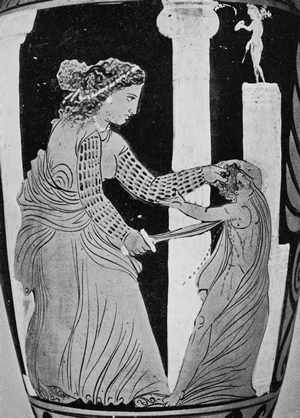
Figure 1. image of Medea murdering her young son on ancient Greek vase
“You have to show violence the way it is. If you don't show it realistically, then that's immoral and harmful. If you don't upset people, then that's obscenity.” (Roman Polanski, film director)
“Why is it that people have such strange attitudes toward images, objects, and media? Why do they behave as if pictures were alive, as if works of art had minds of their own, as if images had a power to influence human beings, demanding things from us, persuading, seducing, and leading us astray? Even more puzzling, why is it that the very people who express these attitudes and engage in this behavior will, when questioned, assure us that they know very well that pictures are not alive, that works of art do not have minds of their own, and that images are really quite powerless to do anything without the cooperation of their beholders? How is it, in other words, that people are able to maintain a double consciousness toward images, pictures, and representations in a variety of media, vacillating between magical beliefs and skeptical doubts, naive animism and hardheaded materialism, mystical and critical attitudes?” (W.J.T. Mitchell, from What Do Pictures Want?: The Lives and Loves of Images)
COURSE OBJECTIVE
The primary objective of this course is to introduce students to representative works in world literature, and to help students develop an appreciation of literature by understanding themes, purposes, techniques, history. Prerequisite: ENG101.
COURSE DESCRIPTION
ENG111 is traditionally a course in which students are given an introduction to a variety of literary authors and genres in order to help students cultivate the reading and appreciation of literature for its own sake. In order to create a classroom in which we have the best chance for really seeing, together, both the beauty and cultural value of literature (as well as its ability to always remain provocative, daring, and even disturbing), we are going to concentrate our focus on the inter-related literary genres of classical epic poetry, classical and Renaissance drama, and contemporary film, and furthermore, on plays and films that take the staging or spectacle of violence as their primary subject matter, calling into question the nature of the relationship (artistic, moral, social, and otherwise) between violence itself and the ways in which it is seen, or beheld, by an audience. We will also be considering how art makes clear, or confuses, or constructs our relationship to violence. And we will be interested in exploring as well, vis-a-vis the two quotations above from Polanski (a film director known for his violent movies) and Mitchell (a theorist of visual images), whether or not the representation of violence in art, in the classical drama or Shakespearean tragedy or contemporary film, can actually be argued to be morally necessary, and even a virtuous act on the part of the artist, and also, whether or not works of art can be argued to want something from us, the spectators, and if so: what do they want? As a final consideration, we will also investigate the role that gender plays in relation to what might be called the violent self.
In order to enhance your ability to truly understand and also enjoy literature and film, and to comprehend their multiple levels of reality and unreality, we will also spend some time in this course deepening our knowledge of the artistic techniques and forms that writers, both in the past and the present, employ in their work, and we will also practice our hands at the arts of close reading and literary analysis. Lecturing will not be a main component of this course; rather, assigned texts and films will be supplemented by reading guides, notes on important background material, thinking and discussion prompts, and occasional "mini-lectures," all designed to help you to better understand the primary course material, but the real meat of the course will be the discussions we have together about these materials in relation to the main themes of the course, in class and on our online Discussion Board (see below). Therefore, being an active participant in these discussions is vital to your success in this course.
SPECIAL NOTE: Sections F05, F06, F07, and F08 of this course, which comprise all of the students who will meet together with me on Tuesdays and Thursdays from 2:00 to 3:15, are also linked to special sections of ENG101 taught by Adam Cleary, Nancy Ruff, and Mary Steible, the content and assignments for which have been coordinated with the ENG111 syllabus, thereby allowing for what we hope will be a rich experience of integrated learning for the students.
REQUIRED TEXTS
Textbook Rental Services>
The Longman Anthology of World Literature, Volume 1. Ed. David Damrosch et alia. Longman/Prentice Hall, 2004.
*The Iliad and Agamemnon are our two readings from the Longman Anthology.
Morris University Center Bookstore>
Euripides, Medea. Greek Tragedy in New Translation Series. Oxford University Press, 2006.
Shakespeare, Macbeth. Folger Shakespeare Library edition. Washington Square Press, 2003.
Shakespeare, Titus Andronicus. Folger Shakespeare Library edition. Washington Square Press, 2005.
*there will be some readings made available online as well
COURSE REQUIREMENTS
DISCUSSION BOARD (40%)
On our Blackboard course site, there will be a Discussion Board which we will rely upon for our collective online discussions. Some of these will be prompted by me in relation to thinking and discussion prompts that I will post as links on the online syllabus, but this is also the place where you will need to also initiate new discussion threads (by, for example, asking questions about parts of a reading or film you may not have fully understood, or by sharing what you thought was interesting and/or provocative about a reading or film, or by asking for clarification on something I may have shared with you, in my prompts, in relation to a reading or film). In addition, you are responsible for jumping into discussions that I or one of your classmates may have started, and making whatever contributions you feel may help keep the conversation moving along. Since this counts for 40% of your final grade, participating in a sustained manner in conversations on the Discussion Board, as well as initiating discussions, is vitally important. This course will place an important emphasis on open and free discussions where you should feel encouraged to express your opinions and questions without worrying over whether you are saying the "right" or "wrong" things (this is, essentially, the informal writing component of this course). This is a literature course, not a chemistry or astronomy course, and the best we can do in this course is learn together how to be more thoughtful readers of literature, and also to see if we can get more (enjoyment- and otherwise) out of literary texts and films than we might have initially thought was possible. We want to have fun, while also exploring the very serious and pressing social and cultural questions that great works of art always raise for us. I will help you become sharper and more critical readers, and each student will help each other and me to create a learning community that is student-centered and highly interactive.
As a general rule of thumb, I expect each student to initiate at least one discussion thread a week and to actively participate in at least two other threads (initiated by me and/or by other students) per week. As the initiator of a particular thread, you are also that thread's moderator-leader, and you will want to guide the dialogue that occurs there, stimulate participation, and seek clarification when necessary (which means: initiating a thread does not just mean starting a discussion and then never returning to it to respond to what others have added--do what you can to keep the conversation moving in a productive fashion).
2 EXAMS: MID-TERM AND FINAL (25% each)
There will be two take-home comprehensive exams. For the Mid-Term Exam, you will answer short answer questions that test your knowledge of the content and themes of the primary texts and films (as well as background material to those texts) covered thus far, and also write a short essay in which you explore one or more of those texts and films in relation to the main themes of the course: beholding violence and the relation between violence and art. For the Final Exam, you will devise your own 4-page (typed, double-spaced) essay that explores some aspect of the themes of the course in relation to at least one play and one film from the syllabus.
1 RESPONSE PAPER: DRAMATIC PERFORMANCE EVENT (10%)
All students are required to attend the SIUE Theater Department's staging of Maxim Gorky's The Lower Depths, scheduled to be perfomed December 3-7 and 12-14 at the Metcalf Theater, and to write a 2-page (typed, double-spaced) response to the performance that is connected to the themes of this course.
GRADING POLICY
| 90-100% | A: Exemplary work in all areas identified in assignment instructions |
| 80-89% | B: Good in most areas, but some lack of attention to detail is present |
| 70-79% | C: Standard work, but needs improvement in numerous areas |
| 60-69% | D: Substandard work, needing improvement in all areas |
| under 60% | F: Entirely fails to meet the standards of university work and minimum assignment expectations |

Figure 2. still image from a recent production of Titus Andronicus at the Globe Theater
WEB ACCESS AND USE
An SIUE e-mail account and Web access are REQUIRED for this course. We will actively use our Blackboard course site (logon at bb.siue.edu) for website links, assignments, reading and study guides, Discussion Board, additional course materials, the reporting of grades, etc. This online syllabus will be your main portal to all course materials, but the Blackboard site will get you here, as well as to the Discussion Board, and also provide important announcements that will not always be locatable through this syllabus. Our Blackboard site, under Course Content, is also where I will ocassionally be posting thinking and discussion prompts that are related to the readings and/or viewings assigned each week (and which are designed to help you forumlate your own questions and discussion starters for the Discussion Board). You will not be able to pass this course without being or becoming a proficient user of Blackboard (which, by the way, is extremely user-friendly).
Please note that Blackboard may not work properly with certain internet browsers or web servers. If you are having trouble connecting or navigating the site, you may obtain assistance at the Faculty Technology Center. The Faculty Technology Center also provides Blackboard workshops and support for SIUE students. For general information, training schedules, or to make an appointment, please contact them by phone at 650.5697 or email them at ftc_help@siue.edu.
In order to get started with learning how to use Blackboard and making sure it works with your computer's browsers, you will want to visit these sites:
Blackboard Student Resources Page
Known Issues Concerning Blackboard and Certain Internet Browsers
WRITING CENTER
This support service resides in Peck Hall #1419 (Chad Verbais, Coordinator).
Writing consultants are available there to work with you by appointment on ANY
writing assignment, at any point in the drafting process. Smart students, no
matter how advanced or limited their writing skills, understand the benefit of such a
service and regularly seek it out.
ATTENDANCE POLICY
Attendance, promptness, and participation are essential to success in college courses. Faculty members recognize that unexpected occasions may arise when a student must be absent from class, but the general attendance policy of this professor is that if a student is absent more than the number of required class sessions per week (in this case, that would be more than 2 sessions), the professor has the option of lowering the student's final course grade by one letter grade for each additional session missed. Furthermore, if absences become excessive (more than two weeks' worth of sessions), the SIUE Registrar, at the professor's request, reserves the right to withdraw the student administratively. For more information on this, please consult the following: SIUE Class Attendance Policy. Failure to attend class in a responsible and committed manner may thus be grounds for failure in or administrative withdrawal from the course.
ACADEMIC DISHONESTY
Any student found engaging in an act of academic dishonesty will be promptly dismissed from the course with a grade of "F." By "academic dishonesty," I mean PLAGIARISM (the act of representing the work of another as one's own), which the University considers a grave breach of intellectual integrity. All definitions, terminology, concepts, and patterns of organization taken from an outside source must be identified and given credit in any essay or exam you write--whether it be for the English department or any other department. For more detailed information on this, please consult the following: SIUE Plagiarism Policy.
DISABILITY ACCOMMODATIONS
If you feel that you are entitled to special accommodations (for example, a volunteer note-taker, interpreter, special desk, or extra time on tests), please contact the Disability Support Services office in Rendleman Hall #1218 (Phillip A. Pownall, Director), and they will help you fill out the necessary paperwork.

Figure 3. movie poster for Sam Peckinpah's 1971 classic Straw Dogs
SCHEDULE OF EVENTS
| Tuesday | Aug. 26 | Introduction to Course |
| Thursday | Aug. 28 | NO CLASS: PROFESSOR AT CONFERENCE |
| READ: | ||
| Ian Johnston, "Some Preliminary Observations on Classical Greek Culture" | ||
| Joe Sachs, "Aristotle's Poetics" | ||
| Thinking/Discussion Prompts: Johnston & Sachs Essays | ||
| Tuesday | Sep. 2 | VIEW: Funny Games (film) |
| "I try to give back to violence that what it truly is: pain, injury to another."--Michael Haneke | ||
| "A cinema of disturbance: the films of Michael Haneke in context" | ||
| Interview with Michael Haneke | ||
| Thursday | Sep. 4 | VIEW: Funny Games (film) |
| Tuesday | Sep. 9 | Discuss: Aristotle and Funny Games |
| Michael Haneke Interview on the 1997 version of Funny Games (YouTube): Part One, Part Two, Part Three | ||
| Thursday | Sep. 11 | READ: from The Iliad (Book I) |
| BACKGROUND/READING GUIDES: | ||
| Synopsis: The Iliad | ||
| The Epic Tradition | ||
| Background Notes: The Trojan War | ||
| Reading Guide: The Iliad | ||
| Tuesday | Sep. 16 | READ: from The Iliad (Books 16 & 18) |
| Thursday | Sep. 18 | Discuss: The Iliad (Books 16 & 18) |
| Achilles' Shield | ||
| W.H. Auden, "The Shield of Achilles" | ||
| Tuesday | Sep. 23 | READ: from The Iliad (Books 22 & 24) |
| Thursday | Sep. 25 | Discuss: The Iliad (Books 22 & 24) |
| Tuesday | Sep. 30 | READ: |
| Ian Johnston, "Lecture on The Oresteia" | ||
| Aeschylus, Agamemnon | ||
| BACKGROUND/READING GUIDES: | ||
| Structure of the Greek Theater | ||
| Dionysus and Greek Drama | ||
| The Origins of Western Theater | ||
| Reading Notes on Agamemnon | ||
| Background Notes: The Trojan War | ||
| Synopsis and Analysis: The Oresteia | ||
| British TV Production: Agamemnon, Parts 1, 2, 3, 4, 5, 6, 7, 8, 9, 10 | ||
| Thursday | Oct. 2 | Discuss: Aeschylus, Agamemnon |
| Tuesday | Oct. 7 | Discuss: Aeschylus, Agamemnon |
| Thursday | Oct. 9 | READ: Euripides, Medea |
| BACKGROUND/READING GUIDES: | ||
| Mythological Background to Medea | ||
| Reading Notes on Medea | ||
| Reading Guide: Medea | ||
| Play Clip: Medea and Creon | ||
| Tuesday | Oct. 14 | Discuss: Euripides, Medea |
| Thursday | Oct. 16 | Discuss: Euripides, Medea |
| Tuesday | Oct. 21 | VIEW: Titus (film) |
| Thursday | Oct. 23 | VIEW: Titus (film) |
| TAKE-HOME MIDTERM DUE | ||
| Tuesday | Oct. 28 | READ: |
| Terence Hawkes, "On the Way in which Tragedy Openeth up the Greatest Wounds and Showeth forth the Ulcers that are Covered with Tissue" | ||
| Shakespeare, Titus Andronicus | ||
| BACKGROUND/READING GUIDES: | ||
| Plot Synopsis: Titus Andronicus | ||
| Shakespeare's Globe Theater | ||
| Steven Mullaney, "Shakespeare and the Liberties" | ||
| Thursday | Oct. 30 | Discuss: Shakespeare, Titus Andronicus |
| Humorous Abridgement of Titus Andronicus | ||
| Tuesday | Nov. 4 | Discuss: Shakespeare, Titus Andronicus |
| Thursday | Nov. 6 | NO CLASS--PROFESSOR AT SYMPOSIUM |
| Tuesday | Nov. 11 | VIEW: Ripley's Game (film) |
| Thursday | Nov. 13 | VIEW: Ripley's Game (film) |
| Tuesday | Nov. 18 | READ: |
| Shakespeare, Macbeth | ||
| Ian Johnston, "An Introduction to Macbeth" | ||
| BACKGROUND/READING GUIDES: | ||
| Plot Synopsis: Macbeth | ||
| Dramatic Structure: Tragedy and Comedy | ||
| Thursday | Nov. 20 | NO CLASS--PROFESSOR AT CONFERENCE |
| Tuesday | Nov. 26 | NO CLASS--THANKSGIVING BREAK |
| Thursday | Nov. 28 | NO CLASS--THANKSGIVING BREAK |
| Tuesday | Dec. 2 | Discuss: Shakespeare, Macbeth |
| Thursday | Dec. 4 | Discuss: Shakespeare, Macbeth |
| Tuesday | Dec. 9 | View: Straw Dogs (film) |
| Thursday | Dec. 11 | View: Straw Dogs (film) |
| Wednesday | Dec. 17th (by midnight) | Final Exam Essay & Performance Event Response Due (essay and response must be emailed to me at: ejoy@siue.edu formatted as a Word/.doc or Rich Text Format/.rtf documents) |