Where Am I Going From Here
Now that my dream of establishing a non-profit, known as TradeTools, is a reality, I have been aggressively spearheading the role of the company's first Creative Design Engineer. Being the first and only working member of TradeTools with instructional design experience, I feel my position is very important in the development of this new organization and its employees.
TradeTools is a non-profit with a goal of providing donated refurbished tools to low-income, unemployed veterans across various trades, who need tools in order to start, to restart, and to sustain viable employment and income. We also pride ourselves on employing unemployed and transitioning veterans to perform the repair work on the tools.
Mission—
The mission is to actively serve the veteran population living in the Metro East/ Riverbend area by building permanent charitable capital through philanthropic grants and by providing services that contribute to the health and the vitality of the community in the form of reclaimed unserviceable tools for use.
Vision—
The vision is to strengthen individual veterans and the communities in which they live and to work by sharing reconditioned tools across a variety of trades, populations, and generations.
As the Creative Design Engineer for TradeTools I am currently in charge of designing and implementing meaningful and effective instruction, as well as creating and implementing new innovations and technologies. Since I am very new in my dream position and still trying to find my niche, I have been heavily relying on the knowledge I learned, as well as skills and experiences I developed, while obtaining my M.S.Ed degree in Instructional Technology as my guide to fulfilling my duties and achieving the TradeTools' mission and vision.
Designing and Implementing Meaningful and Effective Instruction
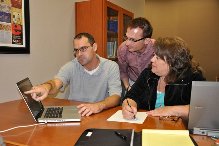
In order to design meaningful and effective instruction, I assembled and have been working with a few dedicated professional veteran volunteers from various trades and fields, who are bound by a strong sense of achievement. These veteran volunteers are subject matter experts (SMEs) in various trades that are critical to the successful design and development of TradeTools' related training such as carpentry, mechanics, logistics and material handling. They are currently helping me develop processes and procedures, as well as building a database of technical manuals and training aides, for use by TradeTool employees while performing their work refurbishing damaged tools.
Alongside these SMEs I have been identifying instructional problems in each of their specialty areas and specifying key training that employees need to be successful while working as repair technicians for TradeTools. To ensure that I am developing satisfactory training programs and to reduce designing by trial and error, I have been relying heavily on the Kemp Design Model to develop solid procedural-based objectives in order to reduce training time and to increase worker productivity. I am fond of this model, as it is very comprehensive and systematic in nature and creates a nice framework for ensuring a quality product is achieved. It also complements my military background and training, as well as that of my TradeTool veteran volunteers who also served in the military and are very task and procedure oriented.
I learned how to build rapport and to work alongside an SME in IT 500 while developing a detailed procedural analysis over properly operating various software tools within a networked computer environment. The SME was my link to understanding the content and upon whom I relied to provide me with accurate and detailed information, so I could design and produce a step-by-step instructional guide. I now follow a similar approach when working with TradeTool SMEs in their respective specialties. In addition to gaining information to the develop instruction, I am building rapport with them by understanding their individual goals, aspirations, and reasons for volunteering with TradeTools. This is valuable information I use to motivate and to move each of them forward personally and professionally as we work collectively towards building a comprehensive learning and resource library. Every day I find myself SMEs tell me about their life experiences or to show me how to do something within their specialties so I can better understand their thought processes as they perform their work.
As the Creative Design Engineer, I have been heavily focused on working with each of them in laying out how TradeTools will operate and how employees will be trained in various core operational areas. This closely relates to improving the organizational performance of TradeTools. For example, I have been working with the carpenter learning about the various carpentry tools we encounter and identifying the typical parts on the various tools that break or wear out most often. The mechanic has been critical in helping me understand the most effective and the least labor intensive process of troubleshooting, breaking down, repairing, and reassembling unserviceable tools back into serviceable ones that will become our core product. Later this week I will be meeting with both the logistic and the material handling SMEs to determine the best method for collecting, inventorying, and storing donated unserviceable tools. We also will determine the best practices for inventory utilization and waste recovery, which will become secondary project lines. Our meeting will involve discussions related to recovering spare parts from unserviceable tools to be used in rebuilding so other more commonly needed repair parts can be purchased and kept in stock. All the remaining by-products, which include various precious metals, base metals, and plastics, will be recycled and/or repurposed into other products or resold, so funds can be reinvested.
Just the other day I found myself working alongside my mechanic SME in the shop area as he was removing and replacing a broken circular saw blade guard, which is a common cause of making a circular saw unserviceable. Since a circular saw with this type of damage is one of the main problems that TradeTool employees repair, as the Creative Design Engineer I wanted to better understand the steps involved in fixing one for my own personal knowledge. The steps, the knowledge, and the cues required to replace a blade guard are very detailed despite the SME making it look simple. While working alongside the mechanic, I had a flashback to IT 510 when I learned how to conduct a procedural analysis and how critical it was to really dig deep and to understand each required step. I could almost hear Dr. Knowlton asking the SME probing questions like, "How do I know that the blade guard is damaged beyond repair and needs to be replaced?" "When tightening the nut on the side of the new blade guard how do you know when it is tight enough?" From this meeting, I was able to compile and to analyze all the information collected from my analysis, as well as to determine critical instructional objectives that were needed to assist staff in both troubleshooting an unserviceable saw and making the necessary repair.
Future Planning and Initiatives
My calendar for the foreseeable future will involve me working alongside SMEs, such as the mechanic, reviewing and analyzing the troubleshooting, the disassembly, and the reassembly of various components from a variety of unserviceable tools. As the Design Engineer, I see most of my time initially being spent developing training that anticipates the future needs required to develop a competent TradeTools' repair technician team. Since most of my staff consists of once unemployed veterans who are re-entering the workforce, most of the instruction I anticipate developing will be task specific, as most will have conducted similar procedural work while in the military and will only need to go through basic training. As a result, I have begun utilizing Robert Mager’s Criterion Referenced Instruction (CRI) to drive my instructional designs, as it is breaks design down into four clearly defined manageable steps. I appreciate CRI because it is research based, widely accepted and heavily used as the basis for designing military training and doctrine. It also is heavily applied in areas of instruction involving troubleshooting, which is what I need to take instruction at TradeTools to the next level. I became familiar with CRI during IT 510 while completing a model comparison paper, and I have actually instructed various military courses that were developed using CRI. I found it to be concise and effective at instructing service members.
Next week, TradeTool repair technicians are scheduled to begin receiving training on performing basic troubleshooting and repairs. Training is structured around Robert Gagne's Nine Events of Instruction. Gagne's step-by-step approach to instruction will engage both the trainer and the repair technician team, so they get the most out of their training. I learned about Gagne and his Nine Events of Instruction while studying various instructional theories as part of IT 510. After learning about Gagne's Nine Events of Instruction, I utilized it in IT 520 as part of a design project developed to instruct military learners over properly configuring various pieces of military software. I am so excited to be a part of TradeTools as the Creative Design Engineer who gets to design instruction for an audience of learners about whom I know a lot. About whom I appreciate want to succeed, and for whom I have a deep sense of respect.
By using Gagne's instructional approach, TradeTool trainers have a checklist to follow that, when completed properly, will engage TradeTools repair technicians and put them on the right path of being the best around while at the same time building a cohesive team. I also believe that, after the training is conducted using Gagne's Nine Steps, I am one step closer to moving TradeTools forward in meeting its mission. As part of this upcoming training, I am planning on filming the various training sessions. I will add them to the database, and learners can access them anytime from our training and resource database. I have never filmed any training for future use; however, I see myself doing so moving forward for my own professional development and growth. I can see myself someday cataloging all of our training resources on a professionally development Learning Management System. I also am currently designing instruction incorporating into the mix other instructional approaches that have been used to assist training military service members.
Project Planning and Management
I learned about the planning and project management process as it relates to the instructional design (ID) during IT 510 while completing a design project using the Kemp Design Model and again in IT 520 while completing a case study and proposal project over incorporating a Learning Management System into an organization. I do not claim to have learned everything about planning and project management from IT 510 and 520, but I did learn the basics of determining resources, preparing creative proposals, establishing work plans, and setting project timelines. When combined with my nearly 20 years of project management experience as a Commissioned Officer in the Army, I believe that I have a good understanding of the principles involved in project management activities. However, I am still developing how to assess ID-related costs and how to prepare a departmental budget within a larger organization. Since I am still developing in these areas, I surround myself with a variety of resources. My office is littered with project calendars, resource and labor cost charts, case studies, and organizational financial reports that I am using to understand how best to define instructional design costs. Since starting with TradeTools as the Creative Design Engineer, I have been aggressively moving the organization forward using sound project planning and management practices. Since I have so many areas to develop, I have been researching and implementing various new innovative technologies to assist me in understanding the vast amount of work that is being generated, as well as to keep better track of future projects.
One of the resources to which I often refer in managing design projects is Designing Effective Instruction by Morrison, Ross, and Kemp. It covers in detail the Kemp Design Model and also provides some insight into project management as it relates to ID. The textbook has and continues to help me gain perspective on project management when I find myself slipping back into the military project management mind-set of "do whatever it takes to get the mission accomplished." This mind-set is not always the best philosophy when planning ID budgets and proposals. I also learned from IT 510 that there is an orderly, logical method of developing and evaluating ID goals and objectives within the broader goal of project planning and management. Now it is my responsibility to decide how much time, money, and effort to expend on research, development, and training. I consider project planning and management to be a critical part of my position. Another resource that I often use is case studies that were completed by much larger organizations with deeper pockets. I often mine the Internet during lunch looking at company profiles and reading case studies related to ID solutions that make organizations collaborative and sustainable. Although TradeTools does not have a large staff requiring a very extensive collaborative training and project portal, nor the vast financial resources to implement one, I have made it my goal as the Creative Design Engineer to develop one that fits the current needs of TradeTools and is cost effective.
In the case of TradeTools, free seems to be the most cost-effective solution at this time. Therefore, I am keeping the TradeTools team organized, connected, and focused using free online resources, such as Google Plus and Asana. Google Plus is being utilized to collectively house, transmit, and conduct staff training, as well as to communicate with them in an effective and collaborative way. Asana is being used to help me manage my time and projects, as well as to communicate and to collaborate with SME in a new and innovative way across a variety of free customizable add-ons. I learned about the importance of establishing and using online learning communities in IT 486 where I participated in my first virtual discussion via Blackboard. Using such communities helped me overcome my fear of participating in virtual discussions. It now has become a valuable tool when conducting remote meetings and brainstorming sessions within and across TradeTools.
Another way that I am working on implementing innovation and technology across TradeTools is through the use of networked repair workstations. I am currently applying for a grant, with the State of Illinois that would provide TradeTools' free donated laptops as a workforce incentive for hiring and employing veterans. If approved for this grant I envision one laptop for each TradeTools repair technician to use at his/her workstation, so each technician can pull up Google Plus and utilize all available training resources and job aids that I am currently developing related to properly repairing various types of unserviceable tools. Right now, repair technicians are limited to a centralized resource room and training library which contains mostly hard copies of available resources. Getting TradeTools these networked workstations is critical to establishing and to sustaining a fully integrated collaborative learning environment.
Concluding Thoughts
There is really no way to fully explain what my typical day is as the Creative Design Engineer at TradeTools. I often find myself jumping from one exciting project to the next. I can honestly say that I can connect every course I completed while pursuing my Master’s degree some project on which I am currently working within this organization. Within the TradeTools organization, I have already utilized many of the skills I acquired while completing my M.S.Ed degree in Instructional Technology. Each day brings unknown challenges and new design opportunities for which I am trained and well prepared to face. As the Creative Design Engineer, I am thankful to be in such a unique position with a growing organization where I can only continue to learn and to develop professionally.
Image Source:
jscreationzs / FreeDigitalPhotos.net